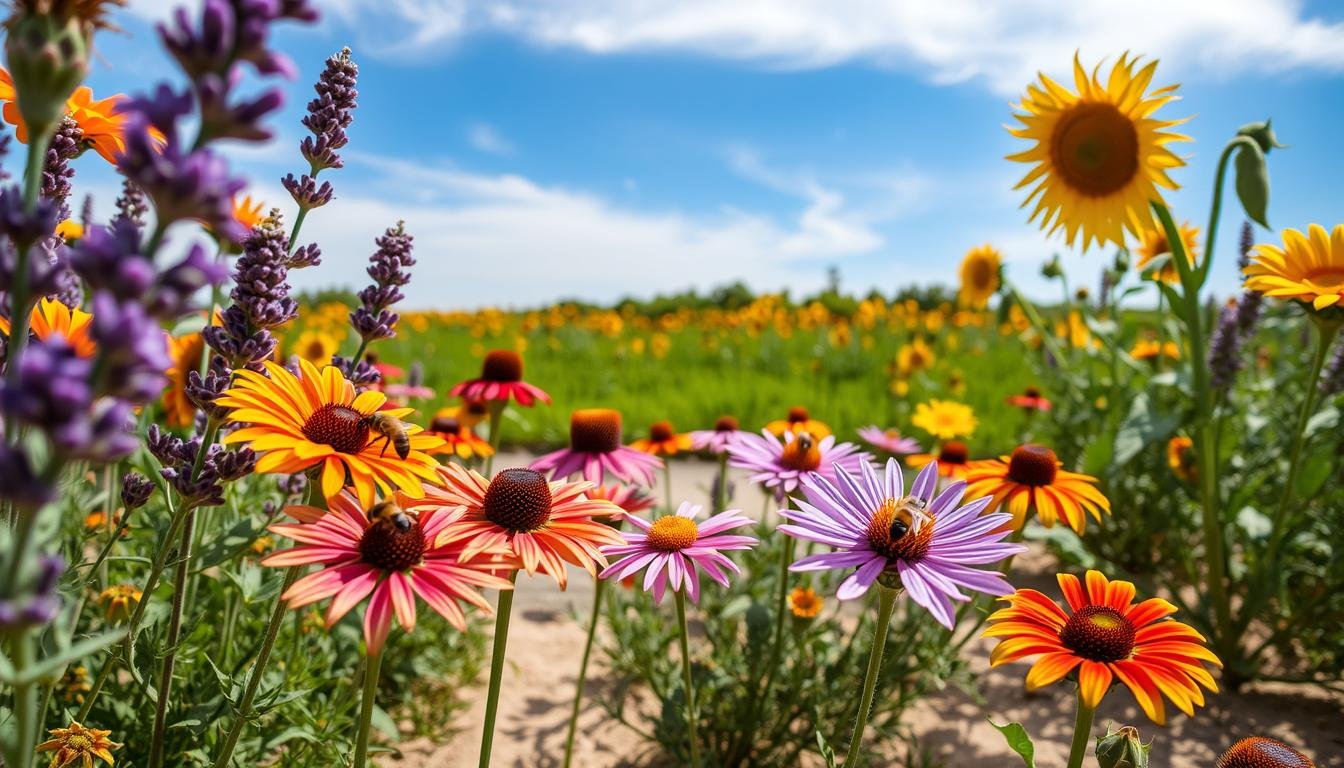
This guide helps U.S. gardeners pick reliable, low-water plants that feed pollinators across spring, summer, and fall.
It lists species and cultivars that handle heat and lean soil while offering nectar and pollen. Many choices are native or regionally adapted, so they support native bees, butterflies, and hummingbirds.
Practical care tips focus on well-draining soil, strong sun exposure, and low maintenance once established. Pairings emphasize variety across heights and bloom times to create continuous foraging lanes and shelter.
Expect quick references to USDA zones, sun and soil needs, and simple maintenance. The selections also offer wildlife value like seedheads for birds and structural interest beyond bloom.
Key Takeaways
- Find heat-tolerant plants that supply nectar and pollen through overlapping bloom windows.
- Choose native or adapted species to support local pollinators and reduce irrigation.
- Design with full-sun beds, part-sun edges, and vertical accents for diverse foraging lanes.
- Use mulch and deep, infrequent watering to conserve water and build resilience.
- Each entry includes bloom timing, cultural needs, and pollinator relationships for easy planning.
Why drought-resistant, bee-friendly plants matter right now in the United States
Now more than ever, gardeners can make a measurable difference by choosing plants that use less water while supplying steady nectar and pollen. Pollinator declines near 40% increase the need for landscapes that offer reliable food across the growing season.
Water-wise gardening reduces irrigation pressure. Native, low‑irrigation species can save 50–70% more water than non-natives and still support pollinators like bees, butterflies, and hummingbirds. That matters during expanding drought and heat waves.
Pollinators under pressure and water-wise gardening
Layered plantings provide continuous forage and shelter from spring through fall. Deep-rooted perennials endure dry spells, stabilize soils, and cut replacement costs.
“Choosing regionally adapted plants is one of the simplest, most effective steps homeowners can take to support pollinator health.”
How native choices reduce irrigation needs
- Regional advantage: Native and adapted species often need less supplemental water and support specialist pollinators.
- Soil and sun: Well-draining soils and full sun maximize bloom and reduce disease risk.
- Urban fit: Compact natives and reseeding annuals work well in containers and small gardens while saving water.
Homeowner benefits: Lower water bills, less mowing and fertilizing, and richer biodiversity make these plant choices practical and rewarding.
How to choose water-wise plants that attract pollinators
Start by matching site conditions—zone, sun exposure, and drainage—to narrow which plants will thrive and feed pollinators reliably. A quick audit saves time and water and helps the garden sustain nectar through the season.
Match plants to USDA zones, sun, and soil drainage
Map your USDA zone, hours of sun, wind exposure, and drainage before you shop. Many low‑water species prefer full sun and well‑draining, sandy or rocky soil. If you have clay, amend with grit or build raised beds to protect roots from rot.
Plan overlapping bloom times from spring through fall
Sequence species so bloom windows overlap. Pair early Ceanothus and flattop buckwheat with mid-season Asclepias tuberosa and Echinacea, then add late Solidago or Liatris to carry nectar into fall. This keeps pollinators working your garden all season.
Select nectar-rich species with proven appeal
Choose documented nectar producers: Gaillardia, Nepeta, Lavandula, and Helianthus reliably draw pollinators and native bees. Integrate native milkweeds and prairie perennials to support specialist insects and monarchs.
- Diversify structure: mix groundcovers, clumping perennials, and shrubs to create multiple foraging layers.
- Group by water needs: cluster similar xeric plants to simplify deep soaking and avoid overwatering.
- Build redundancy: plant multiples of key nectar species so one failure won’t break the forage chain.
Maintenance tip: favor long‑lived, low‑input plants that reseed or clump to keep your garden productive with minimal irrigation.
Drought-resistant Flowers for Bees
A reliable forage plan blends early shrubs, heat-tolerant perennials, and late-season bloomers to sustain pollinators. Divide the garden into three seasonal blocks to keep nectar available from emergence to migration.
Spring starters: early nectar to jump‑start native bees
Shrubs and low perennials such as California lilac (Ceanothus) and flattop buckwheat (Eriogonum fasciculatum) offer nectar from late winter into spring. These species are great for native bees emerging early and set a strong foundation for the season.
Summer stalwarts: heat-loving bloom machines
Midseason plants like butterfly weed (Asclepias tuberosa), coneflower (Echinacea), blanketflower (Gaillardia), catmint (Nepeta), bee balm (Monarda), and lavender (Lavandula) keep pollinators fed during hot months. Group them in sunny beds with well-draining soil to maximize visits and visual impact.
Fall finishers: late-season fuel for migrating monarchs
Close the season with goldenrod (Solidago), blazing star (Liatris), asters, and sunflowers (Helianthus). These late bloomers provide vital nectar and seeds as insects build reserves for colder weather and migration.
- Design tip: plant clusters of the same species to boost visibility and foraging efficiency.
- Timing: overlap bloom windows so one group hands off to the next.
- Sitings: most of these choices prefer full sun and well-draining soils.
Spring into bloom: drought-tolerant flowers that feed early pollinators
Early spring beds set the season when bulbs, shrubs, and woodland perennials offer the first nectar to hungry pollinators.

Allium (ornamental onions): deer resistant, bee magnets
Allium bulbs prefer drier soil and full sun. Their purple globes are nectar-rich and attract many bees while remaining largely deer resistant.
Plant bulbs in clusters to give early structure and strong visual cues for foraging insects.
California lilac (Ceanothus): early blue clusters
Ceanothus is an evergreen shrub with blue‑violet clusters that bloom in spring. It thrives in well-draining soils and full sun.
Minimal water and fertilization help preserve its drought traits, and hummingbirds and bees visit freely.
Columbine (Aquilegia): woodland-edge favorite
Aquilegia forms a deep taproot after establishment and tolerates dry spells in part shade. It feeds hummingbirds, bees, and butterflies.
Use it as a mid-height bridge between bulbs and shrubs to layer the garden and extend bloom.
“Provide early nectar and you jump‑start native pollinators as they emerge.”
| Species | Sun | Soil | Benefits |
|---|---|---|---|
| Allium | Full sun | Well-draining, drier | Deer resistant; early nectar; bulbs cluster well |
| Ceanothus | Full sun | Well-draining soils | Evergreen backdrop; low water; attracts bees & hummingbirds |
| Aquilegia | Part shade | Moist first year, then tolerates dry spells | Taprooted; supports hummingbirds and bees |
Sun-loving summer workhorses for bees, butterflies, and hummingbirds
Pick sunny, low‑input plants that deliver long bloom and steady nectar through summer. These selections thrive in full sun, need lean soils and good drainage, and attract a wide variety of pollinators while staying low maintenance.
Catmint (Nepeta)
Nepeta blooms from late spring into fall and draws steady pollinator traffic. It tolerates heat and once established needs little water in full sun.
Plant in drifts, deadhead lightly to extend bloom, and space for airflow to keep leaves healthy.
Bee balm (Monarda)
Monarda produces showy, tubular blooms that attract hummingbirds, hawk moths, and bees. It benefits from regular watering every 7–10 days during peak heat to maintain big flower heads.
Give it room to prevent mildew and place where its scent and color can be appreciated.
Blanket flower (Gaillardia)
Gaillardia thrives in poor, well‑drained soils and holds color through hot, dry spells. Its composite blooms are easy pickings for a range of native pollinators.
Minimal supplemental water is needed except in long droughts; deadhead to prolong the summer display.
Lavender (Lavandula)
Lavender prefers hot, dry sites with excellent drainage and is especially reliable in containers or raised beds in humid areas. It draws bumblebees and honeybees to its aromatic spikes.
Avoid heavy soils and over-fertilizing; prune lightly after bloom to maintain shape.
| Plant | Sun | Soil & Water | Pollinators |
|---|---|---|---|
| Nepeta (Catmint) | Full sun | Well-drained; low once established | Bees, butterflies, hummingbirds |
| Monarda (Bee balm) | Sun to part sun | Average soil; moderate water in heat | Bees, hummingbirds, hawk moths |
| Gaillardia (Blanket flower) | Full sun | Poor, sandy soils; drought-tolerant | Bees, butterflies |
| Lavandula (Lavender) | Full sun | Very well-drained; low water | Bumblebees, honeybees |
Soil prep matters: prioritize drainage, avoid heavy feeding, and space plants to promote airflow. Mass Nepeta and Gaillardia for season-long color and nectar. Occasional deadheading and light pruning will keep blooms coming late into summer.
Prairie-power perennials with deep roots and durable nectar
Prairie perennials bring deep roots and steady nectar that hold through hot, dry stretches. These plants evolved to survive lean soils and deliver late-season food when pollinators need it most.
Purple coneflower (Echinacea)
Echinacea tolerates hot, dry weather and thrives in well-drained soil. It self-sows and attracts hummingbirds, bumble bees, and butterflies.
Maintenance: minimal fertilizer, occasional deadheading, and full sun placement help it perform year after year.
Goldenrod (Solidago)
Solidago blooms in late summer into fall and is highly drought tolerant. Its pollen is protein-rich and supports monarchs and many pollinators.
Note: choose compact cultivars if spread is a concern; myths about allergy-causing pollen are often overstated.
Leadplant (Amorpha canescens)
Leadplant blooms June–August and thrives in sandy, rocky soils. Its deep taproot gives long-term drought resilience.
Ecology: supports native bees and serves as a larval host, making it a high-value perennial for prairie-style gardens.
- Cluster these perennials in full sun with well-draining soils to boost establishment and nectar visibility.
- Combine them to bridge late summer and fall nectar gaps; seedheads and standing stems also feed birds through winter.
- Water deeply but infrequently while plants develop roots and use mulch to conserve moisture without encouraging shallow roots.
| Perennial | Best siting | Soil | Wildlife value |
|---|---|---|---|
| Echinacea | Full sun | Well-drained; tolerates poor soils | Hummingbirds, bumble bees, butterflies; self-sows |
| Solidago | Full sun to part shade | Poor, dry soils; drought hardy | Late nectar for pollinators; seeds for birds |
| Amorpha canescens | Full sun | Sandy/rocky, well-drained | Supports native bees; larval host for some butterflies |
For more perennial recommendations that support pollinators and water-wise design, see best plants for honeybees.
Native milkweeds and companions that support monarchs and native bees
Plant a small patch of milkweed and blazing star to create a visible feeding lane for pollinators. These species supply both larval leaves and summer nectar that help monarchs and native bees refuel during migration.
Butterfly weed (Asclepias tuberosa)
Asclepias tuberosa (zones 3–9) thrives in full sun and well-drained soils. It needs low water once established and offers bright orange clusters that attract butterflies, hummingbirds, and bees.
Arizona milkweed (Asclepias angustifolia)
A. angustifolia suits arid Southwest gardens (zones 7–10). Its deep taproot gives lasting drought resilience in sandy or rocky soils and supports monarch caterpillars and pollinators with steady nectar.
Blazing star (Liatris)
Liatris blooms July–September, extending nectar into late summer and early fall. It prefers full sun, reduces irrigation after roots set, and draws monarchs, native bees, and hummingbirds.
- Group 3–5 plants to increase visibility and feeding efficiency.
- Expect caterpillar herbivory; plants typically rebound.
- Pair milkweed with Gaillardia or Echinacea to keep blooms while leaves recover.
- Water moderately during establishment, then deep, infrequent soaks.
Vines and vertical accents that sip water and serve pollinators
Vines and tall annuals create high-reward feeding corridors that fit fences, decks, and sunny walls. Use vertical elements to add forage without expanding beds and make the most of limited garden space.

Trumpet honeysuckle (Lonicera sempervirens)
Lonicera sempervirens climbs to about 20 feet in full sun and offers long tubular blooms that hummingbirds and select butterflies favor.
It becomes drought tolerant once established. Light pruning after bloom shapes growth and encourages new flowering stems.
Sunflowers (Helianthus annuus)
Helianthus annuus has deep roots that reach moisture and thrive in heat with minimal water. Their abundant pollen and nectar attract many pollinators and may benefit honey bee health when planted nearby.
Succession sowing extends bloom from summer into fall. Stake tall stems in windy sites and mix colors and variety to broaden the visual and ecological appeal.
- Install trellises, fences, or arbors in full sun to support climbers.
- Space plants for airflow and maximum sun capture to keep leaves healthy.
- Let seedheads stand late into the season to feed birds and add multi‑season value.
For more ways to build vertical forage and choose native options, see native bee-friendly plants.
Southwestern and desert-adapted bloomers for full sun and lean soils
In arid southwestern yards, select plants that stand up to relentless sun and thin, rocky soils. Choose species with silvery or waxy leaves that cut moisture loss and keep nectar available across the season.
Flattop buckwheat (Eriogonum fasciculatum)
Bloom: March–June. This long-lived shrub thrives in zones 7–11 on sandy, rocky soils and anchors early spring forage for native bees and Acmon Blue and Mormon Metalmark butterflies.
Goodding verbena (Verbena gooddingii)
Bloom: spring–fall. It handles temps near 100°F, needs well-draining soil, and provides steady nectar to bees, hummingbirds, and moths through hot summer days.
Desert senna (Senna covesii)
Bloom: March–November. Suited to alkaline soils, it hosts Sulphur butterflies and specialist Senna bees. It also fixes nitrogen, improving poor desert soil.
| Plant | Best siting | Soil | Wildlife value |
|---|---|---|---|
| Eriogonum fasciculatum | Full sun | Sandy/rocky, very well-drained | Early nectar; supports native butterflies and diverse bees |
| Verbena gooddingii | Full sun to bright sun | Well-draining; low water | Long bloom; attracts bees, hummingbirds, moths |
| Senna covesii | Full sun | Alkaline, lean soils | Hosts Sulphur butterflies; Senna specialist bees; nitrogen fixer |
Site tips: water regularly until roots establish, then deep, infrequent soaks only during drought. Space plants to allow airflow and prune lightly after bloom to avoid lush regrowth that raises moisture needs.
Pair these species with regional natives like Blackfoot daisy to extend bloom and habitat value. For broader climate strategies, see beekeeping in different climates.
Extended-season color: annuals and short-lived perennials that reseed
A handful of re-seeding annuals and semi‑succulent varieties can keep steady bloom and nectar through summer and into fall with little fuss.
Cosmos: sunny cups that attract pollinators
Cosmos, native to Mexico, thrives in full sun and poor soil. It reseeds readily and gives a long summer–fall display of cup-shaped blooms.
Bees and butterflies visit freely, and hummingbirds will take nectar from open-faced heads.
Moss rose (Portulaca grandiflora): semi‑succulent splash
Moss rose is heat‑tolerant and pest resistant. Its fleshy leaves and stems store water so blooms persist during hot spells.
Use it in hanging baskets, rock gardens, or hot strips along paths to add bright color with low water needs.
Purslane (Portulaca oleracea): edible groundcover with pollen
Purslane makes a drought-tolerant mat that supplies abundant pollen. It is edible—avoid chemicals if you plan to harvest leaves.
“Allow some seed set and you create naturalized drifts that refresh themselves each year.”
- Soil: well-draining, low fertility favors sturdy stems and longer bloom.
- Space plants to improve airflow and reduce overcrowding.
- Mix colors and forms to broaden pollinator appeal and visual interest.
- Let a portion of the plants set seed to maintain annual refreshment.
| Species | Site | Water & soil | Pollinator value |
|---|---|---|---|
| Cosmos | Full sun | Lean, well-drained; low water | Long summer–fall nectar; attracts bees & butterflies |
| Portulaca grandiflora | Full sun | Very well-drained; occasional water | Heat-tolerant blooms; visits by pollinators |
| Portulaca oleracea | Sunny groundcover | Poor, dry soils; drought-tolerant | Abundant pollen; edible leaves (no chemicals) |
For more low‑input perennial ideas that extend season and support pollinators, see best perennials.
Woodland edge to part-sun picks that still tolerate dry spells
Woodland margins can host showy vertical plants that tolerate dry spells once they root in. These part-sun options bridge shady beds and sunnier borders and carry nectar from spring into early summer.
Foxglove (Digitalis)
Digitalis grows in a range of soils, from sandy to clay-heavy, and becomes drought-tolerant after establishment. Its tubular blooms favor long-tongued bumble bees and hummingbirds.
Plant foxglove where it gets morning sun and afternoon shade in hot zones to preserve blooms and leaves. Note: Digitalis is toxic—site away from kids and pets.
Delphinium (Larkspur)
Delphinium produces tall spires in pink, white, and blue that attract hummingbirds and butterflies. It needs well-drained soil and often benefits from staking to support long stems.
Choose full sun to sun part exposure in cooler summers, or give morning sun with afternoon shade in warmer areas to protect flower longevity.
Planting tips: mulch to moderate moisture swings without waterlogging roots, group several specimens to form vertical forage lanes, and pair with Aquilegia to extend shade-garden nectar availability.
| Species | Exposure | Soil | Notes |
|---|---|---|---|
| Digitalis | Morning sun / afternoon shade | Sandy to clay; tolerates dry once established | Tubular blooms; toxic—site responsibly; early summer bloom |
| Delphinium | Full sun to sun part (or morning sun/afternoon shade) | Well-drained; avoid heavy wet soils | Tall spires; stake stems; appeals to hummingbirds & butterflies |
Regional natives that supercharge bee diversity with little irrigation
Regional natives can offer long bloom windows while cutting irrigation needs and boosting local pollinator diversity.
Blackfoot daisy (Melampodium leucanthum)
Melampodium leucanthum blooms March–November and stays compact. It thrives in alkaline, well‑draining soil and needs very little water once set.
Its low mat suits rock gardens and xeric borders. Native bees and Bordered Patch butterflies visit the showy heads. Use clusters as edging to raise pollinator visibility.
Stokes’ aster (Stokesia)
Stokesia offers bold purple blooms in midsummer and can carry into early fall if deadheaded. It tolerates heat and pairs well with late prairie perennials.
Plant in groups in full sun and lean soils. Deep, infrequent watering during extended drought keeps leaves healthy without encouraging shallow roots.
- Design tip: cluster both plants with milkweed and Gaillardia to widen seasonal nectar and create variety in the garden.
- Maintenance: minimal water after establishment; deadhead Stokesia to extend blooms and tidy beds.
Designing a pollinator buffet: full sun vs. part sun, by season
Plan placement by light and bloom time to create a reliable forage corridor from spring into fall. Positioning reduces supplemental water and makes the garden easier to maintain.
Full sun champions that stand up to heat
Place Masses in full sun: Gaillardia, Echinacea, Lavandula, Helianthus, and Solidago are heat winners that deliver nectar during drought. Group three to five plants together to form visible drifts that attract pollinators.
Use tall Helianthus and Solidago at the back, mid-height Echinacea in the middle, and low Gaillardia and lavender at the front to create a strong visual rhythm.
Part-sun allies for edges and afternoon shade
Edges that get afternoon shade suit Aquilegia and Digitalis. These plants tolerate relatively dry soils while offering tubular and open blooms that broaden the variety of visitors.
Situate them along borders, under light tree shade, or where walls cast afternoon shade to conserve moisture and extend bloom life.
Sequencing and layering to bridge spring, summer, and fall
Layer by height and timing: spring Ceanothus and Eriogonum start the season, summer Asclepias and Nepeta take over, and late summer–fall Liatris and Solidago finish strong.
Keep airflow by spacing crowns and pruning crowded stems. Select well-drained beds in full sun and amend compacted areas to improve infiltration of soil. Add vertical accents like Lonicera or sunflowers where ground space is tight.
- Spacing tip: leave room for mature spread to promote airflow and reduce mildew.
- Soil note: well-drained sites lower watering frequency and favor deep roots.
- Design goal: include tubular, composite, and spike forms to serve a broad pollinator guild.
Soils, drainage, and roots: setting drought-tolerant flowers up for success
A healthy garden begins belowground. Good soil texture and honest drainage let roots find deeper moisture and reduce disease. This is the single best step to help heat‑tolerant plants thrive in spring, summer, and fall.
Why well-draining soils beat frequent watering
Drainage prevents root suffocation and rot. Sandy or rocky soils shed excess water so species such as Lavandula, Eriogonum, and Penstemon keep their drought traits instead of collapsing in soggy beds.
Deep roots, mulch, and infrequent deep soaks
Train roots downward with deep, infrequent soaking rather than daily surface wetting. Shallow cycles keep stems and leaves green short-term but weaken long-term resilience.
Soil prep tips: mix mineral grit into heavy soils, avoid high‑organic pots for true xeric species, and build mounded beds where clay holds water. Test infiltration by timing how fast water disappears from a test hole.
| Action | Why it helps | Example plants |
|---|---|---|
| Improve drainage | Prevents root rot and disease | Lavandula, Eriogonum |
| Deep, infrequent watering | Encourages deep roots | Leadplant, Helianthus |
| Light mulch (mineral or coarse) | Reduces evaporation without trapping moisture | Gaillardia, Penstemon |
Avoid over‑fertilizing. Excess nutrients push thirsty growth that stresses plants and pollinators when moisture is low.
Wildlife-wise choices: deer resistance, beneficial insects, and bird value
Smart plant choices can reduce deer damage and create year-round structure for birds and beneficial insects.
Deer- and rabbit-resistant bloomers to reduce browsing
Allium and aromatic Lavandula are unappealing to deer and rabbits while still attracting pollinators like bees and butterflies. Portulaca is also generally pest-resistant and suits hot, exposed sites where browse pressure is high.
Place these less-palatable plants at the garden edge to act as a living buffer and protect more tender inner beds.
Seedheads and structure for birds after bloom
Leave Echinacea and Helianthus standing into fall and winter. Their seedheads feed finches and other birds and support insects that overwinter in stems and leaf litter.
Delay cutback until late winter to maximize food and shelter value while keeping the garden tidy with selective trimming.
“Standback seedheads and sturdy stems give wildlife food and winter shelter while keeping the garden colorful through the season.”
- Structure: shrubs like Ceanothus and Senna offer nesting cover and early-season nectar.
- Soil benefit: nitrogen-fixing Senna improves fertility for neighboring plants.
- Maintenance: balance neatness with habitat—tidy selectively but preserve stems and seedheads for birds and beneficial insects.
| Feature | Example plant | Wildlife value | Placement tip |
|---|---|---|---|
| Deer resistance | Allium | Unpalatable bulbs; attracts pollinators | Edge buffer or rockery |
| Pest resistance | Portulaca / Lavender | Heat-tolerant; low browse | Hot, exposed sites; containers |
| Seed & shelter | Echinacea / Helianthus | Seed for finches; stems for overwinter insects | Leave standing through fall |
| Habitat & soil | Ceanothus / Senna | Nesting cover; nitrogen fixing | Background shrubs or hedgerow |
Conclusion
Match plant habits to your site and you’ll maintain color, nectar, and habitat through spring, summer, and into fall. Start with a few proven specimens, place them in full sun or part-sun where they belong, and prioritize well-draining soils to build resilience.
Use natives like Asclepias, Amorpha, and Eriogonum alongside adaptable ornamentals such as Lavandula and Nepeta. Cluster and layer plants to boost nectar density and habitat value, and water deeply but infrequently after establishment to train deep roots.
Leave seedheads for birds, choose deer-resistant options, add vertical accents or reseeding annuals for variety, and expand in drifts to secure steady blooms and pollinators. See this study on pollinator plantings for evidence that thoughtful mixes increase visitation and resilience. Small gardens can make a big difference—create a low‑water garden buzzing with bees and butterflies across the season.
FAQ
What makes a plant a good choice for water-wise, bee-friendly gardens?
Look for species adapted to your USDA hardiness zone that tolerate dry soils and full sun. Plants with deep or taproots, well-draining soil needs, and nectar-rich flowers attract a wide range of pollinators while reducing irrigation. Native selections often require less supplemental water and support local bee species, butterflies, and hummingbirds.
How do I plan plantings to provide nectar through spring, summer, and fall?
Sequence bloom times by combining early nectar sources like alliums and California lilac with summer stalwarts such as lavender and bee balm, then add late-season bloomers like goldenrod and Liatris. Staggering spring through fall bloom keeps food available for native bees, migratory butterflies, and hummingbirds.
Can native plants really lower my garden’s water use?
Yes. Native species evolved for local climates, so they typically need less irrigation once established. Choosing regionally adapted prairie perennials, milkweeds, and desert-adapted species reduces the need for frequent watering while still supporting pollinators and wildlife.
Which plants are best for full sun and lean, dry soils?
Sun lovers with drought tolerance include blanket flower, lavender, California lilac, and many Helianthus sunflower varieties. In arid regions, choose true desert or southwestern natives like flat-top buckwheat, Goodding verbena, and desert senna for reliable performance in poor soils.
How do I improve soil and drainage to help drought-tolerant perennials establish?
Prioritize well-draining soil mixes and avoid heavy clay compaction. Incorporate coarse sand or gravel in tight soils, plant on slight mounds if drainage is poor, and apply organic mulch to conserve moisture. Water deeply but infrequently during establishment to encourage deep roots.
Are there low-water annuals that still support pollinators?
Yes. Cosmos, moss rose, and purslane reseed readily, offer long bloom periods, and provide pollen and nectar with modest moisture needs. They make excellent fillers to extend color and food sources between perennials.
Which plants are particularly good for supporting monarchs and milkweed-dependent insects?
Butterfly weed (Asclepias tuberosa) and Arizona milkweed (Asclepias angustifolia) are excellent low-water hosts for monarch caterpillars while supplying nectar for bees and other pollinators. Plant these with companion natives like blazing star and coneflowers to create habitat and continuous forage.
How can I design a garden that resists deer and rabbit browsing while feeding pollinators?
Choose species less palatable to deer and rabbits, such as lavender, leadplant (Amorpha), and many sages. Add structural elements—seedheads and durable stems—to provide bird value after bloom. Avoid tender, highly browsed plants and place favorites for pollinators in protected areas.
Do vines and vertical plants help pollinators in small spaces?
Absolutely. Vertical accents like trumpet honeysuckle and sunflowers provide high-value nectar and pollen while using limited ground area. They create corridors for hummingbirds and bees and add season‑long interest without expanding your footprint.
How should I balance full-sun and part-sun plantings in a water-wise pollinator garden?
Match plants to light exposure: pick full-sun champions for the hottest sites and part-sun allies for shaded, dry edges. Group plants by water need and exposure to simplify irrigation and encourage healthy growth. Sequencing blooms across these microclimates bridges forage gaps through the season.
Will adding native perennials truly increase bee diversity in my yard?
Yes. Native perennials such as purple coneflower, goldenrod, and leadplant support specialist and generalist bees by offering familiar nectar and pollen sources. Plant diversity, structural variety, and minimal pesticide use together create habitat that attracts many native bee species.