This review synthesizes past findings on how queen signals produced by multiple glands coordinate life across Apis mellifera colonies.
The focus is the mandibular gland bouquet and its primer and releaser effects that shape worker physiology, task allocation, and reproduction. The retinue acts as a distribution network and information hub, spreading queen cues through antennation, grooming, and trophallaxis.
We preview how mating state, insemination volume, and reproductive activation recalibrate chemical profiles and worker responses. Queen quality, set during larval development, predicts gland chemistry, retinue attraction, and colony productivity.
Methods surveyed here include retinue bioassays, pseudoqueen lures, and chemical analytics such as GC-MS. Geographic and subspecific variation also appear: some A. m. adansonii workers show queen-like signals in queen-right colonies, which informs social regulation across ecozones.
Finally, links to applied practice, limits of synthetic blends, and knowledge gaps are noted. For an authoritative overview of queen pheromone effects see this summary at NCBI.
Key Takeaways
- Mandibular bouquet integrates with other queen secretions to shape colony-level behavior and physiology.
- The retinue is a behavioral network that distributes queen signals among workers.
- Mating state and insemination metrics change gland chemistry and worker responses.
- Queen quality set during larval stages predicts attraction and colony performance.
- Synthetic pheromone blends can suppress but not permanently prevent queen rearing.
- Important gaps remain on non-mandibular contributors and long-term colony outcomes.
Scope and significance of mandibular gland research in Apis mellifera
Examining queen chemical cues uncovers links between molecular signals and worker tasks across a colony. Research on the mandibular gland in apis mellifera has clarified how small blends act as both fast-acting triggers and long-term modulators of behavior.
Queen pheromones from mandibular, tergal, and Dufour’s glands regulate division of labor, foraging onset, and reproductive suppression. QMP functions as a primer and a releaser: it alters juvenile hormone titers and worker brain chemistry while also shaping immediate retinue behavior.
These chemical cues spread through antennation, grooming, and trophallaxis, so signaling works across contact networks rather than only direct queen-worker encounters. That spatial reach links chem. ecol. and behav. ecol. perspectives with neurophysiology.
Applied value: understanding gland chemistry improves queen selection, colony management, and pollination reliability. Genetic and environmental variation in worker responsiveness means results must guide context-specific practices.
| Aspect | Key finding | Implication |
|---|---|---|
| Signal types | Primer and releaser | Short-term behavior and long-term physiology |
| Distribution | Retinue, trophallaxis | Colony-wide information flow |
| Applied outcomes | Queen quality affects productivity | Better queen management improves resilience |
Mandibular glands: anatomy, secretion sources, and integration with other queen glands
Multiple secretory organs form a coordinated signaling system in the queen. The mandibular gland sits near the head and releases compounds during antennation. Tergal and Dufour’s glands sit on the abdomen and emit complementary chemicals that expand signal range.
The mandibular gland drives strong primer effects. These outputs suppress worker ovary activation and attract a tight retinue. Tergal secretions add releaser cues—especially alkenes produced after natural mating. Dufour’s products convey mating status via a distinct chemical signature.
Primer versus releaser signaling
Primer pheromones change worker physiology over days. They influence hormone levels and brain dopamine, altering task timing and reproduction. Releaser pheromones trigger immediate acts like antennation and grooming.
| Source | Main effect | Context |
|---|---|---|
| Mandibular gland | Primer: ovary suppression, retinue | Consistent queen output |
| Tergal gland | Releaser: retinue enhancement (alkenes) | Upregulated after natural mating |
| Dufour’s gland | Status cue: mating-specific signature | Reflects insemination and age |
Signals spread by direct contact and trophallaxis. Workers sample the bouquet and pass cues through grooming and food exchange. This multi-gland synergy creates a robust communication network that the diverse worker audience interprets across the colony, a key insight for chem. ecol. studies of apis mellifera.
Chemical architecture of queen mandibular pheromone and queen retinue pheromones
A defined set of molecules composes the core queen substance that guides worker behavior and physiology. Major mandibular outputs in mated queens include 9-ODA (~80% by signal strength), R- and S-9-HDA, HOB, HVA, 10-HDAA, and 10-HDA.
Core QMP components and stereochemistry
9-ODA dominates blends from mature, inseminated queens. Chiral 9-HDA isomers and aromatic HOB/HVA add potency and specificity. These aromatics tune brain-level responses in apis mellifera.
From QMP to QRP: synergists and retinue effects
Non-mandibular compounds — methyl oleate, coniferyl alcohol, hexadecanol, and linolenic acid — synergize with the mandibular pheromone to form queen retinue pheromones (QRP). Together they maximize retinue attraction and strengthen reproductive suppression.
Diagnostic ratios and monitoring
Ratios such as 10-HDA/9-HDA, 9-ODA/10-HDA, and 9-ODA/(9-ODA+10-HDA) reliably distinguish queen-like from worker-like profiles. These metrics, measured by standardized GC-MS workflows, support research and practical queen status checks.
Mandibular gland pheromone and the retinue response: mechanisms and assays
Antennation, licking, and trophallaxis form a behavioral chain that moves queen signals from the source to the group. This sequence creates a living retinue that both samples and spreads chemical cues. Workers gather scent on antennae, groom the queen, then pass trace amounts by mouth-to-mouth exchange.
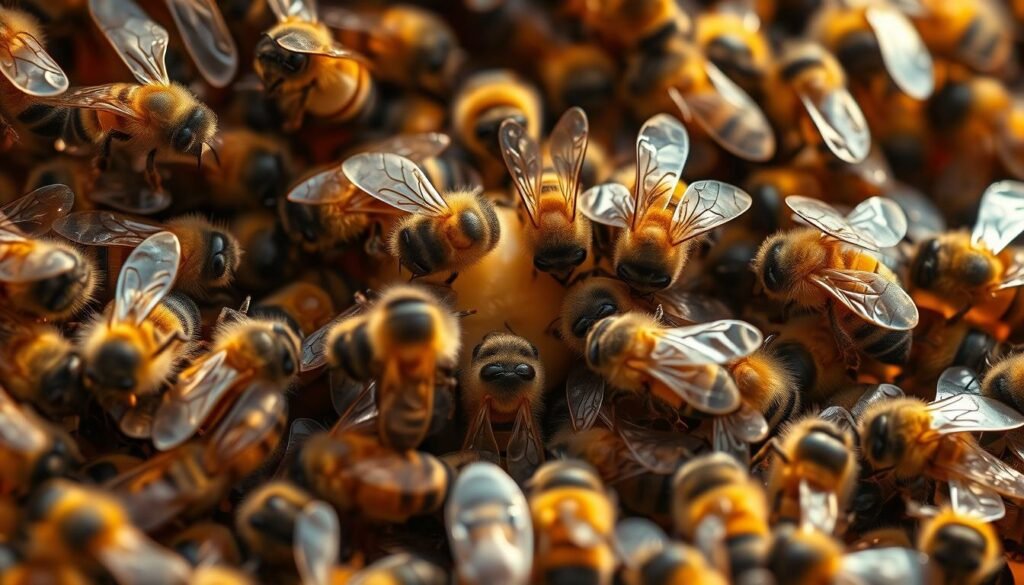
Worker antennation, grooming, and trophallactic dissemination
Messenger workers act as mobile carriers. They contact the queen, pick up a dose, and visit brood or foragers. This amplifies the retinue response across the colony without constant queen contact.
Laboratory retinue bioassays and pseudoqueen lures
Simple assays use treated beads or a dead queen model to count attending workers on video. Researchers compare attraction to mandibular gland pheromone, tergal extracts, and solvent controls.
| Assay element | Measured output | Typical result | Note |
|---|---|---|---|
| Mandibular extract lure | Attendant count per minute | High attraction | Strong primer/releaser mix |
| Tergal extract lure | Duration of grooming | Moderate attraction | Enhances retinue with alkenes |
| Pseudoqueen (control) | Baseline visits | Low | Isolates chemical from visual cues |
Worker responsiveness varies with genetics, colony context, and queen reproductive state. Assays require replication, randomization, and solvent controls to be robust. Data on retinue response inform selection of high-performing queens and help link lab measures to field outcomes for honey bee apis mellifera in behav. ecol. studies.
For a practical primer on chemical signaling see bee pheromones overview.
Reproductive control: how mandibular gland signals modulate worker ovary activation and queen rearing
Queen mandibular cues keep reproduction centralized by suppressing worker oogenesis and limiting emergency queen rearing. Workers exposed to the queen pheromone show reduced initiation of queen cells and a low rate of ovary development under queen-right conditions.
Experimental evidence: synthetic queen mandibular blends strongly inhibit queen rearing for several days, with suppression highest in the first 3–4 days and often declining by day six. When signals decay or the queen is removed, inhibition lifts and worker-laid queen cells are initiated.
Oogenesis checkpoints and caspase activity as molecular readouts
Mid-oogenesis acts as a checkpoint where queen pheromone triggers programmed cell death. Researchers measure increased caspase activity and reduced ATP-linked viability to track this process. Live germ cell counts fall as caspase markers rise, providing a clear molecular signature of suppression.
- Primer action: sustained pheromone exposure lowers worker reproductive physiology.
- Molecular markers: caspase assays and ATP measures quantify apoptotic events in ovaries.
- Lineage convergence: both European and Africanized honey bee workers respond similarly to synthetic QMP, indicating conserved mechanisms.
- Practical note: timing matters—pheromone-based interventions are effective early but wane within about a week.
By maintaining ovarian suppression, queen signals stabilize brood production and colony productivity. Future work should connect hormonal pathways and neural circuits to pheromonal control to improve applied queen management and refine rearing strategies.
Role of mandibular glands in hive organization
Chemical signals from the queen set the tempo for worker life histories, delaying or accelerating foraging onset.
Mandibular gland output lowers juvenile hormone in young workers and shifts age polyethism. This delay keeps nurses on brood tasks longer and staggers the flow of foragers.
Exposure to queen pheromone also raises pollen and nectar collection rates. More food supports brood rearing and strengthens colony growth under high demand.
Swarming, drone attraction, and cohesion
Strong queen signals suppress swarming by signalling a stable queen-right state. At the same time, 9-ODA acts as a drone sex attractant during mating flights, boosting mating success and genetic diversity for queens.
The retinue shares scent through antennation and trophallaxis. This network keeps workers coordinated and maintains soc. stability across colonies.
- Trade-off: very strong primer effects can reduce behavioral flexibility when resources shift.
- Resilience: reliable queen cues help colonies respond predictably to stress and maintain task allocation.
For broader context on pheromone production see a focused review at queen pheromone research and a practical primer at bee pheromone overview.
Mating state, insemination factors, and long-term modulation of mandibular gland chemistry
Early events around mating produce lasting changes in queen head chemistry. CO2 anesthesia, genital manipulation, and the volume used for insemination each drive measurable shifts in the mandibular gland bouquet. These shifts persist and alter how workers judge queen quality.
CO2, genital handling, substance, and volume effects
Experimental manipulations such as CO2 and physical genital handling change gland output even when saline is used instead of semen. Larger insemination volumes (for example, 8 μL vs 1 μL) accelerate early postmating changes more than the inseminate content. In short, process and volume matter most in the first days after mating.
Natural versus instrumental insemination: different gland responses
Natural mating produces stronger ovarian activation and a distinct chemical profile. Tergal alkenes rise after natural copulation, while Dufour’s gland signatures change only when insemination actually occurs. Workers reliably distinguish mandibular extracts from naturally mated, instrumentally inseminated, and virgin queens.
| Treatment | Mandibular change | Dufour’s change | Worker preference |
|---|---|---|---|
| Virgin | Baseline profile | No change | Low |
| Instrumental (small volume) | Partial shift | Only after insemination | Moderate |
| Instrumental (large volume) | Marked shift | Present after insemination | High |
| Natural mating | Distinct profile + tergal alkenes | Changed upon insemination | Highest |
Implications: workers prefer extracts from queens with greater ovary activation. Monitoring mandibular gland profiles after insemination helps validate queen status and better mimic natural cues in instrumental protocols. Semen versus saline has limited immediate influence; technique and volume drive early pheromone remodeling.
Queen quality, developmental plasticity, and mandibular gland profiles
Queen developmental timing during grafting predicts adult fecundity and scent profiles. Queens reared from first-instar larvae often show greater reproductive potential than those started at third instar.
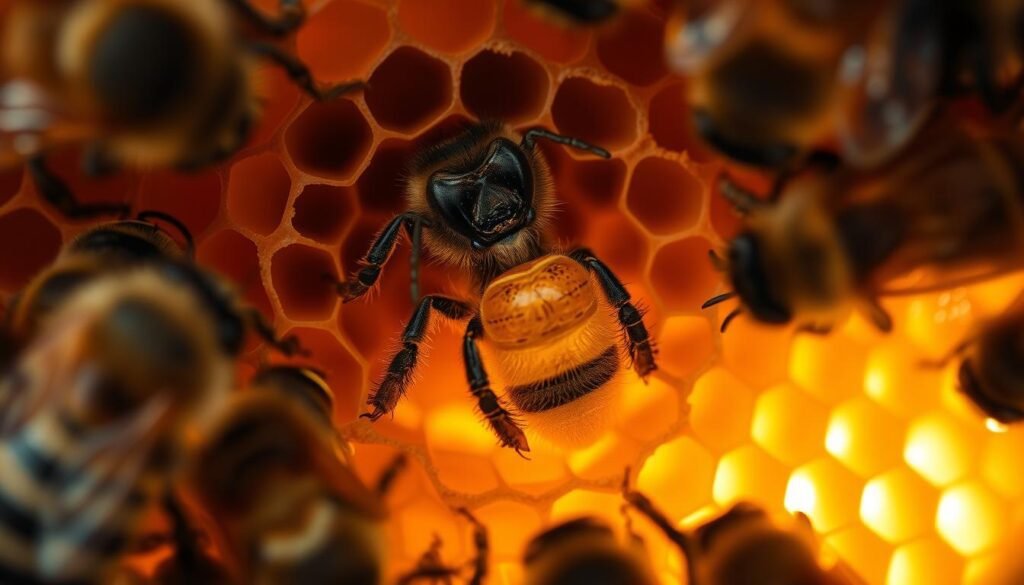
First-instar vs. third-instar outcomes and worker attraction
Field studies report that first-instar queens produced higher egg-laying rates and larger ovaries. Chemical assays from 2010 found elevated HVA and 9-HDA in high-quality queens, linking chemistry to function.
In 2012, measured mandibular gland chemistry sometimes showed no clear difference, yet workers still preferred high-quality queens by retinue response and care. This suggests behavior can reveal quality when chemistry is subtle.
Year effects, diagnostics, and management implications
Diagnostic ratios such as 9-ODA/(9-ODA+10-HDA) and 10-HDA/9-HDA help classify queen-like bouquets in mated queens. Colonies led by higher-quality queens built more comb and stored more food, improving productivity.
“Integrating chemical profiling with simple behavioral assays yields the most reliable assessment of queen status.”
| Factor | Evidence | Practical tip |
|---|---|---|
| Larval instar | First-instar → higher fecundity | Graft earliest instars when possible |
| Chemical markers | HVA, 9-HDA vary by quality | Use GC-MS ratios for validation |
| Year effects | Env. modulation can mask chemistry | Standardize rearing and repeat assays |
Recommendation: favor early-stage grafting, pair behavioral retinue assays with chemical checks, and standardize rearing conditions to reduce year-to-year variability in queen quality outcomes for U.S. honey bee operations.
Worker and larval responses to queen mandibular signals
Young brood interpret chemical cues in their diet, which steers developmental pathways toward typical worker traits or reproductive alternatives.
Larval exposure to queen substance in food tells larvae which caste to follow. When larvae receive consistent queen-derived cues they develop normal worker anatomy and behavior.
Rearing without queen cues produces a “rebel” phenotype. Rebels show more ovarioles, enlarged mandibular and Dufour’s glands, and higher reproductive potential than typical workers.
Evidence and timing
Experiments show that adding macerated gland material to larval diet prevents rebel development. Timing matters: early larval stages are sensitive to these diet-borne signals.
Detection likely uses chemosensory pathways in the gut and antennae during feeding. Larval perception complements adult primer effects to keep reproduction centralized.
| Condition | Typical outcome | Colony implication |
|---|---|---|
| Queen-right rearing | Normal workers, low ovary activation | Stable brood care and task allocation |
| Queenless larval rearing | Rebel workers, more ovarioles | Increased worker reproduction risk |
| Gland material added to diet | Rescued worker phenotype | Prevents unintended reproductive shifts |
- Management tip: maintain consistent queen signals during rearing to avoid unwanted worker reproduction.
- Future work should identify molecular sensors that mediate larval pheromone detection.
Subspecies and geographic variation: insights from A. mellifera adansonii
Comparing head extracts across Nigerian regions uncovers clear clusters in compound proportions and absolute amounts. Sampling in North Central, North West, and South West Nigeria revealed two main pheromone groups that separate South West workers from the other zones.
Regional pheromone clusters and absolute amounts across Nigerian ecozones
Queens showed a consistent proportional profile across regions with ~63.6% 9-ODA and a mean total near 229 μg per queen. By contrast, workers averaged ~7 μg total and displayed higher proportions of 10-HDA and 10-HDAA.
Worker production of queen-like signals under queen-right conditions
Notably, workers from A. m. adansonii produced detectable 9-ODA and elevated 9-HDA, generating queen-like signals even in queen-right colonies. This pattern varied by region: South West workers formed a distinct cluster from North Central and North West based on both absolute amounts and relative proportions.
| Group | Dominant compounds | Total (mean) | Regional pattern |
|---|---|---|---|
| Queens | 9-ODA major; 9-HDA present | ~229 μg | Consistent proportions across regions |
| Workers (South West) | Higher 10-HDA / 10-HDAA; notable 9-HDA | ~7 μg | Cluster A: distinct proportions |
| Workers (North Central / North West) | Lower 10-HDA ratios; variable 9-ODA | ~7 μg | Cluster B: grouped together |
Analytical note: comparisons used BSTFA derivatization, internal standards, and an HP1 column for GC quantification. These methods supported robust contrasts in absolute μg and proportional data.
Ecological gradients, genetics, and morphometrics likely shape these patterns. Worker-produced queen-like signals may affect within-colony interactions and local social regulation. Extending this approach to other African and non-African subspecies will clarify how apis mellifera diversity maps onto pheromone variation and colony outcomes.
Tergal gland interactions and within-hive communication beyond the mandibular bouquet
Tergal alkenes act as complementary releasers that sharpen the queen’s scent and boost retinue activity around brood and comb. These surface compounds increase grooming, antennation, and short-term attendance by nearby workers.
Laboratory bioassays show tergal extracts attract more attendants than solvent controls and produce distinct behavioral endpoints. Workers contact treated dummies more often and groom longer when alkenes are present.
Natural mating reliably triggers tergal alkene production. Instrumental insemination and CO2 treatments do not elicit the same terpene-like shift, so maturation follows natural copulation cues rather than handling alone.
Important distinction: these tergal compounds do not act as drone sex attractants. Instead they refine within-colony communication by amplifying a queen’s presence and clarifying status to workers.
- Temporal dynamics: alkenes rise during early postmating days and then stabilize.
- Worker endpoints: increased antennation, grooming duration, and localized feeding visits.
- Assay note: separate tergal and head extracts to isolate effects; combined blends give fuller retinue responses.
Research need: mechanistic studies on tergal–head synergy will improve synthetic blends that better mimic natural bouquets for apis mellifera management and behav. ecol. research.
Behavioral ecology of retinue: factors shaping response strength and worker heterogeneity
Retinue formation follows simple contact rules: antennation, brief grooming, and trophallaxis create local hubs that spread scent through the nest. Small differences among individuals then scale these hubs into a colony-wide pattern.
Worker heterogeneity matters. Genetics, age, and experience each change how a worker samples and attends the queen. Some workers are consistent responders; others rarely join the retinue.
Standard methods help quantify this variation. Observation hives, point-sampling and videorecorded pseudoqueen assays yield counts per minute and number distributions across cohorts. Robust designs use replication and balanced sample sizes.
Queen reproductive phenotype modulates overall response strength. Queens with stronger chemical profiles get larger retinue size and higher per-worker attendance. Colony context — brood level and food stores — can up- or down-regulate that intensity.
| Factor | Effect on retinue | Recommended measure |
|---|---|---|
| Genetics | Alters baseline responsiveness | Cross-stock comparative assays |
| Age/experience | Shifts probability of joining | Cohort marking and point sampling |
| Colony context | Modulates overall size | Brood/food census + replication |
Social networks propagate cues: a few messenger workers distribute scent to many nestmates. That transmission has costs and benefits — concentrated care stabilizes brood care but can reduce labor flexibility.
Linking behavior to neural readouts and running comparative trials across stocks will clarify genetic bases of the retinue response. For synthesis of pheromone effects that inform these methods see retinue response.
Colony-level outcomes: productivity, brood rearing, pollen/nectar foraging, and social homeostasis
Strong queen chemical signals link directly to higher foraging rates and better resource storage. Colonies led by queens reared from earlier larval stages built more comb and stored more honey and pollen in field tests. This shows a clear tie between queen quality and colony productivity.
Primer pheromone effects delay foraging onset among young workers. That delay keeps enough nurses at brood tasks and maintains a steady care capacity. The timing calibration preserves brood growth while the forager pool expands when needed.
Feedback loops reinforce this pattern. Better stores fund more brood, which sustains nurse numbers and keeps the retinue strong. As a result, workers keep foraging efficiently and the colony grows along a stable trajectory.
Management signals and trade-offs
Stable queen presence lowers swarming risk and improves social homeostasis under changing conditions. Strong chemical cues increase resilience during forage shortages or weather stress.
Trade-off: excessive suppression of worker flexibility can limit rapid shifts when resources change. Practical indicators of healthy pheromonal regulation include steady foraging levels, full honey stores, even brood pattern, and a consistent retinue size.
Monitoring queen chemical signatures alongside performance metrics offers a pragmatic path for apis mellifera managers who want reliable, long-term colony growth.
Methods spotlight: GC/GC-MS, derivatization, and quantification standards in pheromone profiling
Reliable chemical work links behavior and chemistry. Robust workflows pair retinue assays with GC and GC‑MS to attribute attendance patterns to measurable scents. These methods sit at the core of chem. ecol. studies on apis mellifera and honeybee queens.
Standard steps begin with careful solvent extractions of head and gland tissue, using cold handling and short storage times. Derivatization with BSTFA or MSTFA follows to stabilize fatty acids and aromatics for clear peak shapes.
Instrument choices matter. Use HP‑1 (methyl silicone) or DB‑5/HP‑5MS columns with splitless injections, helium carrier gas, and temperature ramps tailored to separate 9‑ODA, 9‑HDA isomers, HOB, and HVA. GC‑FID provides quantitation while GC‑MS confirms identities and retention indices.
- Internal standards: octanoic acid, tetradecane, and 10‑undecenoic acid normalize recovery.
- Enantiomers: chiral separations are required when resolving 9‑HDA stereochemistry.
- Quality checks: blanks, retention index markers, and replicate runs ensure integrity.
| Step | Purpose | Outcome |
|---|---|---|
| Extraction | Recover volatile and semi‑volatile compounds | Clean extracts for derivatization |
| Derivatization | Stabilize fatty acids/aromatics | Sharper peaks, better quantitation |
| GC‑MS + GC‑FID | Identify and quantify | Diagnostic ratios for queen status |
Report results as normalized peak areas and relative mass ratios with means ± SE and appropriate nonparametric tests when distributions are skewed. Preserve labile samples at low temperature and pair chemical profiles with behavioral data to draw causal links between scent and colony outcomes for queens.
Applied implications for queen rearing and apicultural management in the United States
Practical queen selection and monitoring tie chemical profiles to predictable colony performance. Managers who combine early grafting with simple scent and behavior checks raise more reliable queens and stronger colonies.
Selecting high-quality queens and tracking QMP/QRP signatures
Best practice starts with grafting first-instar larvae to boost reproductive potential and later productivity. Pair grafting with short retinue assays to gauge attraction.
Use GC-based checks or quick chemical screens to track queen mandibular and QRP ratios after insemination. These metrics validate maturation and worker acceptance.
Limits of synthetic QMP for suppression and practical lures
Synthetic QMP can suppress emergency queen cell initiation for about two days but does not prevent long-term rearing. Blends that include non-head components perform better as management lures.
Align insemination volume and handling with protocols that favor stronger mandibular gland pheromone signals to improve acceptance.
| Action | Benefit | Note |
|---|---|---|
| Graft first-instar larvae | Higher fecundity and brood output | Standardize timing |
| Retinue + chemical screening | Better breeder selection | Use paired behavioral checks |
| Combined mandibular + non-mandibular lures | Longer suppression, improved attraction | Field-test blends per stock |
- Track QMP/QRP ratios after insemination to confirm queen maturation.
- Recognize regional and stock-specific responses and tailor management.
- Educate beekeepers to interpret pheromone indicators alongside laying pattern and pollen stores.
“Integrate pheromonal data with brood checks to improve queen selection and pollination reliability.”
For practical materials and further reading on queen rearing resources see queen rearing resources.
Gaps, constraints, and future research directions in mandibular gland chemical ecology
Major gaps remain where environmental drivers and genetics alter queen scent and worker behavior across years. Long-term, multi-year studies are needed to separate seasonal noise from true shifts in queen quality.
Priority areas include paired field trials that test expanded synthetic blends and QRP components, and subspecies comparisons beyond A. m. adansonii to map global variation in signals and response.
Research should integrate head, tergal, and Dufour’s contributions into unified models. Studies that combine chiral analytics, absolute quantification, and behavioral assays will improve links between chemistry and bioactivity.
Work on neural and endocrine pathways will clarify how pheromone cues alter worker physiology. Larval sensory mechanisms also deserve study to trace early-life impacts on caste fate and later colony fitness.
| Need | Action | Outcome |
|---|---|---|
| Standardization | Harmonize methods, open datasets | Cross-study synthesis |
| Field relevance | Stress trials (nutrition, pathogens) | Fitness-linked metrics |
| Chemical detail | Chiral & absolute measures | Better bioactivity prediction |
Takeaway: targeted chem. ecol. work that blends laboratory precision with field trials will advance applied queen selection and deepen understanding of apis mellifera social signaling.
Conclusion
Integrated head and abdominal secretions create a multi-layered signal that keeps colonies cohesive and productive.
Mandibular gland chemistry, together with tergal and Dufour’s outputs, forms a robust set of pheromones that guide worker attention and reproductive checks. These cues shape retinue size, task timing, and brood care by modulating worker physiology.
Mating status and developmental history recalibrate scent profiles, so queens mature into distinct chemical states that workers read and respond to. Strong queen signals link to higher foraging, steadier brood patterns, and greater colony productivity.
Diagnostics — behavioral assays and diagnostic ratios — offer practical checks, while synthetic blends give partial control but cannot fully replace natural cues. Continued study of larval signaling, neural mechanisms, and subspecies diversity will refine management for the honey bee apis mellifera. For data on queen removal of glands and worker outcomes see the demandibulated queen study.
FAQ
What are mandibular gland secretions and how do they affect honey bee colonies?
Mandibular gland secretions are chemical blends produced by queen bees that include core queen mandibular pheromone (QMP) components such as 9-oxo-2-decenoic acid (9-ODA), stereoisomers of 9-hydroxy-2-decenoic acid (9-HDA R/S), HOB, HVA, and related fatty acids like 10-HDA and 10-HDAA. These compounds drive the retinue response, suppress worker ovary activation, and coordinate social behaviors like grooming, antennation, and trophallaxis. Together they help maintain colony cohesion, regulate division of labor, and reduce emergency queen rearing when a functional queen is present.
How do mandibular secretions integrate with other queen gland products?
Queen communication is multipronged. Tergal glands, Dufour’s gland, and other cuticular compounds provide complementary signals. Some non-mandibular compounds synergize with QMP to form queen retinue pheromone (QRP), strengthening attraction and behavioral effects. This integration creates a diagnostic chemical profile that workers interpret to assess queen status, mating success, and quality.
Which chemical components define QMP and which are most important for the retinue response?
Core QMP includes 9-ODA, 9-HDA (R and S), HOB, and HVA. These compounds elicit strong retinue behavior. Additional components—certain esters, fatty acids, and tergal-derived volatiles—enhance or modulate this response. Diagnostic ratios among these molecules help differentiate queen-like versus worker-like pheromone profiles and influence how workers respond.
How do researchers measure retinue behavior and mandibular gland activity?
Common methods include laboratory retinue bioassays where worker attraction to synthetic blends or extracts is quantified, antennation and grooming observations, and field assays using pseudoqueen lures. Chemical analysis uses GC or GC-MS with derivatization and internal standards to quantify QMP and QRP components. Molecular readouts like gene expression and caspase activity can complement behavioral assays.
In what ways do mandibular signals regulate worker reproduction and queen rearing?
QMP acts as a primer pheromone that inhibits worker ovarian development by altering endocrine pathways, including juvenile hormone dynamics and gene networks tied to oogenesis. When QMP levels drop or queen profile changes, workers may initiate emergency queen rearing. Experimental measures of oogenesis checkpoints and caspase activity reveal molecular shifts linked to reproductive suppression.
Do mating and insemination alter mandibular gland chemistry?
Yes. Mating status, insemination volume, and factors delivered during mating modify gland profiles over time. Natural mating, CO2 treatment, and instrumental insemination can produce distinct chemical outcomes. These changes influence long-term queen attractiveness and worker responses; queens with fuller insemination histories often emit a stronger queen-like bouquet.
How does queen quality and developmental stage affect pheromone profiles?
Developmental plasticity matters. Queens reared from first-instar grafts versus later instars show differences in mandibular chemistry and elicit variable worker preference. Environmental factors and year-to-year variation also shape absolute amounts and ratios of pheromones, which in turn affect colony-level metrics like brood production and foraging patterns.
Can workers produce queen-like signals under queenright conditions?
Workers can synthesize queen-like compounds at low levels, and certain subspecies or ecotypes may show regional variations. In some cases, worker-produced queen-like signals emerge under specific genetic or social contexts, but these signals typically lack the full suite or ratios of true queen pheromones and do not fully substitute for a mated queen’s effects.
What variation exists among subspecies, for example A. mellifera adansonii?
Subspecies and geographic populations show distinct pheromone clusters and absolute quantities across ecozones. Studies on A. mellifera adansonii and other regional types reveal variation in component ratios and amounts, which can affect worker perception and colony dynamics. Local adaptation can therefore influence management practices and queen selection.
How do mandibular gland signals shape foraging, division of labor, and swarming?
Queen signals modulate juvenile hormone levels and worker behavioral ontogeny, influencing when bees transition to foraging. Strong queen signals help stabilize task allocation, reduce premature foraging, and maintain colony cohesion. During swarming and mating flights, pheromones also act at longer range to attract drones and coordinate colony decisions.
What are practical implications for apiculture and queen rearing in the United States?
Monitoring QMP/QRP signatures can aid selection for high-quality queens. Beekeepers use synthetic QMP lures to manage behavior, but synthetic blends have limits and may not fully suppress emergency queen rearing. Integrating chemical profiling with breeding for desirable traits improves colony productivity, brood rearing, and social homeostasis.
Which analytical methods provide reliable pheromone profiles?
Gas chromatography and gas chromatography–mass spectrometry (GC/GC-MS) with appropriate derivatization and validated quantification standards yield robust profiles. Careful sampling, internal standards, and replicated assays are essential to compare queens, workers, and developmental stages accurately.
What major knowledge gaps remain in mandibular gland chemical ecology?
Key gaps include the mechanistic links between specific pheromone ratios and molecular pathways in workers, the long-term effects of subtle gland changes on colony fitness, and the ecological consequences of subspecies variation. More field-validated assays and integrative studies combining behavior, chemistry, and genomics will advance applied and basic understanding.