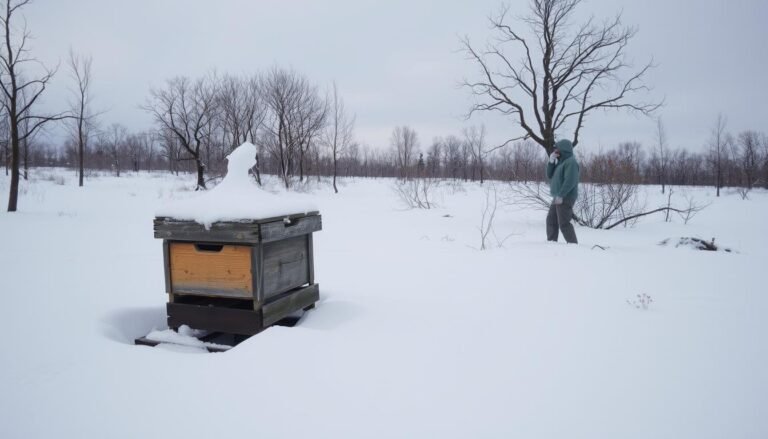
Public curiosity often asks whether bees detect infrared wavelengths. This introduction sets a clear goal: evaluate current evidence and explain what their visual system reliably perceives.
Bees are keystone pollinators that support many crops, from almonds to apples and blueberries. Their sight drives efficient foraging and helps plants reproduce.
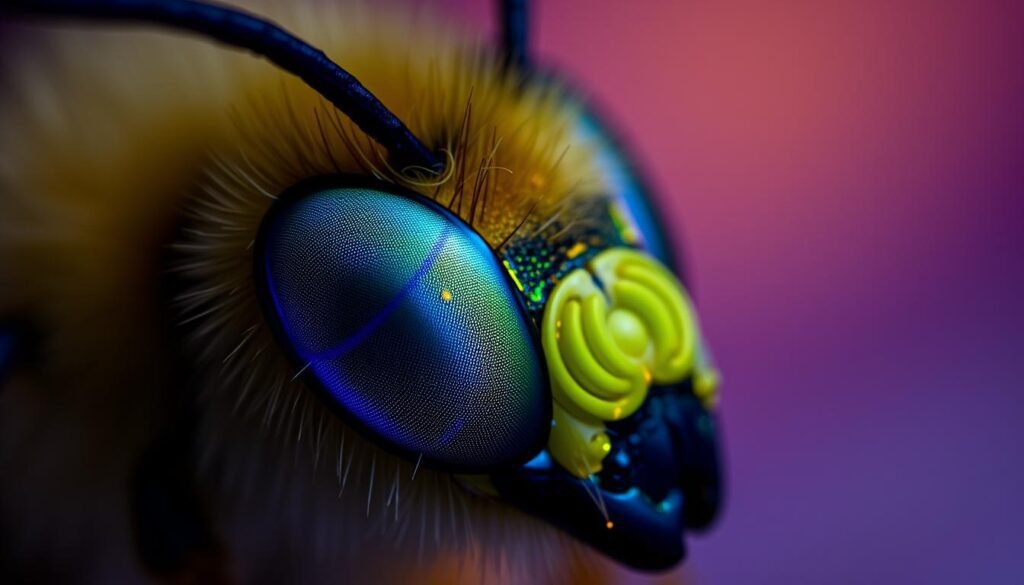
Scientifically, worker eyes form a mosaic of thousands of facets. They are trichromatic in the ultraviolet, blue, and green ranges, so they cannot see red like humans do.
UV patterns and iridescence act as precise landing signals. Ocelli and polarized skylight guide navigation even on cloudy days, while a high flicker rate aids motion detection.
This section outlines what is proven, separates myths from facts, and previews the article’s deeper review of anatomy, spectrum evidence, and behavioral impacts.
Key Takeaways
- Bees drive crucial crop pollination and depend on vision for foraging.
- Their trichromatic system senses ultraviolet, blue, and green.
- UV guides and iridescence improve flower targeting and success.
- Ocelli and polarized skylight help navigation in varied skies.
- We assess infrared claims against established sensory evidence.
How to evaluate the claim at the present time: Do bees really use infrared light?
Begin by separating thermal sensing from true visual perception.
Myth versus fact: Bees see ultraviolet and polarized light, not infrared
Claim evaluation starts with biology. The consensus is that honey and bumble bees have receptors tuned to ultraviolet, blue, and green bands. No validated receptor responds beyond red into infrared as a visual color channel.
Light spectrum basics: Human vs. bee-visible wavelengths and what “infrared” means
Humans detect roughly 700–400 nm. Bees detect about 600–300 nm, which includes ultraviolet. Infrared lies above ~700 nm and falls outside known photoreceptor sensitivity.
Why confusion happens: Heat cues vs. optical cues in bee navigation
Bees may react to temperature or scent, but that is not forming color images from heat. Polarized skylight and ocelli give directional and intensity cues, letting bees orient even under clouds.
| Observer | Approx. range (nm) | Primary cues |
|---|---|---|
| Human | 400–700 | Color vision: red to violet |
| Bee | 300–600 | UV, blue, green; polarized patterns |
| Infrared (thermal) | >700 | Heat radiation; not a visual color for bees |
For credible sources, check measured spectral sensitivity, receptor types, and replicated behavior assays. At present, the evidence supports UV-driven foraging, polarized orientation, and no visual infrared images in bee vision.
How bees use infrared light
C. To evaluate the claim, start with receptor biology and then inspect behavior.
Step-by-step evidence check
Identify the claim: that insects sense thermal bands as visual cues. Next, confirm what photoreceptors exist. Finally, test whether foraging or navigation depends on those bands.
What the sources show
Receptor check: Honey and bumble eyes have UV, blue, and green receptors. There is no validated red or thermal receptor that would extend vision into longer wavelengths.
Behavioral evidence: Trials show foraging relies on UV-absorbing nectar guides and polarized skylight for direction. Tunnel experiments reveal distance estimates come from optical flow—the motion of nearby objects—not from thermal imaging.
- Foraging: UV cues act as bullseyes that drive landing and nectar collection.
- Navigation: Polarization patterns and ocelli stabilize flight and give a sky-based map.
- Image formation: Visual images form from UV/blue/green channels; no infrared components appear in recorded images.
Practical implication: When designing pollinator-friendly habitats or bioinspired tech, prioritize UV patterns, polarization cues, and textured motion features rather than thermal assumptions.
See the world like a bee: Eyes, colors, and navigation you can understand
A worker’s vision is a stitched mosaic made from thousands of tiny lenses and cells.
Compound eyes and ommatidia
Each compound eye holds about 6,900 facets in workers and roughly 8,600 in drones. Every ommatidium contains a lens, visual cells, and pigment cells that capture a narrow view.
The brain assembles these inputs into a mosaic image that favors motion and wide fields over fine resolution.
Ocelli and light intensity
Ocelli do not form pictures. Instead, they sense overall brightness and help stabilize flight. This readout aids orientation to the horizon and keeps the colony oriented toward the hive.
Polarized sky as a roadmap
Bees parse polarization patterns in the sky produced by Rayleigh scattering. These cues reveal the sun’s position even when it is hidden by clouds and function like a GPS for heading and orientation.
Waggle dance translation
The waggle dance encodes direction relative to the sun and distance derived from optical flow. Combined with value signals, this communication turns individual sight and motion sensing into efficient colony decisions.
- Practical note: UV, blue, and green cells tune vision to patterns and colors humans miss, including a unique “purple” blend from UV plus yellow.
- More facets boost motion detection; drone and worker eye designs reflect different roles in the field.
To explore imaging approaches that reveal insect perception, see a device that helps us see the world through insect eyes.
From flowers to the hive: Practical ways bees use light to forage and communicate
Flowers broadcast visual cues that direct workers to nectar-rich patches. Many flowers show ultraviolet patterns that act as clear nectar guides. These markings, plus UV iridescence, make blooms flash at flight speed and attract more visits.

UV patterns, iridescence, and “bee’s purple”
Yellow ultraviolet contrasts combine with pigment to create a “bee’s purple” signal. This perceptual blend makes some flower varieties stand out while appearing plain to people.
Practical effect: UV guides and edge contrasts focus landings on the nectar source and improve pollination rates for plants and honey yield for colonies.
Fast color processing and distance judgment
Color processing runs about five times faster than in humans, so insects can target single flowers while moving. High flicker thresholds help avoid obstacles and predators.
Distance estimation comes from optical flow: the speed that nearby objects pass across a field predicts traveled distance. Scouts encode that distance and direction in the waggle dance so teams locate the source efficiently.
- Polarized patterns support stable headings during flight when the sun is obscured.
- Outside cues guide foraging; inside the dark hive, smell, touch, and dance coordinate honey production and brood care.
- Planting species with UV-reflective patterns and varied colors boosts foraging efficiency and pollination success.
Applied takeaway:Design gardens and crops with plants that present clear UV patterns and diverse colors to align with bees’ visual ability and improve nectar collection and honey production.
Conclusion
Practical outcomes follow directly from what a worker eye can and cannot detect.
Evidence shows bees do not form visual images from thermal wavelengths; they rely on ultraviolet, blue, and green receptors plus polarized cues and ocelli for stable flight and direction.
The compound eyes, made of thousands of facets and specialized cells, feed the bee brain with wide-field images and fast motion data. This visual system drives precise foraging on flowers and accurate distance encoding via optical flow.
Practical takeaway: Plant diverse, UV-reflective patterns and nectar-rich species to boost visits, honey yield, and overall hive health. Inside the hive, workers shift to smell, touch, and dance to coordinate thousands of tasks.
FAQ
What does "Understanding How bees use infrared light" mean?
The heading introduces the topic and frames common questions about insect vision and electromagnetic wavelengths. It highlights interest in whether insects sense thermal cues or rely on optical channels such as ultraviolet and polarized light for foraging and navigation.
Do insects really detect infrared or heat as a visual signal?
Current evidence shows most social pollinators detect ultraviolet and polarized light rather than true infrared vision. Some species sense temperature with thermoreceptors in sensory organs, but that is not the same as imaging the infrared part of the spectrum with compound eyes.
Why do people confuse heat cues with optical cues in pollinator navigation?
Observers mix thermal and visual observations because warm flowers can emit heat that attracts insects, while floral patterns and UV guides provide visual signals. Both factors influence behavior, so distinguishing thermal sensing from optical detection requires careful experiments.
How does the visible spectrum for humans compare with insect vision?
Humans see roughly 400–700 nm; many pollinators extend sensitivity into near-ultraviolet (around 300–400 nm). Infrared lies beyond human red (>700 nm) and generally outside compound-eye sensitivity for these insects, so claims of infrared vision contradict spectral physiology studies.
What evidence supports UV sensitivity in pollinators rather than infrared?
Photoreceptor studies, behavioral trials, and spectral reflectance measurements show receptors tuned to UV, blue, and green wavelengths. Floral nectar guides and iridescence reflect UV patterns that elicit approach behavior, and polarized light perception is well documented for navigation.
Can compound eyes form clear images at many wavelengths?
Compound eyes consist of thousands of ommatidia, each with a lens and photoreceptors, producing a mosaic image. This architecture favors motion detection, rapid flicker fusion, and spectral discrimination in the UV–visible range rather than high-resolution infrared imaging.
What role do ocelli play compared with compound eyes?
Ocelli are simple eyes that detect overall light intensity and help stabilize flight and orientation. They contribute to maintaining direction to the nest or hive, but they do not provide the detailed color or pattern information delivered by compound eyes.
How do insects use polarized light for navigation?
The sky’s polarized light pattern provides a reliable compass, especially when the sun is obscured. Specialized photoreceptors in the dorsal region of the eye detect polarization angles, enabling bees and other pollinators to orient and maintain bearings over long distances.
Does the waggle dance rely on light cues?
The waggle dance encodes direction, distance, and reward value. Foragers interpret this information using polarized skylight cues and an internal compass. Visual context and memory of landmark and spectral cues help translate the dance into actionable foraging directions.
What floral features attract pollinators visually?
Many flowers present UV patterns, iridescence, and spectral contrasts invisible to humans. These “nectar guides” lead insects to rewards. Color processing is fast in pollinators, supporting quick decisions about approach, landing, and handling.
How do motion and flicker thresholds affect foraging and flight?
Pollinators have high temporal resolution, allowing them to detect rapid motion and use optical flow to judge distance and speed. This helps during fast flights between flowers and while avoiding obstacles near the hive.
Are there species that truly image infrared wavelengths for foraging?
A few insects and other animals have evolved thermosensory or infrared-detecting organs, but among common social pollinators, robust evidence for visual infrared imaging is lacking. Most observed interactions with warm flowers reflect thermosensation or associative learning rather than IR vision.
How should researchers evaluate claims about infrared perception in pollinators?
Reliable evaluation depends on controlled spectral sensitivity tests, electrophysiology of photoreceptors, behavioral choice trials isolating thermal versus optical cues, and careful measurement of floral reflectance across wavelengths. Peer-reviewed replication is essential.