Clear, honest labels matter now more than ever. Consumers face a maze of terms like raw and pure that often lack legal definition. That gap lets sellers vary processing claims and leaves buyers unsure about origin, handling, and authenticity.
Federal rules set basic requirements such as the common name, dual-unit net weight, and packer contact. Some states add warnings and stricter definitions. Voluntary guidance from groups like the American Beekeeping Federation helps, but consistent practices are still uneven.
Transparent labels protect consumers by making it easier to spot adulteration, compare products, and assess traceability. Clear disclosure of processing temperatures, filtration, floral source, and country of origin builds trust. It also supports beekeepers who follow honest methods and preserves the stewardship of bees and honey bees.
This guide will cover raw versus processed distinctions, federal and state requirements, and practical shelf tips to help buyers pick quality jars with confidence.
Key Takeaways
- Honest labeling bridges legal gaps and buyer expectations.
- Transparent processing details reduce risk of adulteration.
- Traceability and contact information boost consumer trust.
- Accurate warnings help protect public health.
- Clear practices reward honest producers and sustain bees.
Why Ethical Honey Labeling Matters for Today’s Buyers
A simple, truthful label is the shopper’s best tool when comparing jars on the shelf.
Quality, authenticity, and trust at the shelf
Clear labeling lets consumers compare products fast at stores. Accurate common names, dual-unit weights, and a packer contact let buyers spot real value and avoid blends that mask lower quality.
“When a label lists origin and contact details, it offers a direct path to resolve quality concerns.”
Health, environmental, and market impacts of clear labels
Transparent labels help shoppers make health-minded choices by showing Nutrition Facts and added sugars notes when present.
Honest origin and floral source claims allow support of producers who follow sustainable practices. This alignment raises market fairness and protects honest makers from being undercut.
- Consistent weight in customary and metric units aids quick price-per-ounce comparisons.
- Optional production dates help with planning, even though honey is shelf-stable.
- Traceability and contact info reinforce confidence and accountability.
| Label Element | Why it matters | Shopper benefit |
|---|---|---|
| Common name | Signals true product type | Avoids adulterated purchases |
| Dual-unit net weight | Standard comparison metric | Easy value checks |
| Contact/traceability | Resolve quality issues | Direct producer support |
Prioritize jars that share clear details beyond buzzwords. For deeper reading on production and labeling practices, see a practical production and labeling guide.
Ethical standards for honey labeling
Good labeling goes beyond legal checkboxes to tell a clear story about how a jar was handled and where it came from.
Core principles: transparency, accuracy, and traceability
Transparency means listing processing details such as highest temperature reached and whether the product was strained or pressure filtered.
Accuracy requires substantiation when naming floral source or using terms like raw honey so consumers are not misled.
Traceability asks producers to add batch IDs, harvest dates, and a contact phone or address. This makes it easy to trace jars back to an apiary when questions arise.
How ethics bridge gaps between minimal rules and consumer expectations
Because federal requirements focus only on common name, dual-unit net weight, and contact, voluntary practices fill the rest.
Producers who publish extraction methods, test results, and source notes on labels or websites create trust and reduce disputes.
| Commitment | What to disclose | Benefit to buyer |
|---|---|---|
| Processing | Max temp, straining vs. pressure filtration | Know if enzymes and pollen are preserved |
| Traceability | Batch/lot ID, harvest date, producer contact | Fast issue resolution and provenance checks |
| Documentation | Source notes, test summaries, state requirements | Verifiable claims and compliance |
For label compliance basics and deeper guidance, consult the FDA guidance on proper labeling: proper labeling of honey and honey.
Raw vs. Processed: What Labels Should Tell You
A clear label tells you if a jar was barely handled or heavily processed.
Defining raw: temperature and minimal intervention
Raw honey typically stays below hive temperature (~95°F/35°C) and is not pasteurized or pressure filtered. This preserves enzymes such as diastase, invertase, and glucose oxidase.
Even moderate heating lowers enzyme activity and changes aroma. Labels that state the highest processing temperature help buyers compare methods and quality.
Straining vs. filtration: pollen and enzymes
Coarse straining (80–200 microns) removes debris but keeps pollen—the botanical fingerprint of the jar.
Ultrafiltration and pressure filtration strip pollen and can hide origin. Producers should note if a product was strained or filtered on the label.
Common claims decoded
Pure honey means no added ingredients, but it may still be heated or ultrafiltered. Natural has no fixed meaning. Organic honey focuses on beekeeping and forage, not processing temperature.
“Local” often suggests less handling, but ask beekeepers about exact methods rather than relying on distance alone. Batch source and seasonality on the label give useful context about floral source and colony conditions.
| Claim | What to look for | Buyer cue |
|---|---|---|
| Raw honey | Max temp ≤95°F, no pasteurization, coarse strain | Cloudiness, pollen, natural crystallization |
| Pure honey | No added ingredients | May still be heated or filtered |
| Organic honey | Certified beekeeping/forage practices | Certification logo and certifier listed |
For help untangling labels, see this practical guide: confusing honey labels decoded.
What U.S. Law Requires on Honey Labels Right Now
U.S. labeling law sets a narrow baseline that all packaged honey must meet before it goes on store shelves. These federal requirements create a minimum level of transparency buyers can expect.
Federal basics: common name, weight, and contact
The core obligations are simple: the correct common name, a dual-unit net weight on the principal display panel, and the packer/manufacturer/distributor contact.
Place net weight in both customary and metric units in the bottom 30% of the PDP so the label complies and remains legible. Include a phone number or full contact address to help consumers trace the product.
When ingredients and nutrition facts apply
Pure honey does not require an ingredient statement. But blends must list ingredients in order (for example, “A Blend of Honey and Corn Syrup”).
Nutrition Facts are optional. If shown, they must include the added sugars footnote. Small producers with under $500,000 in annual sales may qualify for exemptions when they make no health claims.
Origin, floral claims, grades, and color
Imported jars must state country of origin even if repackaged domestically. Floral source claims (like clover) must be supported by evidence that the named plant was the chief source.
USDA grades and Pfund color terms are optional signals of quality. Retailers and national accounts may still require extra documentation beyond federal minima, so producers should confirm store requirements before listing product details.
State Spotlight: Lessons from Mississippi’s Honey Labeling Rules
Mississippi law draws sharp lines on what may be sold as true bee-produced honey. The statute defines honey as a product made by bees from nectar or honeydew with no added ingredients. Lab-grown or imitated sweeteners cannot be labeled as honey.
Definition and adulteration
Additions such as corn syrup or other syrup sweeteners are treated as adulteration. Any jar that contains added sweeteners must not be sold simply as honey.
Required statements
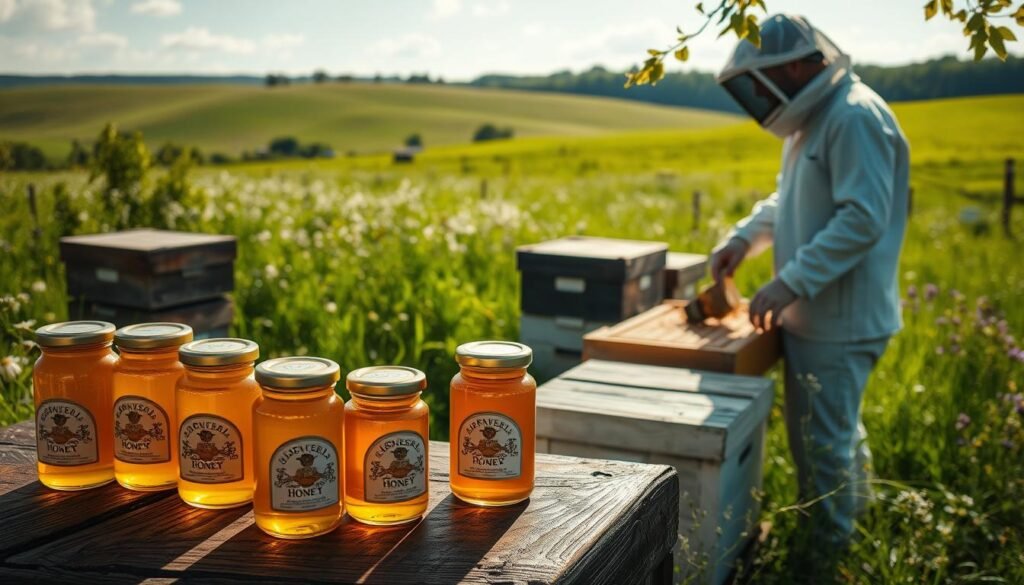
Labels must show a physical address or P.O. Box, dual-unit net weight, and the infant botulism warning on the label or lid. These requirements help buyers and regulators trace product back to the source.
Blends and ingredient order
Blends and value-added jars (for example, cinnamon honey) must list all ingredients in descending order of predominance. If a product mixes honey with other syrups, the name must reflect that it is a blend, and the ingredient order must be clear and consistent.
- Small producers: Under 500 gallons/year may sell without facility inspection, but many stores and packers still require inspected facilities.
- Advice: Keep clear records that verify ingredient order and composition to meet retailer expectations and protect your brand.
A Buyer’s Guide to Reading Honey Labels in the United States
A quick label check can save shoppers from hidden blends and unclear origin claims. Read both panels and favor jars that give clear ingredient order and contact details.
Red flags: blends, ambiguous terms, and missing producer info
Treat vague front-label claims like “natural” as a caution. If a jar mixes sweeteners, the name should say it is a blend and list ingredients by order of predominance (for example, “A Blend of Honey and Corn Syrup”).
Signals of authenticity: batch traceability, floral source, and contact phone number
- Traceability: Batch or lot numbers help consumers and retailers resolve issues fast.
- Floral source: Claims such as clover or wildflower should be explained or backed by testing.
- Contact info: A producer name, address, and a phone number show accountability.
- Ask beekeepers whether jars were handled at hive temperature, strained rather than ultrafiltered, or blended across regions.
“When labels show processing detail and traceability, buyers can choose jars with confidence.”
Beyond the Label: Verifying Authenticity and Ethical Practices
Labels tell part of the story, but direct verification gives the full picture.
- What was the maximum processing temperature and was the product ever pasteurized or heated above hive temperature? Low-heat handling (≈95°F/35°C) preserves natural enzymes and flavor.
- How was the product filtered? Ask if it was strained only or pressure/ultrafiltered, which can remove pollen and obscure origin.
- Do you blend across locations or seasons? Blends change how much a jar reflects a single hive, floral flow, or colony.
- Can you share batch traceability—harvest date, lot ID, and producer contact—and what systems ensure consistency?
Sensory cues and handling notes
Look for natural cloudiness, fine particles or propolis flecks, and normal crystallization patterns. These are common in minimally handled honey and often signal retained pollen and enzymes.
Keep jars sealed and store them away from water, direct heat, and sunlight to maintain quality and protect health. Simple home tests have limits; use them only as a hint, not proof.
“Combine label disclosures with direct questions and sensory checks to form a complete view of product authenticity.”
Conclusion
A label that lists temperatures, filtration, and harvest notes turns vague claims into useful facts.
Raw honey remains undefined legally, so clear disclosures are the best way to compare products and protect health. Producers and beekeepers should publish methods that go beyond minimum requirements to help shoppers make informed choices.
Buyers: read ingredient order, seek batch IDs, and favor names that include contact and production details. Taste, texture, and basic tests can support traceability but ask about handling when in doubt.
Greater transparency benefits everyone — from small honey producers to national stores — by reducing confusion and building trust between hive and shelf.
FAQ
What should a clear honey label include under U.S. federal rules?
A compliant label shows the common name (usually “Honey”), dual-unit net weight (ounces and grams), and the producer or distributor’s business name and address. If you buy packaged honey from a retailer, nutrition facts and an ingredient list are required when the product is a multi-ingredient item or is not just pure honey.
How can I tell if honey is truly raw or minimally processed?
Look for statements about processing temperatures and methods. Raw honey is typically heated below 118°F (48°C) and described as unpasteurized, unfiltered, or minimally processed. Labels that mention pasteurization, ultrafiltration, or removal of pollen suggest higher processing levels and possible loss of enzymes and pollen markers used for traceability.
What do terms like “pure,” “natural,” “organic,” and “local” actually mean?
“Pure” and “natural” are marketing terms with no single federal definition and can vary by producer. “Organic” requires USDA certification and adherence to organic beekeeping and feed rules. “Local” typically refers to geographic origin but is not standardized; check the label for state or county origin and a producer contact phone number for verification.
Are blends or added sweeteners required to be disclosed on the label?
Yes. If a product contains more than one sweetener or a non-honey ingredient, the label must list all ingredients in descending order by weight. Blends of honeys from different countries require country-of-origin statements, and any use of corn syrup or other syrups must be clearly identified to avoid misleading consumers.
What are common red flags that a honey product might be adulterated?
Watch for vague claims like “pure” without contact details, no producer name or address, missing net weight, unusually low price, and labels that omit floral source or country of origin. Ultraclear appearance without any cloudiness or pollen can indicate heavy filtration or ultrafiltration, which may conceal adulteration.
How do state rules, such as Mississippi’s, change what appears on a label?
State laws can add requirements beyond federal rules. For example, some states define honey and list adulteration criteria, require specific statements like infant warnings, and mandate address or dual-unit net weight formats. Always check both federal and state guidance where the product is sold or produced.
What is traceability and why does it matter on a honey label?
Traceability links a jar back to its source via batch numbers, harvest dates, or producer contact information. It helps confirm floral source and production practices, supports quality claims, and enables recalls if contamination or adulteration is discovered. Labels with batch codes and producer phone numbers offer stronger traceability.
How can consumers verify a producer’s claims about sustainable beekeeping or local sourcing?
Ask the producer for details—where hives are located, whether supplemental feeding occurred, and how migratory pollination is managed. Look for third-party certifications, farm-visit opportunities, or transparent supply-chain information on the producer’s website. Contact phone numbers on labels can help you get direct answers.
Does pollen presence affect honey labeling or authenticity?
Yes. Pollen helps confirm floral source and geographic origin, and its removal through fine filtration or ultrafiltration can hinder authenticity testing. Labels that state “unfiltered” or “contains pollen” suggest minimal processing and stronger traceability, while missing pollen raises questions about potential ultrafiltration or adulteration.
When do nutrition facts and ingredient lists become necessary on honey products?
If honey is sold as a single-ingredient food in its pure form, Nutrition Facts labels are generally required under the Nutrition Labeling and Education Act. However, value-added products (e.g., honey-based spreads or mixes) and multi-ingredient items must list all ingredients and include a Nutrition Facts panel.
What temperature information should consumers look for on raw honey labels?
Producers who sell raw honey often state that it was heated below specific thresholds (commonly 118°F/48°C) or that it is unpasteurized. Such temperature disclosures indicate minimal heat exposure, preserving enzymes and typical raw honey characteristics like crystallization and aroma.
Can a honey label claim floral source like “clover” or “wildflower”? How reliable is that?
Floral source claims are allowed but must be truthful. Single-flower honey must come predominantly from that source during the nectar flow. Reliable labels include supporting details such as harvest location or beekeeper contact information. Independent lab testing or traceable batch codes increase trust in floral source claims.
What should I expect on labels for blends or imported honey?
Blends should identify all significant components and list countries of origin when honey from multiple countries is mixed. Imported honey must meet U.S. customs and FDA rules, and reputable brands will disclose origin, batch traceability, and contact details to help consumers assess quality and safety.
How do straining and filtration differ and why does it matter to buyers?
Straining removes large debris while keeping pollen and most enzymes intact. Filtration—especially ultrafiltration—removes finer particles including pollen and microscopic markers used in authentication. Labels that state “strained” or “unfiltered” indicate less processing and better preservation of natural properties.
What actions can consumers take if they suspect mislabeling or adulteration?
Save the product and label, note lot numbers or batch codes, and contact the producer using the phone number on the label. You can report concerns to the FDA, state food regulators, or your state department of agriculture. Independent labs also offer honey authenticity testing for suspicious samples.
Are phone numbers or addresses on labels important?
Yes. Contact information allows consumers to verify claims, request harvest or batch details, and report issues. Labels that omit a phone number, address, or website reduce transparency and make it harder to verify authenticity or production methods.