Last Updated August 26, 2026
Wax moths have troubled beekeepers for centuries, and their impact remains costly today. These pests attack stored comb and weak hives, reducing honey yields and forcing colonies to rebuild lost wax.
Two species matter in the United States: the Greater Wax Moth (the primary threat) and the Lesser Wax Moth. Adults are mainly nocturnal; females lay hundreds of eggs in cracks, and larvae create silk tunnels, leave frass, and cause galleriasis.
Early visual cues you’ll see first include webbing on frames, tunneled comb, and active larvae in corners. Stored supers kept warm, dark, and poorly ventilated are especially vulnerable. Note that moth presence often signals a broader hive problem, such as queen failure or parasite pressure.
This guide gives a practical, step-by-step approach: inspect smarter, confirm the pest (not small hive beetle), remove and freeze affected frames, protect storage, and use chemicals only as a last resort. For deeper background and prevention products, see a reliable resource at wax moths and beekeeping.
Key Takeaways
- Greater Wax Moth is the main culprit in U.S. apiaries and causes the most damage.
- Watch for webbing, frass, tunnels, and larvae when inspecting comb and stored supers.
- Warm, dark, stagnant storage invites infestation; light and airflow deter moths.
- Improve inspections in warm months and treat affected frames by removal or freezing.
- Strong colonies with good management usually control moth pressure naturally.
Why Wax Moths Matter Now: Risk to Bees, Comb, and Equipment
Drawn comb is costly: bees use roughly eight pounds of honey to make one pound of wax, so losing comb reduces surplus honey and forces the colony into rebuilding. That diversion lowers yields and raises feed costs for beekeepers.
Larvae tunnel through comb, lining passages with silk. This webbing mats cells, contaminates wax with frass, and can fuse comb so frames become unusable without remediation.
- Woodenware harm: cocoon “cigars” anchor in corners and create gouges that hide future pests if not cleaned.
- Brood impacts: severe webbing can trap pupae, produce bald brood, and weaken colony growth.
- Storage risk: dark, warm, poorly ventilated equipment invites rapid infestation; in warm weather damage can escalate within weeks.
Minor loss can sometimes be handled by strong colonies, but widespread infestation often means rendering and re-waxing frames is more cost-effective. Prevention and smart storage deliver the highest ROI; for practical storage tips, see keeping wax moths under control.
How to Spot Early Signs of Wax Moths
Small clusters of silk and dusty frass at the frame edges are often the first clues in a troubled hive. Check top bars, end bars, and the face of brood comb for thin, sheet-like webbing that may hide tunnels beneath.
Frass usually gathers on bottom boards and trays as dark, cylindrical pellets. Finding this dust is an early, low-effort indicator that larvae are active inside.
Wax moth larvae are vanilla to whitish with dark heads and move with a wriggling crawl. They spin silk cocoons that look like small “cigars” tucked into crevices of wooden frames and box wood.
Bald brood patterns show scattered uncapped pupae and missing cappings. If pupae are stuck under silk—galleriasis—the infestation has passed the earliest stage and damage is increasing.
- Inspect weak or queenless colonies first; bees there rarely police comb well.
- Photograph suspect frames so you can compare progression and confirm remediation.
- Act immediately when these signs appear to limit comb damage and loss of wax.
| Sign | Where to Look | What It Means |
|---|---|---|
| Silk webbing / tunnels | Frame faces, top bars, crevices | Active larval feeding; clean comb needed |
| Dark pellets (frass) | Bottom boards, trays | Early evidence of larvae in comb |
| Cigar-like cocoons | Wooden frames, corners | Pupae stage present; cocoons protect larvae |
| Bald brood / trapped pupae | Brood comb center | Advanced infestation; brood loss likely |
Know the Culprit: Greater vs. Lesser Wax Moths
Two similar species cause most comb damage in the United States. Learning clear ID markers helps you act quickly and choose the right response.
Adult identification and behavior
Size and color: Greater adults measure about 13–19 mm; Lesser adults run 10–13 mm. Both show mottled brown, gray, and black patterns and hold wings roof-like over the body.
Male moths are often smaller, paler and may show a small wing indentation. Adults fly at night, so daytime inspections rarely reveal them. Seeing adult wax moths inside a hive often signals a weak colony.
Larvae, feeding habits, and eggs
Females lay roughly 300–600 eggs in protected crevices. Hatched larvae feed on wax, pollen, cast larval skins and debris, and line tunnels with silk.
- Size at maturity: Greater larvae ~28 mm; Lesser ~13 mm.
- Appearance: White bodies that gray with age and dark head capsules.
- Damage: Structural harm comes from larvae, not adults; silk-lined tunnels mark ongoing feeding.
Tip: Keep a simple ID chart in the apiary and review development timing with your local beekeeping expansion tips resource.
Wax Moth Life Cycle and Timing Windows
Temperature governs every stage from egg to adult, compressing or stretching the life cycle. Understanding these timing windows helps set realistic inspection intervals and storage protections.
Eggs, larvae, pupae, adult: temperature-driven development
Eggs are tiny (~0.5 mm). At optimal 82–86°F (28–30°C) they hatch quickly. At 84–95°F (29–35°C) hatch occurs in about 3–5 days; at ~64.4°F (18°C) it may take up to 35 days.
Warm temps push larvae to maturity in ~20 days, while cool conditions can stretch that to five months. Mature larvae bore into wood and make cocoons; hardening can take 2–3 days and may fuse comb.
Warm-season acceleration and slower cool-season cycles
Pupation lasts roughly 3–8 days in heat, and up to 2 months when cool. Adults live about 12 days for females and 21 for males. Adults do not feed; they focus on mating and laying wax moth eggs.
- Shorter development means rapid population growth in under a month during warm spells.
- Slow cycles still threaten stored comb; log temperatures and hatch intervals for each inspection.
- Increase hive checks after nectar flows and during warm weather.
“Map development by temperature and act on compressed timing windows.”
Don’t Confuse the Signs: Wax Moths vs. Small Hive Beetles
Distinguishing silk from slime is the quickest way to tell which pest is at work in a hive. Silk-lined galleries, fibrous frass, and cigar-like cocoons indicate moth activity. Slimy, fermenting patches and a sour, yeasty odor point toward hive beetles.
Look closer at larvae. Wax moth larvae are soft, fleshy, and show uniform pairs of prolegs along the abdomen. Small hive beetle larvae are smaller, firmer and lack those matching prolegs.
- Wax moth larvae tunnel through comb and make silk webs; hive beetles swarm cells and leave oozing slime.
- Bottom-board dusty pellets suggest moth frass; shiny slime trails and fermenting honey suggest beetles.
- Use a hand lens to count prolegs and note body texture for accurate ID before treatment.
“Accurate identification prevents misapplied treatments and protects colony strength.”
| Characteristic | Wax Moth | Small Hive Beetle |
|---|---|---|
| Webbing / Residue | Silk-lined galleries, fibrous frass | Slimy patches, fermenting honey odor |
| Larval texture | Soft, fleshy; uniform prolegs | Rigid, smaller; prolegs not uniform |
| Damage pattern | Tunnels across comb; cocoons in wood | Cells often swarmed; slime and decay in comb |
| Field cue | Dusty pellets on bottom board | Shiny slime trails and sour smell |
Document findings with photos and note conditions that weaken bees. For seasonal inspection guidance, see a brief checklist at seasonal beekeeping tasks.
Inspection Checklist for Live Hives
Focus first on tight crevices and top bars. These spots often hide silk, frass, and larvae that bees cannot reach. Lift the inner cover and scan corners before pulling full frames.
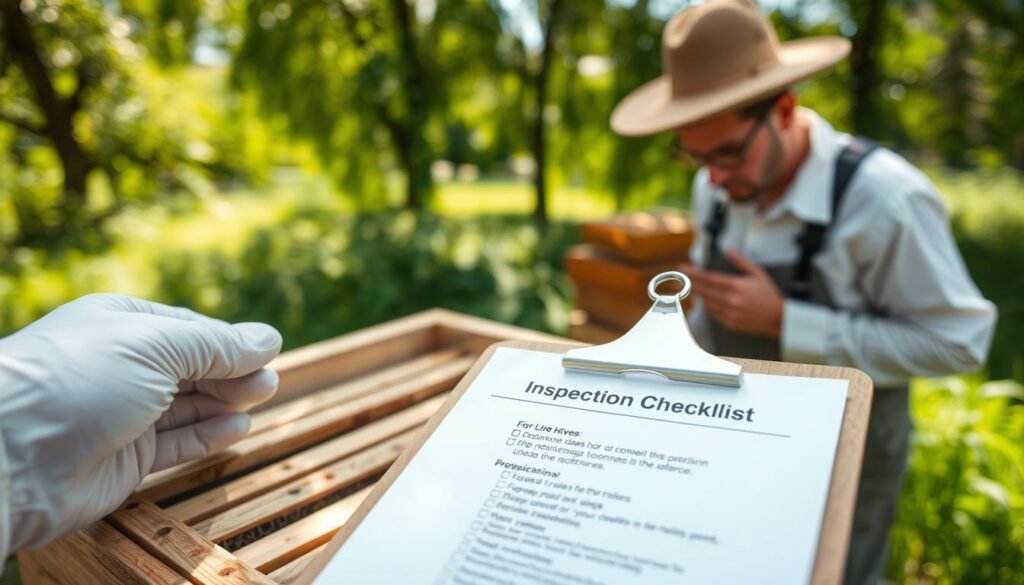
Assess colony strength by counting frames covered with bees and checking brood and eggs. Daytime sightings of adult moth or abnormal activity signal a weak colony and invite pests.
Include a quick varroa mites check. High mite loads weaken bees and raise the risk from wax moth. Use your hive tool to scrape loose webbing and cocoons from wood without shredding salvageable comb.
Decide what to save: lightly webbed frames can be cleaned and frozen; badly tunneled comb is best rendered. Record findings frame-by-frame and reduce boxes or add an entrance reducer to let the colony defend a smaller cavity.
Quick checklist
- Inspect top bars, inner covers, crevices
- Count frames with bees; confirm eggs and brood pattern
- Check varroa mites and beetle traps
- Scrape with hive tool; remove heavily infested frames for freezing
- Reinspect within one week in warm weather
| Check | Where | Action |
|---|---|---|
| Top bars / inner cover | Top of hive | Scan, scrape with hive tool, log findings |
| Frames and brood | Center boxes | Assess bees, eggs, and brood pattern |
| Crevices & corners | End bars, frames, woodwork | Remove cocoons, freeze suspect frames |
| Adult moth sightings | Daytime inside hive | Treat as red flag; inspect colony for stressors |
For a starter reference on hive layout and best practices, see the beehive guide for beginners.
Immediate Actions When You Find Larvae or Webbing
If visible silk and moving larvae inside a hive demand a fast, methodical response, act without delay. Quick steps limit damage and protect usable comb.
Remove and freeze affected frames
Pull affected frames promptly and bag them for safe transport. Household freezer targets: 19.4°F (-7°C) for 4.5 hours; 10°F (-12°C) for 3 hours; 5°F (-15°C) for 2 hours.
Note: extend times for dense stacks or comb honey. Freezing will kill eggs, larvae, pupae and adults and reliably kill wax pests.
Reduce space and secure the colony
Match boxes to the number of frames bees can cover. Install an entrance reducer so fewer guards can defend the opening.
Clean cocoons and repair woodenware
Use a hive tool or wire brush to scrape cocoons, silk and frass from end bars, rabbets, and corners. Clean deep gouges and sand if needed to remove hiding sites.
- Don’t store active infestations indoors; lean heavily infested boxes outdoors in light and air so larvae leave before salvage.
- Reintroduce frozen-thawed frames only after confirming no remaining webbing or frass, and log which frames were treated.
- Plan a follow-up inspection in warm weeks to ensure larvae did not reestablish.
Strength First: Prevention in Live Colonies
Strong colonies with tight bee coverage deter most pests before damage begins. Size your hive to match the adult population and avoid adding extra supers when frames are sparsely covered. Over-supering creates undefended space where larvae and moths can develop unseen.
Keep varroa mites under control. High mite loads weaken workers and reduce hive hygiene. Treat and monitor regularly so honey bees remain vigorous and able to police comb.
Use queen excluders so brood stays out of honey supers. Brood-free supers are less attractive for storage and easier for beekeepers to manage after extraction. Remove or freeze supers quickly in high-risk areas after harvest.
Practice bottom-board hygiene and entrance reduction. Scrape debris and old comb from the bottom board with a hive tool and cut the entrance so guards can defend the hive. Clean wood crevices and sand deep gouges where cocoons hide.
“Match space to population, manage stressors, and keep equipment clean — prevention beats remediation.”
| Action | Why it matters | Quick tip |
|---|---|---|
| Limit extra supers | Reduces undefended comb | Add space during strong nectar flows only |
| Varroa control | Maintains worker health | Monitor monthly during active season |
| Bottom-board care | Removes larval hiding spots | Scrape weekly in high-risk months |
Protecting Stored Comb and Equipment
Protect stored comb and gear by prioritizing light and airflow. Bright, moving air discourages pests and slows development in stored boxes and supers.
Hang frames or use spacers so there is at least 1 inch between frames and between stacked supers. This spacing improves circulation and makes it harder for adult moths to lay eggs in quiet gaps.
Light and ventilation setup
Store equipment in bright, ventilated areas. Open-sided sheds or circulation fans work well for commercial and hobby operations. Avoid warm, dark, stuffy rooms that encourage rapid pest growth.
Frame spacing and hanging methods
- Hang frames or use wooden spacers to keep at least 1 inch gaps.
- Stack supers with 1-inch ventilation channels rather than tight piles.
- Label and rotate stored comb so older comb is used or culled.
Cleaning and re-waxing plastic foundations
Clean plastic foundations thoroughly before storage. Brush off cocoons and frass, then re-wax lightly to help bees accept cleaned foundations after reuse.
Freezing before bagging is essential: kill eggs and larvae, then seal for storage. If you find active infestation, remove and treat frames before using light-and-air methods.
| Task | Why it matters | Quick action |
|---|---|---|
| Hang frames / use spacers | Improves airflow; deters egg laying | Maintain ≥1″ gaps |
| Freeze then bag | Ensures eggs and larvae are dead | Follow freezing time guidelines before sealing |
| Clean plastic foundations | Removes harborage and encourages rebuild | Brush, wash, then re-wax lightly |
For detailed storage protocols and product ideas, see keeping wax moths under control.
Temperature Controls That Work
Controlled cold and heat treatments are practical ways to protect frames and comb from infestation.
Freezing reliably kills eggs, larvae, pupae and adults when you hit the right temperature for the right time.
Typical freezer targets: 19.4°F (-7°C) for 4.5 hours; 10°F (-12°C) for 3 hours; 5°F (-15°C) for 2 hours. Increase time for comb honey or tightly packed loads.

Safe heat options and cautions
For low-honey comb, use controlled heat: hold 115°F (46°C) for 80 minutes or 120°F (49°C) for 40 minutes. Start timing only after the core of frames reaches the target.
Never exceed 120°F. Higher temperatures can sag or deform comb; beeswax softens near 148°F (64°C).
- Treat frames upright and allow full cool-down before handling.
- Choose time-temperature settings based on freezer or oven capacity and load size.
- Document batch settings and reinspect before returning frames to the hive.
- Combine temperature control with light, ventilated storage to prevent reinfestation.
| Treatment | Target Temp | Minimum Time | Notes |
|---|---|---|---|
| Freezing (light loads) | 19.4°F (-7°C) | 4.5 hours | Good for most frames; increase time for dense comb |
| Freezing (medium) | 10°F (-12°C) | 3 hours | Use for stacked supers; verify core temp |
| Heat (low-honey comb) | 115°F (46°C) | 80 minutes | Start timing after core reaches temp; treat upright |
| Heat (fast) | 120°F (49°C) | 40 minutes | Do not exceed; avoid treating honey intended for people |
Traps, Biological Aids, and “Farmyard” Helpers
Simple, low-cost traps and a few biological helpers can cut adult pressure around stored frames. These measures reduce moth flights near storage and give beekeepers time to apply freezing and ventilation.
DIY vinegar-sugar-banana trap
Use a clear 2-liter bottle with a 1.25-inch hole. Add 1 cup white vinegar, 1 cup sugar, 1 cup water, and one banana peel. Allow the mix to ferment 24–48 hours before hanging.
Hang traps a few feet off the ground and well away from hive entrances. Positioning draws adult wax and moths toward the bait, not the bees.
Farmyard helpers and fire ants
In some southeastern U.S. sites, heavy fire ant activity can reduce moth pressure on stored equipment. Clemson research notes near-total control where ants are abundant.
Use caution: ants pose risks to people and bees; do not rely on them unless populations are extreme and allergy risks are managed.
Bt aizawai (Certan / B401)
Bt aizawai targets larvae that feed on treated wax and can be used for stored comb in some states. Availability and legal use vary; it is not cleared everywhere (notably restricted in California).
Follow labels: use only products labeled for wax moths and never substitute other Bt strains. Do not apply inside live colonies unless explicitly allowed.
Combine traps and biological aids with freezing, light-and-air storage, and sanitation for best results.
- Traps lower adult numbers but do not replace strong colony management.
- Check state regulations and supplier guidance before buying or using Bt products.
- Keep traps away from hives and review results weekly during warm months.
Chemical Options in the United States (Last Resort)
Chemical measures belong at the end of any plan and only after sanitation, freezing, and improved ventilation have failed. Follow label directions and treat stored equipment cautiously. These options are for sealed storage, not for live hives or comb intended for human consumption.
PDB crystals for stored comb only and airing out before reuse
Paradichlorobenzene (PDB) may protect stacked supers and boxes in storage. Use PDB only on empty, dry comb or frames; never treat comb honey or place crystals in an active hive.
Stack five full-depth supers (or ten half-depth) and seal cracks with tape. Place ~3 oz (4 tbsp / 85 g) of PDB on paper atop the stack so vapors sink through the load.
PDB vapors kill adults, larvae, and pupae and repel moths but do not kill eggs. In warm conditions, check and replenish crystals periodically. After treatment, air equipment outdoors for 1–2 days before reintroducing bees; residual high concentrations are toxic to a hive.
Why naphthalene mothballs are not acceptable
Naphthalene products are not approved for beekeeping use. Honey and wax can absorb fumes, creating food-safety hazards. For that reason, mothballs should never be used around comb or boxes.
“Position chemicals as last-resort tools and document every application.”
- Use chemicals only after IPM steps fail or are impractical.
- Keep detailed logs: product, amount, dates, temperatures, and airing times.
- Wear PPE and follow the label when handling PDB; do not cut corners.
- Combine occasional chemical treatment with freezing and lighted storage to lower frequency and doses.
| Chemical | Use case | Key cautions |
|---|---|---|
| PDB (paradichlorobenzene) | Stored comb / sealed supers | Not for live hive or comb honey; eggs survive; air 1–2 days |
| Naphthalene | Not acceptable | Contaminates honey and wax; food-safety risk |
| IPM alternatives | First choice | Freezing, light & ventilation, sanitation |
Keep records and prioritize non-chemical methods. For a thorough practical reference on control and safe handling, see controlling wax moths in storage.
Regional and Seasonal Considerations in the United States
Regional weather patterns shape when and where moth pressure intensifies across an apiary. In most temperate zones, risk peaks late summer into fall. Warm spells speed development and compress life cycles, creating rapid population growth in just a few days.
In mild-winter and subtropical regions, activity can continue nearly year-round. That means stored boxes and neglected gear may harbor a hidden infestation through winter and reveal damage by early spring.
Warm climates, late-summer risk, and mild-winter regions
Warm areas: expect longer active windows and higher moth numbers. Plan light-and-air storage and more frequent checks.
Mild winters: do not assume cold kills every pest in storage; living stages can persist in warm sheds.
Small hive vulnerabilities and timing around nectar flows
Small splits, post-swarm colonies, and hives recovering from queen issues are especially at risk. Less bee coverage leaves comb undefended and attractive to moths.
- Right-size boxes to colony strength when flows taper.
- Increase inspection cadence during and after major nectar flows.
- Schedule freezing or storage prep ahead of peak risk windows.
Local beekeeper networks provide the best timing cues for microclimates—consult them for region-specific actions.
| Region | High-risk window | Practical step |
|---|---|---|
| Southern / subtropical | Nearly year-round; peaks late summer | Robust ventilation; consider fire ant deterrence |
| Temperate / coastal | Late summer → fall | Freeze frames after harvest; increase inspections |
| Northern inland | Late summer; watch warm storage | Store in cold, ventilated spots; verify temps |
Conclusion
Preventing damage starts with matching hive space to bee numbers and keeping frames well defended.
Build strength first. Strong colonies and tidy equipment make an apiary less attractive to moths. Watch for webbing, tunnels, frass, and cocoons as triggers for immediate action.
Freezing and bright, ventilated storage protect comb and honey best. Right-size boxes, keep bottom boards clean, and log treatments in a simple APIARY MOTH CHECK.
Distinguish silk from SHB slime before you treat. Use chemicals only as a last resort, follow labels, and air equipment well after PDB use.
With steady inspections, good sanitation, and local collaboration, beekeepers can prevent major loss and keep hives productive.
FAQ
What are the first clues that a hive or stored frames have been attacked?
Look for fine silky webbing through comb, dark granular frass on bottom boards, and irregular “tunnels” in brood comb. You may also see vanilla-colored larvae or silk-wrapped “cigars” on wooden frames. Check for trapped pupae and areas where bees avoid the comb.
How can I tell larvae from other pests like small hive beetle larvae?
Wax moth larvae are creamy and caterpillar-like with visible prolegs; they spin silk and form cocoons. Small hive beetle larvae leave slime and feed externally on honey and brood. Inspect damage: silk and tunneled comb usually mean moths; slime and fermented honey point to beetles.
How do adult moths look and when are they active?
Adults range from pale beige to mottled brown. Greater wax moths are larger with patterned wings; lesser wax moths are smaller and paler. They fly at night and are attracted to light and stored equipment in dark, warm spaces.
Where do moths lay eggs and how long until they hatch?
Females lay eggs in crevices, frame joints, stored comb, or empty equipment. Eggs hatch in roughly 3–10 days depending on temperature. Warm conditions speed development; cool conditions slow it.
How fast can an infestation destroy comb and equipment?
In warm, unattended storage, severe damage can occur in weeks. Larvae chew comb, leave cocoons in wood, and weaken frames. Active colonies with strong bee populations resist much of the damage; weak colonies lose comb quickly.
What immediate steps should I take when I find webbing or larvae in live hives?
Remove affected frames and freeze or heat-treat them, reduce excess space to match colony size, and clean and repair gouged wooden ware. Strengthen the colony by boosting population and managing varroa and other stressors.
Can stored frames be saved without chemicals?
Yes. Expose frames to freezing (several days at 0°F) or sustained heat treatments designed for comb. Sunlight, ventilation, and hanging frames so air circulates help deter adults. Repair or replace damaged comb and foundation as needed.
Are there biological controls available for wax moths?
Bacillus thuringiensis aizawai (Certan/B401) targets Lepidoptera larvae and is used in some areas. Its availability and registration vary in the U.S., so read labels and follow local regulations before using any microbial product.
Should I use mothballs or naphthalene around beekeeping gear?
Avoid naphthalene and similar mothballs. They can contaminate comb and honey and are not acceptable for stored comb intended for bees or human consumption. Use approved methods like freezing or PDB for stored-only equipment, following safety guidance.
What role does colony strength play in prevention?
Strong colonies with high bee-to-comb ratios outcompete moths for space and destroy eggs and young larvae. Keep brood nests tight, prevent excess empty space, control varroa, and maintain queen health to reduce vulnerability.
How do I distinguish damage by greater versus lesser species?
Greater wax moth larvae are larger and create conspicuous silk tunnels and heavy webbing. Lesser wax moths produce less silk but similar feeding damage. Adult wing patterns and larval size help with exact ID during inspection.
What inspection routine reduces risk in live apiaries?
Inspect top bars, inner covers, and dark crevices where eggs hide. Check bottom boards for frass and debris. Monitor colony strength and queen status, and keep varroa loads low. Use a hive tool to remove webbing and clean frames when needed.
How should I store equipment to deter adults from laying eggs?
Store in well-lit, ventilated areas with minimal darkness and stable cool temperatures. Hang frames or space them so adults cannot move freely. Consider sealed plastic tubs for short-term storage and treat combs by freezing before reuse.
What temperature and time settings kill all life stages in frames?
Freezing at 0°F for at least 48–72 hours generally kills eggs, larvae, and pupae. Heat treatments must be controlled to avoid melting wax or warping frames; follow proven protocols or consult extension resources before using heat.
Are traps useful for adult control in apiaries?
Traps baited with fermented baits, vinegar, or fruit can reduce adult numbers around storage. They help in combination with good storage and hygiene but won’t eliminate larvae already in comb. Place traps away from hives to avoid attracting adults near colonies.
When is chemical treatment justified for stored comb in the U.S.?
Chemical options are a last resort. PDB crystals are listed for stored comb only; follow label directions and allow airing before reuse. Always prefer mechanical and biological controls first and avoid contaminating comb intended for honey.
How do regional climates affect wax moth risk?
Warm climates and mild winters let populations persist year-round and accelerate life cycles, increasing late-summer risk. In colder regions, moths slow or pause development; stored comb still needs protection during warm storage periods.
What ongoing maintenance keeps boxes and frames safe long-term?
Regularly inspect and remove damaged comb, re-wax or replace plastic foundations, repair gouges in wood, and keep areas clean. Match stored frame spacing to deter entry, and routinely rotate stored equipment through freezing or treatment cycles.