This guide explains how a healthy hive breathes during hot weather and what beekeepers can do without upsetting the colony.
Bees keep brood near 90–93°F and work to control humidity and nectar drying. Sudden changes from human interventions can take days for the colony to rebalance.
The colony acts like a fan: it pulls make-up air at the entrance or screened bottom and pushes moist, warm air out near the top. Too little air traps heat and moisture; too much can disturb the carefully held climate.
Our aim is balance. You will learn practical ways to move air safely, protect openings from rain and robbing, and choose seasonal options that match your location and equipment.
Follow this step-by-step approach and use the linked overview on beehive ventilation to match techniques to your apiary and the local weather.
Key Takeaways
- Hives regulate brood temperature tightly; interventions should be gradual.
- Proper air flow reduces strain on bees and improves honey drying.
- Protect openings from wind-driven rain and robbing.
- Not every tactic fits every location—match methods to microclimate.
- Adjust ventilation seasonally and watch colony behavior before changing setups.
Why Summer Ventilation Matters for Bee Health and Honey Flow
A colony’s internal air and moisture balance directly affects brood survival and how quickly nectar becomes honey.
Brood thrives within a narrow band near 89.6–92.6°F. Even a half-degree shift can slow development, and it may take days for the hive to recover after a disturbance.
Bees keep interiors warm and slightly humid to aid nurse tasks and to remove water from nectar during curing. Moving moist, warm air out at the right rate speeds honey drying without chilling the brood or collapsing comb.
What bearding and condensation really mean
Front bearding often shows redistribution of worker bodies to manage space and temperature, not an immediate emergency.
A thin film of condensation can supply needed water to foragers in hot weather. But pooling or dripping over brood signals poor airflow or misdirected exchange and needs attention.
- Air exchange clears CO2 and odors while keeping spores low.
- Timing inspections to cooler parts of the day avoids disrupting fanning rhythms.
- Adjust gradually and watch fanning, bearding, and brood pattern over several days.
| Sign | Likely cause | Action |
|---|---|---|
| Bearding | Redistribution to cool or free space | Watch; avoid adding large openings |
| Light condensation | Normal water source | No immediate change; monitor |
| Pooling/drip | Airflow misdirection | Improve upper escape paths |
Airflow Fundamentals: How a Hive Breathes in Hot Weather
Warm days trigger a moving column of air inside a hive that carries humidity out while bees steer circulation.
Make-up air is the fresh air the colony draws in to replace what leaves. Visualize intake at the entrance and a rising stream through the middle of the stack. When the colony fans, exchange rates rise and moisture moves up toward top exits.
The main intake points are the entrance and a screened bottom board. Exhaust usually leaves near the top if you provide a path. Small holes and gaps on the sides change pressurization and can pull air where you don’t want it.
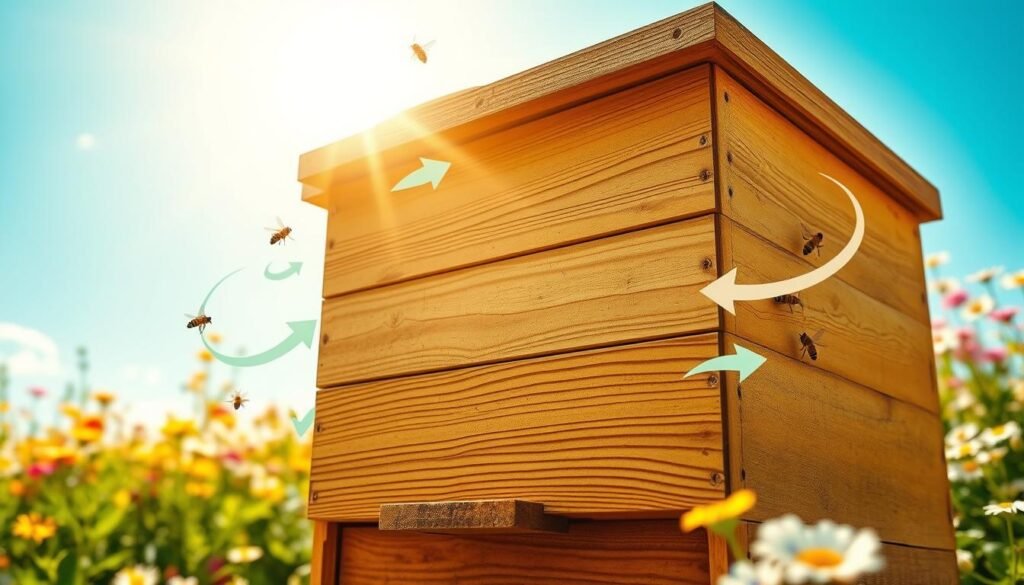
How the colony-as-fan works
The bees form fanning lines at the entrance and inside. Their wing beats boost flow during nectar curing. Faster flow dries nectar sooner and shortens the time interior conditions take to restabilize after you change equipment.
“A well-aligned intake and escape route lets the colony move air like a controlled chimney, without chilling the brood nest.”
Avoiding harmful drafts
Cross-drafts across supers help dehydrate honey. However, drafts through the brood nest disrupt nurse work and brood temperature. Angle or place vents so air travels past frames, not through the brood nest.
Quick checklist to tune with the bees
- Watch fanning lines at the entrance and inside.
- Check the middle convection path on hot afternoons.
- Feel for exhaust strength at the top cover.
- Inspect box joints and holes on the sides and screen new openings to stop robbing.
| Point | Typical effect | Action |
|---|---|---|
| Entrance | Primary intake; supports exchange | Use reducer if crowded; screen small openings |
| Screened bottom board | Increases low-level intake and cooling | Keep clear; screen to block pests |
| Top exits / vents | Main exhaust; removes heat and moisture | Provide protected openings; avoid direct wind on brood |
For a broader overview of safe ways to guide air and match equipment to colony behavior, see hive ventilation guidance.
Best Ventilation Methods for Summer Hives
Small gear changes and site tweaks can yield big gains in hive cooling and honey curing. Use a mix of quick wins and hardware to guide warm, damp air away from the brood without causing drafts.
Quick wins: entrance management, shade, and elevated stands
Adjust entrance sizing during peak foraging to reduce congestion and keep fresh air flowing. Add temporary shade or an awning during the hottest hours to cut solar gain. Place hives on elevated stands to access clearer air and lower ground heat.
Hardware helpers: screened bottom boards, inner covers, and shims
Screened bottom boards with removable varroa drawers give flexible cooling—leave the drawer out in hot weather. A screened inner cover or an inner cover with a center hole helps upward exhaust when paired with a ventilated cap.
Smart openings: upper entrances, imirie shims, and ventilation ekes
Fit small upper entrances or an Imirie shim to move moist air up. Screen these ports if you want exchange without extra bee traffic. Build a ventilation eke with protected ports to keep rain and robbers out.
Layout tweaks: follower boards, slatted racks, and box spacing
Follower boards encourage a taller brood stack and support a chimney effect. Slatted racks and slight box spacing create calm, laminar passages that guide air through comb without chilling brood.
Moisture control while curing nectar
Align openings to pull damp air over supers while avoiding direct drafts across brood. Make changes in stages and allow time for bees to rebalance comb stability and internal climate.
“Pair screened bottom + slatted rack + screened inner cover to balance airflow and protection.”
| Tool | Primary benefit | When to use |
|---|---|---|
| Entrance reducer | Manage congestion and intake | Peak foraging or robbing risk |
| Screened bottom | Cooling from below; pest control | Hot days; removable drawer for flexibility |
| Imirie shim / upper entrance | Top exhaust; directs moist air | During nectar flow; screen if no traffic wanted |
| Slatted rack / follower board | Improves vertical flow and brood protection | When boxes are crowded or comb is high |
Entrance Strategy: Controlling Congestion and Air Flow Without Inviting Robbers
A well-managed entrance keeps traffic moving and helps the colony steer warm, moist air where it belongs.
Using reducers vs. fully open entrances during peak foraging
Modulate the entrance through the day so foragers are not stalled at the front while house bees fan inside. Open to the largest reducer notch or leave fully open during peak nectar flow to ease congestion and improve exchange.
Fully open openings increase airflow and cooling but raise robbing risk. The largest reducer notch balances extra intake with security—use it when activity is high and predators are low.

Upper entrance placement to move warm, moist air up and out
Place a small upper entrance near the top box to let warm, moist air escape without creating a draft through the brood nest. Fit an internal baffle so air rises along the comb rather than cutting across brood frames.
Screening and sizing to deter robbing and wasps
Screen any extra holes and upper ports to deter robbers and wasps. Screening lets air pass while keeping unwanted traffic out, especially when nearby colonies are stressed.
- Slatted racks reduce jams at the front and smooth intake across the landing zone.
- Watch for bearding, intense fanning lines, or chilled brood edge as signs to adjust openings.
- Pair entrance tuning with a screened bottom or upper exhaust only after confirming airflow bypasses the brood nest.
| Action | Effect | When |
|---|---|---|
| Largest reducer notch | More intake, moderate security | Peak foraging |
| Fully open entrance | Max airflow, higher robbing risk | High nectar flow, low threat |
| Screened upper port | Top exhaust, reduced traffic | When moisture removal needed |
Transition changes over several days so the colony can rebalance interior currents without sudden shocks.
Screened Bottom Boards and Varroa Drawers: Cooling from Below
A screened base pulls cooler air under the lowest box and starts a gentle upward draft through the stack.
How it works: A screened bottom board creates a steady intake of cooler air beneath the brood. As workers fan, that flow supports convection and helps lift warm, moist air out through upper exits.
Leveraging removable trays seasonally
Pull the varroa drawer on hot spells to maximize exchange and heat relief. Reinsert it when you need to count varroa or when nights cool and you want to lower drafts.
Pros, trade-offs, and installation tips
Compared to solid floors, screened bottom boards remove moisture faster and relieve entrance congestion. But balance openings so drafts do not cut across brood frames.
Seat the board tight at the edges so air channels uniformly. Pair with a slatted rack to buffer direct streams and protect the brood.
“Use the screened bottom as a controllable intake—open for relief, close for protection.”
- Monitor brood edges after heat waves; cool nights can chill young bees.
- Clear debris from the screen regularly to keep air steady and hygienic.
For practical step-by-step adjustments, see this guide on increasing air exchange.
Top-Side Ventilation Tools: Screened Inner Covers, Vivaldi Boards, and Ventilation Ekes
A few thin components at the top can change how the hive handles heat and humidity. These tools give controlled exits without upsetting the brood below.
Using a screened inner cover safely
A screened inner cover lets you peek and moves warm air up during inspections. Place it when you want short checks on frames; it calms bees and reduces agitation.
Choose an inner cover with a center hole and a notched rim to guide exhaust along the box edge. This creates a steady path that does not blast the brood nest.
Vivaldi boards and ekes
Vivaldi boards add a shallow chamber that moderates moisture and heat. Add absorbent media if humidity spikes.
Build a ventilation eke by drilling screened holes and adding rain shields over ports. Plug or screen holes to scale exhaust as weather changes.
“Top-side ports must be shielded from wind-driven rain and screened to deter robbers.”
| Tool | Main benefit | When to add |
|---|---|---|
| Screened inner cover | Safe top exchange | Hot inspections |
| Vivaldi board | Buffer moisture | High nectar flow |
| Ventilation eke | Adjustable exhaust | Variable weather |
Hive Geometry and Comb Space: Shaping the Chimney Effect
Narrowing lateral space inside a hive nudges the colony to form a taller, more chimney-like brood column. This tree-cavity shape supports steady upward flow and helps pull warm, moist air past the comb toward top exits.
Follower boards and vertical draft
Follower boards reduce side-to-side space and encourage a taller brood nest. A taller column keeps laminar movement up the stack and prevents dead corners where humidity lingers.
Slatted racks and calm intake
Place a slatted rack between the bottom board and the lowest brood box. It creates a quiet air buffer under the frames and eases traffic at the entrance. The result is smoother intake that travels upward without buffeting the brood nest.
Practical spacing tips: keep box joins tight and avoid large lateral gaps. Leave narrow corridors so air moves as one coherent column past supers during heavy nectar flow.
Comb alignment matters: stabilize foundation and use close fastening to reduce sag in heat. Well-aligned comb and compact space preserve the bees’ preferred circulation.
- Signs of success: less bearding, calmer bees at the entrance, and a steady vertical plume at the top during fanning.
- For construction detail and historical context, see constructive beekeeping plans.
Climate, Site, and Season: Adapting Methods to Your Weather
Local climate dictates how open you can leave brood boxes without inviting damp or heat stress.
In arid regions, extra openings often over-dry the interior and can leave comb brittle. Keep changes small and focus on shade and stands rather than wide ports.
By contrast, humid or rainy areas demand more exchange to cut mold and stale air. Increase screened escape paths and watch for fuzzy growth along frames.
Sun, shade, and daily timing
Map sun exposure across the day. Place partial shade to block peak heat while keeping morning warmth that wakes foragers.
Timed shade or a small awning lowers fanning workload during the hottest hours and reduces internal temperature spikes during the summer season.
Site basics that matter
- Stands and drainage: keep hives off the ground to shed water and cut damp at the base.
- Wind breaks: moderate gusts so top exits don’t become destructive drafts.
- Placement: avoid low spots that collect runoff after storms.
Adjust your setup as the season cools toward winter. Roll back aggressive openings when nights lengthen and moisture risk shifts.
Observe today: check for condensation, mold smell, and fanning intensity to fine-tune openings instead of relying on blanket rules.
| Site type | Primary risk | Suggested action |
|---|---|---|
| Arid / dry | Over-drying comb | Use shade, limit extra upper ports, keep water nearby |
| Humid / rainy | Mold and trapped moisture | Increase screened escape, elevate stands, clear drainage |
| Resource dearth | Robbing during heat | Tighten openings, reduce traffic, monitor water access |
For local tips and shared experience on helping colonies in hot spells, see helping bees in hot weather and this guide to beekeeping in different climates.
Managing Moisture, Heat, and Honey Curing Without Over-Chilling
Controlling where warm vapor leaves the hive lets you speed honey formation without stripping vital warmth from the brood nest.
How directing air helps nectar dry
Nectar dries as warm, humid air rises through the stack and exits near the top. Guide that flow across supers so evaporated water moves away from comb and becomes honey faster.
Placement and protection of upper exits
Place small, screened exhausts on the top box edge so air leaves predictably. Add drip edges and simple shields over any drilled holes to stop wind-driven rain from increasing internal moisture.
Managing heat and checking drafts
Use shade and timed openings during peak heat to keep wax stable and reduce nurse bee strain. Make changes slowly and watch behavior.
Test for misdirected drafts with light smoke or by feeling airflow at the side of the brood; streams crossing brood frames can chill larvae and need rebaffling.
“Open pathways during strong nectar flow, then scale back as honey is capped.”
| Focus | Action | Result |
|---|---|---|
| Nectar drying | Direct air above supers | Faster honey formation |
| Rain prevention | Shield top ports/drip edges | Lower internal moisture |
| Draft testing | Use light smoke / feel at sides | Protect brood from chill |
For stepwise adjustments to increase airflow safely, see this short guide to increase air exchange.
Myths, Mistakes, and Evidence-Based Trade-offs
Not every sign of activity or moisture requires immediate change. Bearding can be a normal redistribution of workers to manage heat and space. Small pockets of condensation often act as a local water source near the cluster.
Avoid reflex fixes. Drilling extra holes or prying covers open can upset the brood nest and cause more harm than good. Instead, watch behavior and brood edge condition for a day or two before altering equipment.
Top-side caution: don’t pull air through brood
Creating a strong chimney from screened bottom to a large top exit may overdraw the brood nest. Route any purposeful exhaust above the supers so drafts pass over honey boxes, not through the brood comb.
CO2, varroa, and the nuanced role of fresh air
Bees tolerate higher CO2 than humans, and studies indicate elevated CO2 can affect varroa biology. That means more air is not always the most effective way to control pests or improve health.
Decide by observation: check larval condition, comb integrity, and fanning patterns across years to learn what your colony tolerates.
“Step up interventions only when observation shows the hive truly needs it.”
| Problem | Likely mistake | Least disruptive fix |
|---|---|---|
| Bearding / light condensation | Immediate extra holes | Observe 24–48 hours; add shade if heat spike |
| Wet brood edge or mold | Top vents facing storms | Shield ports; reroute exhaust over supers |
| Robbing increase | Unscreened upper holes | Screen ports; reduce entrance during threat |
| Persistent brood chill | Strong chimney through brood | Close lower drafts; move flow above brood nest |
Practical rule: change one thing at a time and monitor. This way you learn which adjustments help over months and years, and you avoid unnecessary disturbance to brood and comb.
Conclusion
A clear rule: match any changes to the hive with how the bees already move air inside the nest.
Start with a simple stack: a screened bottom for intake, a slatted rack to buffer flows, and an inner cover to guide exhaust. Add an Imirie shim or a screened inner cover only as needed to move moist air over supers, not through the brood comb.
Mind hole placement and shield the side facing prevailing storms to avoid drafts across frames. Adjust the entrance to relieve front congestion, check for a steady vertical plume in the middle, and confirm frames stay stable in heat.
Scale these steps to top bar hives by using bars and follower boards to shape space. Pick two changes to try this week, observe the bees for several days, then refine. Over years, these small, evidence-based moves keep colonies dry, defended, and productive into winter.
FAQ
Why does summer ventilation matter for bee health and honey flow?
Proper summer airflow keeps brood nest temperature and humidity within the range developing workers tolerate, helps bees evaporate nectar into honey, and reduces condensation that can mold comb or chill brood. It also lowers heat stress so foragers return and the colony maintains normal work rhythms.
How do bees themselves contribute to air exchange in the hive?
Colonies act like a coordinated fan. Worker bees position at entrances and within the brood area to fan air, moving hot, humid air upward and out. Good hive openings and internal spacing let that fan action create effective make-up air and exchange rates without forcing the bees to overwork.
What entrance adjustments give quick relief on hot days?
Simple steps include widening the main entrance a bit during peak heat, using entrance reducers early in the season then removing them as colonies grow, elevating stands to catch breezes, and providing shade to cut solar gain. These quick wins improve airflow without major hardware changes.
Should I use screened bottom boards in summer?
Screened bottoms improve ventilation by allowing air to flow up through the brood boxes and out the top. They also help monitor varroa with removable trays. In hot, humid climates they help dry the nest; in cold or very windy sites consider closing them seasonally to avoid chilling.
What is a screened inner cover and when do I use one?
A screened inner cover replaces the solid inner cover with mesh and a controlled spacer. It lets hot moist air escape at the top while keeping bees from clustering on the crown board. Use it in warm weather or when curing heavy nectar flows; provide a rainproof cap or ventilation eke to keep rain out.
How do Vivaldi boards and ventilation ekes help control moisture?
Vivaldi boards provide an upper entrance and a protected exit for moist air, reducing condensation without exposing the brood. Ventilation ekes add a sealed space with screened ports above the boxes so warm, humid air can leave while keeping pests and rain out.
What is an Imirie shim and how does it influence airflow?
An Imirie shim is a shallow spacer placed between boxes with screened or notched openings. It creates a controlled top entrance and increases vertical chimney effect, encouraging warm air to rise out of the hive while avoiding direct drafts through the brood nest.
Can adding space between boxes improve cooling?
Yes. Adding a slatted rack or a thin eke raises the brood cluster slightly and improves laminar flow up the center of the hive. Follower boards can also reshape the brood nest, making a taller, tree-like core that channels warm air upward and out.
How do I balance ventilation with robbing and wasp protection?
Use screened or adjustable upper entrances, maintain a controlled lower entrance size during nectar dearths, and add meshes or wasp guards on landing boards. A well-placed reducer and careful timing—opening upper vents only when colonies are strong—reduce robbing risk.
Does extra ventilation increase varroa or CO2 risks?
Increased airflow doesn’t raise varroa levels directly; varroa management relies on chemical, mechanical, and hygienic measures. Regarding CO2, colonies tolerate a range of gas levels; modest ventilation that keeps temperature and humidity stable is preferable to over-ventilating and creating disruptive drafts through the brood.
How should ventilation differ in dry versus humid climates?
In dry regions, prioritize airflow to aid nectar dehydration and cooling. In humid climates, focus on controlled upper vents and screened covers that remove moist air but limit rain ingress. Excessive open screening in humid areas can leave the nest damp, so balance air exchange with weather protection.
Will shade help with hive cooling, and how should it be positioned?
Shade reduces solar heating during the hottest hours. Place shade to block afternoon sun while allowing morning sun for drying dew. East- or north-side partial shade works well in many U.S. climates; avoid deep shade that encourages moisture retention and poor foraging activity.
Can top ventilation create harmful chimney effects through the brood nest?
If poorly implemented, a strong top-to-bottom draft can pull heat from the brood nest and chill larvae. To avoid this, use screened inner covers with small, protected ports or adjust Imirie shims and ekes so air exits above the brood cage without forcing cross-drafts through comb.
How do I support nectar curing without over-chilling frames?
Encourage gentle upward airflow and let bees finish evaporation. Use screened tops or shallow ekes to let humidity escape while keeping the brood area insulated. Avoid opening brood boxes frequently during heavy flows; minimize inspection time and handle frames quickly.
Are slatted racks worth adding beneath brood boxes?
Slatted racks lift boxes, improving air circulation and reducing entrance congestion. They also provide a buffer that prevents the brood nest from being exposed to direct drafts when the lower entrance is wide open. They’re a low-tech way to encourage vertical flow and reduce overheating.