Last Updated August 26, 2026
This article gives a practical, step-by-step guide to running a rigorous risk assessment at scale across multi-region apiaries in the United States. It draws on WOAH steps—hazard identification, risk assessment, management, and communication—and modern systems methods used by EFSA.
Large operations face multiple concurrent stressors: Varroa and other biological agents, variable weather, forage shifts, and management actions. Integrating sentinel monitoring with validated colony models like ApisRAM or BEEHAVE creates a defensible approach to evaluate exposure, effects, and impact over time.
Readers will learn how to scope a network, set up sentinel hives, collect FAIR data, run simulations, and turn outputs into clear management triggers. The guide focuses on U.S. practice while using international best practices to reduce uncertainty and produce transparent, auditable decisions.
Key Takeaways
- Follow a WOAH-aligned structure to identify hazards and outline control options.
- Build a monitoring backbone with sentinel hives and standardized data collection.
- Use agent-based models (e.g., ApisRAM) to test scenarios and find key drivers.
- Adopt FAIR data practices and continuous updates across seasons and regions.
- Translate monitoring and model outputs into clear thresholds and management actions.
- See related frameworks and consultation materials via this risk management framework.
Why a systems-based risk assessment matters for large-scale honey bee operations
Linking on-the-ground monitoring with agent-based models creates practical foresight for complex apiary networks. EFSA’s systems-based work pairs sentinel hives and the ApisRAM model to simulate Apis mellifera across 10×10 km landscapes at 1 m² resolution.
The value is clear: isolated tests miss cumulative and interacting stressors that unfold across seasons and terrain. A systems orientation connects standardized hive observations to predictive simulations, improving management decisions and resource allocation.
Benefits include a holistic view of effects and earlier detection of threats. Standardized sentinel data on health, residues, and landscape context reduces noise and lets teams compare sites over years.
- Stronger protection for colonies through adaptive responses;
- Better evaluation of forage flows, weather limits, and exposure pathways;
- Transparent evidence to guide partners and regulators.
This integrated use of monitoring, model outputs, and continuous calibration supports operational optimization and regulatory-aligned assessment. Beekeepers gain clearer thresholds for intervention and data-driven prioritization of actions. See guidance on standardized records to improve data quality and interoperability.
Define scope, objectives, and acceptable level of protection for your apiary network
Begin by defining the geographic and operational bounds that shape your monitoring and decision targets. Specify the number of apiaries, regions, migratory routes, and target crops so endpoints reflect real production contexts.
Setting targets and endpoints: colony survival, health, and production
Select measurable endpoints such as overwintering survival, adult population strength, brood patterns, honey and pollen stores, and queen performance. Map each endpoint to clear metrics and reporting intervals.
Aligning with negligible thresholds and tolerance bands
Anchor decisions by defining an acceptable level of protection that aligns with WOAH and CFIA ALOP/NRL guidance. Use that level to judge when controls or escalations are justified.
“Compare estimated exposure and effects against reductions expected from proposed measures, and document justification when controls exceed international norms.”
- Translate endpoints to triggers: e.g., Varroa counts that prompt treatment rotation or biosecurity steps.
- Balance biology and business: set objectives that reflect colony health and honey production targets.
- Document assumptions: capture tolerance ranges and uncertainty to keep decisions transparent.
- Periodic review: update targets as new data and model outputs refine your approach.
Risk assessment for large-scale beekeeping: a step-by-step workflow
Use a structured process to turn field signals into ranked actions and documented choices across regions. This workflow follows four clear components defined by WOAH and used by veterinary authorities to keep data traceable and decisions transparent.
Start with hazard identification. List pests, pathogens, chemical exposures, and behavioral traits by region and source. Keep lists current and linked to sentinel monitoring data.
Core phases and practical tasks
- Hazard identification: compile pests, pathogens, residues, and colony traits.
- Likelihood & consequences: structure entry, exposure, and establishment probabilities and pair with consequence scores.
- Management selection: map treatments, biosecurity, movement rules, and landscape controls to each hazard.
- Communication: share findings, uncertainty, and actions with staff, partners, and authorities.
Translate analysis into ranked profiles that drive immediate and seasonal tasks. Use documentation standards so each step is auditable across teams and seasons.
| Hazard | Control | Trigger | Documentation |
|---|---|---|---|
| Varroa mite | Treatment rotation, monitoring counts | Threshold adult mite counts per 100 bees | Treatment log, sample results, date |
| Pathogen outbreak (AFB/EFB) | Movement restriction, hive removal | Clinical signs + lab confirmation | Incident report, lab certificates |
| Pesticide exposure | Forage zoning, timing adjustments | Residue exceedance or bloom overlap | Residue report, field notes |
| Nutrition shortfall | Supplemental feeding, landscape planting | Low colony weight or poor brood | Feeding log, forage surveys |
“Make each step traceable and integrate feedback so outcomes refine the next cycle.”
Map your operational footprint: colonies, landscapes, and climate zones
A clear spatial map of colonies, habitats, and weather zones lets teams design representative monitoring and realistic scenarios.
Inventory locations and landscape types. Count colonies by region and tag each apiary with land-cover class (row crops, mixed agriculture, urban, natural areas). This gives the base areas to sample and model.

Prioritizing representative landscapes and floral resources
Identify key floral resources by season and map bloom windows to nectar and pollen supply. Use high-resolution land cover to estimate resource density within foraging range.
Prioritize sentinel locations that capture gaps in forage continuity and weather extremes. Document knowledge gaps and plan pollen-trap or floral surveys to fill them.
Accounting for weather and foraging windows
Incorporate local climate time series so models reflect realistic foraging windows. EFSA advises sentinel hives across representative climatic zones; ApisRAM simulates 10×10 km landscapes at 1 m² resolution.
Apply conservative thresholds (e.g., foraging above 15°C and reduced activity on precipitation days) as used in BEEHAVE validation with NOAA weather inputs.
“Align spatial mapping with logistics and model inputs so scenarios mirror real movements and service schedules.”
| Mapping element | Purpose | Practical input | Output |
|---|---|---|---|
| Colony inventory | Define sample frame | API of apiary locations, counts | Regions and numbers for monitoring |
| Land cover | Estimate forage | High-res raster within flight range | Resource density maps |
| Climate data | Set foraging windows | Daily temp, precip (NOAA) | Active day calendar for models |
| Floral surveys | Validate inputs | Pollen trap samples, bloom records | Refined model parameters |
Build a monitoring system with sentinel hives and standardized data
A practical monitoring backbone pairs sentinel hives with a shared platform to turn field observations into usable model inputs. This setup supports continuous calibration and keeps data comparable across regions.
Designing sentinel hive coverage across diverse regions
Plan sentinel placement to cover major climate zones, crop systems, and migratory pathways. Aim to capture representative signals from the landscapes where your colonies work.
Core indicators and residue monitoring
Standardize core indicators such as adult bee numbers, brood stages, queen status, honey and pollen stores, and pathogen screens. Collect residue samples from wax, honey, and pollen inside hives and from nearby flora or soil outside to trace exposure pathways.
Data quality, interoperability, and continuous updates
Adopt a common data schema aligned with FAIR principles so information is findable, accessible, interoperable, and reusable.
Connect field inputs to a centralized platform that supports dashboards, alerts, and export to the model. Establish QA/QC procedures, calibration schedules, and training for teams. See guidance on beekeeping safety precautions to complement site protocols.
| Element | Purpose | Practical step |
|---|---|---|
| Sentinel placement | Representative coverage | Map climate zones, crops, routes |
| Core indicators | Health & production tracking | Adult counts, brood, stores, queen checks |
| Residue sampling | Exposure pathways | Wax/honey/pollen + nearby flora/soil |
| Data platform | Integration & modeling | FAIR schema, dashboards, QA/QC |
“Consistent methods and fast data flow let models reflect real-time changes and guide management.”
Leverage modeling and simulations to assess multiple stressors
Agent-based simulations reveal how individual bee behaviors scale up to colony outcomes under varied field conditions. These tools let beekeepers and analysts test scenarios that combine weather, forage, and product exposures without disrupting hives.
Agent-based approaches and colony dynamics
Agent-based models simulate individual foragers, brood, and queen actions and then aggregate those behaviors into colony-level results. That structure captures non-linear interactions and emergent effects that simpler models miss.
Capabilities of ApisRAM and model calibration
ApisRAM embeds apis mellifera colony processes in ALMaSS landscapes and integrates plant protection products, Varroa, Nosema, and sublethal effects like homing and queen performance. Calibrating with sentinel data tightens predictions of combined exposures and effects.
Validation lessons and scenario testing
BEEHAVE validation against LSCFS control data showed close agreement in year one but less reliability in spring after overwintering. Treat spring dynamics with caution and select models based on validation scope and operational questions.
- Build scenario matrices that vary weather regimes, forage continuity, management timings, and product exposure.
- Use outputs to rank drivers and find leverage points: treatment timing, supplemental feeding, or movement changes.
- Include sublethal endpoints—queen performance and homing—when models support them.
“Document model assumptions and performance indicators alongside decisions to keep actions transparent and auditable.”
When choosing a model, match its validation strengths to your operational needs and link model outputs to monitoring validation insights to support decisions.
Identify and characterize hazards relevant to U.S. operations
Begin by listing biological and genetic hazards that most affect U.S. apiaries and describe how they travel and persist.
Pests and pathogens
Varroa mites — note amitraz-resistant populations. These parasites spread by drifting and swarm events and reduce brood survival and adult longevity.
American foulbrood (AFB) — including oxytetracycline-resistant strains. AFB moves via contaminated equipment, packages, and robbing behavior and can force colony destruction.
European foulbrood (EFB) and small hive beetle (SHB) both impair stores and colony vigor. CFIA screening flagged SHB and resistant strains as near-certain entry with high package movement, underscoring surveillance needs.
Genetic and behavioral threats
Africanized traits may alter foraging, defensiveness, and productivity. Manage queen sourcing and genotype records to limit introductions.
“Track resistance and movement patterns closely — they change which controls remain effective.”
- Characterize biology, transmission, and overwinter implications for each hazard.
- Prioritize by likelihood and impact using regional surveillance and sentinel data.
- Align detection indicators and response plans, and maintain a living hazard registry that is updated with field observations and literature.
For detailed exposure and effects testing guidance, consult the EPA guidance on bee studies: testing and exposure guidance.
Exposure assessment: pathways, timing, and level of contact
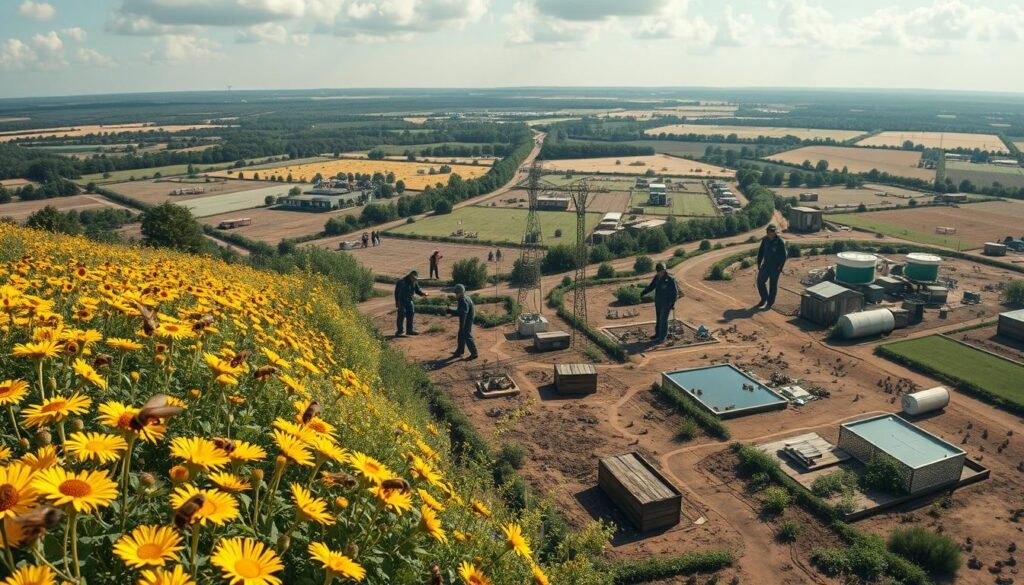
Map how chemicals and in-hive treatments move through colonies and landscapes to spot peak contact windows. This step links sentinel residue data, field calendars, and model outputs so teams can act before harm accumulates.
In-hive products and plant protection products exposure
Trace residues in wax, honey, and pollen to identify where in-hive products concentrate. EFSA monitoring captures inside/outside hive residue patterns that validate model timing and magnitude.
Use sentinel sampling to quantify contact levels and support ApisRAM inputs. LSCFS work shows supplemental feeding can change peak intake and alter exposure to field-applied products.
Landscape-mediated exposure and seasonal resource flows
Overlay bloom calendars and foraging windows to find high-risk weeks. Weather and floral gaps change when bees collect contaminated nectar or pollen, shifting the level of contact across time.
Run scenario simulations to estimate peak exposures under varying weather and resource availability. Segment by life stage and role to capture differing vulnerabilities between brood, nurse bees, and foragers.
Management practices that modulate exposure
Treatment timing, feeding, and supering all alter internal concentrations and external contact. Plan preventive scheduling and buffer actions around high-contact periods to reduce cumulative exposure across migratory routes.
“Use sentinel residues and model scenarios together to turn monitoring information into practical management steps.”
Effects assessment: acute, chronic, sublethal, and synergistic impacts
Understanding how acute mortality, ongoing stress, and subtle impairments interact helps translate monitoring data into management actions. This section focuses on measurable endpoints and how model outputs guide interpretation.
Colony-level endpoints and practical measures
Prioritize queen performance, brood development, forager homing, and stores as integrated indicators of colony health. Use repeated checks to spot brood pattern irregularities and declining laying rates.
Overwintering and population dynamics
Overwintering performance is a critical test of system resilience. Models like ApisRAM include sublethal endpoints such as queen reproductive output and homing ability, while BEEHAVE showed limits in spring simulation fidelity.
- Differentiate acute mortality from chronic stress and sublethal impairments that reduce productivity over time.
- Design field measures to detect subtle changes before colonies fail.
- Consider synergistic impacts—pesticide exposure plus Varroa and nutrition gaps amplify harm.
- Translate effects data into thresholds linked to management triggers and documentation.
| Endpoint | Measurement | Interpretation |
|---|---|---|
| Queen performance | Eggs/day, brood pattern, queen checks | Drop predicts reduced population growth and need for requeening |
| Brood survival | Stage survival rates, patchiness | Signals chronic stress or sublethal exposure |
| Homing ability | Marked forager return rates | Lower return indicates neurobehavioral impacts |
| Overwintering loss | Survival rate, spring build-up | Key metric of combined seasonal stressors |
“Use validated model ranges and clear limits in data to make timely, auditable interventions.”
Data analysis, uncertainty, and validation best practices
Visual and quantitative diagnostics let teams judge how well a model reflects monitored colony trends.
Use side-by-side plots and summary metrics to compare model runs to sentinel hive records. BEEHAVE validation used this approach against LSCFS control data and showed close match in year one, with less fidelity in spring after overwintering.
Performance indicators to track
Checklist: goodness-of-fit scores, bias, variance, and time-series overlap. Add visual residual plots and confidence bands that incorporate known measurement error.
Accounting for field measurement error
Incorporate known uncertainties such as ±30.7% adult bee count error (Imdorf et al., 1987). Treat honey store estimates as ranges because cell volume and fill level vary.
- Document calibration vs. independent validation datasets to avoid overfitting.
- Run sensitivity analysis to find high-impact parameters and guide data collection priorities.
- Record simplifying assumptions (e.g., proxy for sunshine hours) and their likely effects.
“Communicate uncertainty clearly so managers interpret model outputs with appropriate caution.”
| Element | Practical step | Why it matters |
|---|---|---|
| Visual diagnostics | Side-by-side plots, residuals | Quickly reveals timing or magnitude mismatches |
| Measurement error | Include ±30.7% for adult counts; ranges for honey | Expands confidence bands to reflect field reality |
| Sensitivity analysis | Rank parameters by outcome influence | Targets data collection and reduces uncertainty |
| QA/QC | Repeat measures, cross-method checks | Improves data reliability and model inputs |
For additional methods and resources on records and data practices, see this monitoring and records guide.
Estimating likelihoods and consequences at scale
A clear, quantitative plan turns monitoring and model outputs into defensible probability estimates.
Start by structuring likelihood across three stages: entry, exposure, and establishment. Each stage uses site data, literature distributions, and operational calendars.
Probability of entry, exposure, and establishment
Entry uses import volumes and pathway frequencies to set input distributions.
Exposure maps contact windows and residue levels.
Establishment considers seasonality and overwinter survival.
Monte Carlo simulations and sensitivity analysis
Run repeated simulations to stabilize outputs. CFIA used probability distributions and 25,000-run Monte Carlo simulations to estimate entry, exposure, and establishment for hazards such as SHB, AHB, resistant AFB, and amitraz-resistant Varroa.
Use Spearman’s rank sensitivity analysis to identify key drivers. The CFIA example found at least one establishment was nearly certain under specified import numbers.
“Document model structure and assumptions so stakeholders can interpret results and act.”
| Step | Key input | Primary output |
|---|---|---|
| Entry | Import volume, pathway frequency | Probability of introduction |
| Exposure | Residue data, bloom timing | Contact level estimates |
| Establishment | Overwinter survival, movement patterns | Network-level persistence |
Risk characterization: integrating monitoring, models, and management
Combining sentinel indicators, residue profiles, and model outputs reveals where management effort yields the greatest protection.
Use a systems-based approach that links continuous monitoring and simulation to create a clear, time-stamped picture of current and projected risk levels. EFSA highlights that this approach must stay holistic, adaptive, and transparent.
Build a concise narrative by merging field counts, residue data, and model projections into a single dashboard. Weigh likelihood and consequence to sort hazards into tiers that match your acceptable protection level.
- Reconcile mismatches between monitoring and model outputs via targeted data review or recalibration.
- Include sublethal and synergistic effects when evidence shows material impact on colony health.
- Translate findings into prioritized actions tied to timing and operational feasibility.
Document inputs, methods, and uncertainty so teams and stakeholders trust decisions. Set review cadences and use dashboards to keep managers informed as thresholds approach or cross.
“Integrate data, model insights, and practical controls to make timely, auditable decisions.”
Risk management options and decision-making for beekeepers
Practical management mixes preventive steps, adaptive responses, and plain documentation to protect colonies. Use a four-step CFIA-style cycle: evaluate options, select controls, implement measures, then monitor and review outcomes. This keeps actions defensible and traceable.
Protective, adaptive, and transparent control strategies
Categorize controls into protective (preventive), adaptive (data-driven), and transparent (documented). Protective actions reduce exposure; adaptive steps change with new data; transparent practices keep stakeholders aligned.
Beekeeper training, treatment rotation, and biosecurity practices
Train staff on sampling, diagnostics, and threshold-based decisions to reduce variability across sites. Implement treatment rotation plans to limit amitraz resistance and match products to diagnostics and efficacy data.
Strengthen biosecurity: sanitize equipment, use controlled queen and package sourcing, and maintain movement logs.
Zoning concepts and movement controls for disease containment
Apply internal zoning to segregate subpopulations and adjust movement by status. Use quarantine steps and movement controls to contain suspected or confirmed cases before they spread.
“Monitor controls and update SOPs as new monitoring and model outputs change the evidence base.”
Governance, roles, and stakeholder engagement
A defined governance plan makes it simple to know who acts and who shares data when issues arise. Clear roles speed decisions and keep management accountable across an apiary network.
Collaboration with researchers, industry groups, and veterinary authorities
Partner with universities, extension services, and industry groups to co-develop methods and validate model outputs. This builds technical credibility and practical tools that beekeepers can use on time-sensitive operations.
Coordinate with veterinary authorities (USDA-APHIS, state apiarists, CFIA) to align surveillance, reporting, and movement rules. Formalize points of contact and escalation paths so information flows predictably during incidents.
Open data, interoperability, and trust-building
Commit to FAIR principles where possible and publish summaries of methods and findings to build trust. Standardize schemas and APIs so lab results, field monitoring, and model inputs exchange cleanly.
- Define ownership: who stores and shares each dataset.
- Set standards: formats, APIs, and metadata rules for interoperability.
- Create forums: regular stakeholder meetings and feedback channels.
“Transparent governance and shared data accelerate learning and reduce uncertainty across colonies and operations.”
Documentation, reporting, and risk communication
Consistent records make it simple to trace what was measured, why choices were made, and what followed. Good reporting ties monitoring and model outputs to clear decisions. WOAH, EFSA, and CFIA all stress that transparency and timely communication build trust and justify controls when needed.
Standardized records: assessments, assumptions, and actions
Use templates that capture each study or operational assessment: date, site, data sources, model version, key assumptions, and actions taken.
Maintain version control for protocols, parameter sets, and model configurations so teams can replay runs and audits. Record deviations from SOPs with rationale and outcomes.
Communicating uncertainty and results to decision-makers
Report results with clear visuals, concise summaries, and confidence ranges. Link uncertainty to potential impacts and mitigation options so executives and regulators can weigh choices fast.
Tailor messages by audience: operations need tactical steps; leadership needs a short summary with implications; regulators need provenance and traceability.
| Record type | Contents | Who owns it |
|---|---|---|
| Assessment summary | Date, site, model outputs, confidence ranges | Monitoring lead |
| Assumptions log | Parameter values, data sources, version ID | Modeling team |
| Action register | Trigger, control implemented, outcome, notes | Operations manager |
“Document exceptions and communicate uncertainty so decisions remain auditable and stakeholders stay aligned.”
Schedule regular reporting cycles aligned with seasons and key management windows. Ensure records are accessible for audits and stakeholder reviews to sustain trust and enable continuous improvement.
Implementation roadmap: timelines, reviews, and continuous improvement
Start with a phased rollout: Phase 1 builds baseline monitoring and single-factor analyses. Phase 2 layers integrated model use and regular calibration. Phase 3 completes multi-stressor synthesis across regions.
Set milestones by quarter and season tied to sampling, model runs, and management reviews. Use clear KPIs: data completeness, model validation scores, and response time to threshold breaches.
Feedback loops must link monitoring to model updates and SOP changes. Schedule pilots in select regions to test tools, training, and data flow before scaling the system.
Budget for training, software, and data infrastructure. Reassess budgets each season as needs shift with new information and technology.
“Conduct formal after-action reviews after major interventions or seasonal transitions and commit to an annual strategy refresh.”
| Phase | Primary activity | Milestones | KPI |
|---|---|---|---|
| Phase 1 | Baseline monitoring & single-factor analysis | Quarterly sampling; initial dashboard | Data completeness ≥ 85% |
| Phase 2 | Integrated model runs and calibration | Seasonal model validation; stakeholder review | Model fit score > target |
| Phase 3 | Multi-stressor integration & operational scaling | Pilot scale-up; network-wide SOPs | Response time to breaches ≤ defined hours |
Conclusion
In summary, adopt a unified, evidence-led pipeline that ties sentinel monitoring, agent-based modeling, and interoperable data platforms into everyday operations.
This approach yields earlier detection, targeted intervention, and defensible decisions that align with accepted protection levels. EFSA’s systems paradigm and ApisRAM-style modeling make the link between field signals and management clear.
Validate models, publish uncertainty, and iterate on indicators and protocols. See model validation insights at model validation insights to guide calibration and scenario testing.
Work with authorities and researchers, phase implementation, measure outcomes, and repeat. Use this framework to protect honey bee health, colony resilience, and honey production across diverse U.S. landscapes.
FAQ
What is the purpose of a systems-based evaluation for large honey bee operations?
A systems-based approach looks beyond individual hives to consider colonies, landscapes, climate zones, and management practices together. It helps operators predict how multiple stressors—pests, pathogens, forage availability, weather, and chemical exposure—interact and affect colony survival, productivity, and queen performance.
How do I define scope and protection goals for an apiary network?
Start by setting clear endpoints such as colony survival, honey yield, brood health, and overwintering success. Define acceptable tolerance thresholds and negligible levels for impacts. Use those targets to shape monitoring design, model scenarios, and management triggers across your operation.
What key steps make up a practical workflow for evaluating hazards and mitigation?
A reliable workflow includes hazard identification, exposure estimation, effects analysis, management planning, and transparent communication. Integrate sentinel hive monitoring, validated models like agent-based colony simulations, and scenario testing to guide decisions and control strategies.
How should I map my operational footprint to prioritize monitoring?
Map colonies by landscape type, floral resources, and climate zones. Prioritize representative landscapes and foraging windows that reflect peak nectar and pollen flows. Account for weather variability to schedule inspections and interventions when colonies are most vulnerable.
What is a sentinel hive system and what indicators matter most?
Sentinel hives are standardized sites used to track colony strength and exposure over time. Core indicators include adult population, brood pattern, queen status, honey and pollen stores, parasite loads (Varroa), and chemical residues. Consistent protocols make data interoperable across regions.
How can modeling and simulation improve decision-making?
Models, including agent-based and validated colony models, let you test scenarios for weather, forage changes, management practices, and product use. They reveal likely outcomes, sensitivity to inputs, and potential synergistic effects, helping prioritize interventions and reduce uncertainty.
Which biological hazards should U.S. operators prioritize?
Focus on Varroa destructor, Nosema spp., American and European foulbrood, and small hive beetle. Also consider genetic risks like Africanized honey bees and traits that influence behavior or disease susceptibility. Surveillance and rapid response are essential to limit spread.
How do I assess exposure pathways for in-hive products and pesticides?
Map timing and routes of contact: in-hive treatments, foraging-mediated uptake, and contaminated pollen or nectar. Consider seasonal resource flows and management practices that either increase or reduce exposure, such as placement relative to treated crops and timing of applications.
What types of effects should monitoring detect at colony level?
Track acute mortality, chronic declines in strength, sublethal behavior changes (foraging, homing, brood care), queen performance, and overwintering success. These endpoints tie directly to productivity and help quantify long-term population dynamics.
How do I handle data quality, uncertainty, and model validation?
Use standardized protocols, calibrate instruments, and document measurement error. Validate models with independent field datasets and visual or quantitative performance indicators. Apply Monte Carlo simulations and sensitivity analyses to identify key drivers and confidence bounds.
What analytical methods estimate likelihoods and consequences across a network?
Combine probability modeling for entry, exposure, and establishment with scenario-based simulations. Monte Carlo approaches, sensitivity testing, and spatial aggregation let you estimate incidence and identify hotspots for targeted action.
What management options reduce impacts at scale?
Implement protective and adaptive controls: rotation of treatments, integrated pest management (IPM), biosecurity, zoning and movement controls, and targeted treatments informed by sentinel data. Training and transparent record-keeping improve consistency and effectiveness.
How should stakeholders be engaged in surveillance and decisions?
Collaborate with university researchers, extension services, industry groups like the American Beekeeping Federation, and state veterinarians. Share interoperable data, agree on core indicators, and build trust through open communication of methods, assumptions, and results.
What documentation and communication practices are recommended?
Maintain standardized records of inspections, treatments, model inputs, and decisions. Clearly communicate uncertainty and assumptions to buyers, regulators, and partners. Use concise reports and dashboards to support timely, transparent decision-making.