This guide explains current federal and state rules that govern how a jar is named, labeled, and offered for sale across the United States.
Startups to established packers will find plain-language guidance on mandatory federal elements under 21 U.S.C. 342–343, what must appear on the principal display panel, and when an ingredient list is required.
We clarify the difference between pure product naming and blended or flavored versions, show why net weight, common name, and contact information protect consumers, and preview optional items like Nutrition Facts and infant warnings.
Readers will also get an overview of grading, color and floral claims, and how state programs can add local nuance to label requirements.
Use the linked deep dive on grading for more detail: grading and quality rules.
Key Takeaways
- Three mandatory label elements: common name, net weight, and contact information.
- Pure honey can omit ingredients; blends must list sweeteners by weight.
- Nutrition Facts require added sugar footnotes detailing grams and % Daily Value.
- State rules affect local claims and may tighten federal baselines.
- Operational setup—approved facilities and equipment—shapes what can appear on a jar.
Ultimate Guide overview: present-day federal and state rules for honey bottling and processing
This guide pulls federal rules and state differences into a practical map so producers can prepare compliant jars from harvest to shelf. It explains what must appear on a retail label and what items are conditional.
Federal minimums require a clear common name, dual-unit net weight on the principal display panel, and manufacturer/packer/distributor contact information. Small producers with under $500,000 in annual sales and no health claims may qualify for limited label exemptions.
Optional or conditional elements include an ingredients list for blends, a Nutrition Facts panel with an added-sugars footnote (typical pure serving ~17 g sugar, ~34% DV), infant warning guidance, country-of-origin for imports, and suggested best-by dates.
| Element | Status | When required |
|---|---|---|
| Common name | Mandatory | All retail jars |
| Net weight (dual units) | Mandatory | Principal display panel |
| Ingredients / Nutrition | Conditional | Blends, added sugars, or voluntary nutrition info |
| Local/origin claims | Variable by state | States like CT, ME, NJ, NH, VT impose extra rules |
Use this overview to plan what must be set before first sales, and to build checklists that reduce relabeling risk across markets and stores.
Understanding the U.S. honey market and regulatory landscape
Sales channels span tiny weekend stalls to industrial supply chains, each demanding different label formats and packaging sizes.
From farmers markets to bulk sales for food service and manufacturers
The category covers backyard sellers, regional packers, and large suppliers. About 65% of sales move as bulk shipments to food service and manufacturers, which presses producers to meet container-level requirements.
Farmers market vendors often use simple displays and rely on local claims where state rules allow. Industrial buyers expect extra data: date codes, lot numbers, and variable information on large pails.
How national trends shape labeling and packaging choices
Blended and flavored varieties have driven naming shifts and ingredient statements on retail jars. Buyers across markets demand consistent labels, clear product names, and accessible contact details to qualify for repeat orders.
- Match label content to your primary sales channel to reduce redesigns.
- Choose packaging for durability—squeezables, glass, or pails—based on where the product will sell.
- Use resources from the National Honey Board to align positioning with national demand.
Core federal label requirements on every honey jar
Label basics begin with three must-have items on every retail package: a correct common name, a net-quantity statement in dual units, and contact information for the responsible firm.
Common name rules
When to say “honey” and when to describe blends
Use the single word “honey” only for pure product. If sweeteners are added, the name must disclose them. For blends use a clear phrase such as “A Blend of Honey and Corn Syrup” with ingredients shown in descending order by weight.
For flavored jars, put the flavor in the name (for example, “Strawberry‑flavored Honey”) so consumers are not misled.
Net weight on the principal display panel
List net quantity in both U.S. customary and metric units. Place this statement within the bottom 30% of the principal display panel on inner and outer packaging to meet federal requirements and avoid misbranding.
Contact information for the responsible firm
Include a street address, phone number, or website so regulators and consumers can reach the manufacturer, packer, or distributor. The contact must identify the responsible party without ambiguity.
“Clear naming, visible weight, and reachable contact create trust and reduce relabel risk.”
- Keep the common name prominent and legible on the PDP.
- Double-check sweetener order when blends are used.
- Create SOPs that verify PDP layout, weight placement, and contact information before print runs.
For more on modern labeling rules see modern labeling updates.
Optional and conditional honey label elements that impact compliance
Decisions about optional label content often determine whether a product meets retail or state marketplace rules. Use a simple checklist to map which add-ons are required once a formulation or claim changes.
Ingredients and ingredient order
Pure product may omit a list of ingredients. Any jar with added sweeteners or flavors must list ingredients in descending weight order.
Nutrition Facts expectations
When a Nutrition Facts label is present it must be complete. The required added sugars footnote reads: “One serving adds 17 g of sugar to your diet and represents 34% of the Daily Value for Added Sugars.”
Infant safety guidance
Recommended warning: “WARNING: Do Not Feed Honey to Infants Under One Year Old.” Adding this protects health and reduces consumer confusion.
Country of origin and date coding
Imported product must declare country of origin even if it is packaged here. Domestic goods do not need an origin statement.
Best-by and production dates are optional. Many brands include a date for quality; the USDA suggests peak flavor within one year and potential decline after about five years.
| Optional Element | When Required | Recommended Wording | Label Impact |
|---|---|---|---|
| Ingredients list | Any added sweetener or flavor | List ingredients in descending weight | Uses panel space; must be legible |
| Nutrition Facts | Voluntary or when claims trigger it | Standard panel + added sugars footnote | Occupies significant label area; may change design |
| Infant warning | Recommended for all retail jars | “WARNING: Do Not Feed Honey to Infants Under One Year Old.” | Boosts safety, minimal space |
| Country of origin | Imported lots | “Product of [Country]” | Required for imports; affects marketing |
Practical steps: keep documentation for origin and ingredient order, use print-and-apply for variable data, and build a compliance matrix that flags when each optional element becomes mandatory for a given product and sales channel.
Floral source honey claims and substantiation
Floral-source claims must reflect the dominant nectar source and rely on evidence that supports the name used on the label.
Verifying floral origin
Acceptable proof includes pollen analysis, documented apiary sourcing, and harvest windows that match local bloom periods. Keep lot-level records showing where bees foraged and when.
Color, clarity, and honest communication
Describe color and clarity factually without implying a USDA grade. Note that color varies by floral source, season, and region. Clarity depends on filtration and handling.
- When multiple nectar sources exist, use broader terms (for example, “blended floral”) rather than overspecific names.
- Maintain internal quality files to back claims for regulators or retailers.
- Pair floral notes with tasting guidance so consumers understand flavor and use.
Rule of thumb: back any floral name on the principal display with documentation and keep the common name prominent.
USDA honey grades and quality indicators
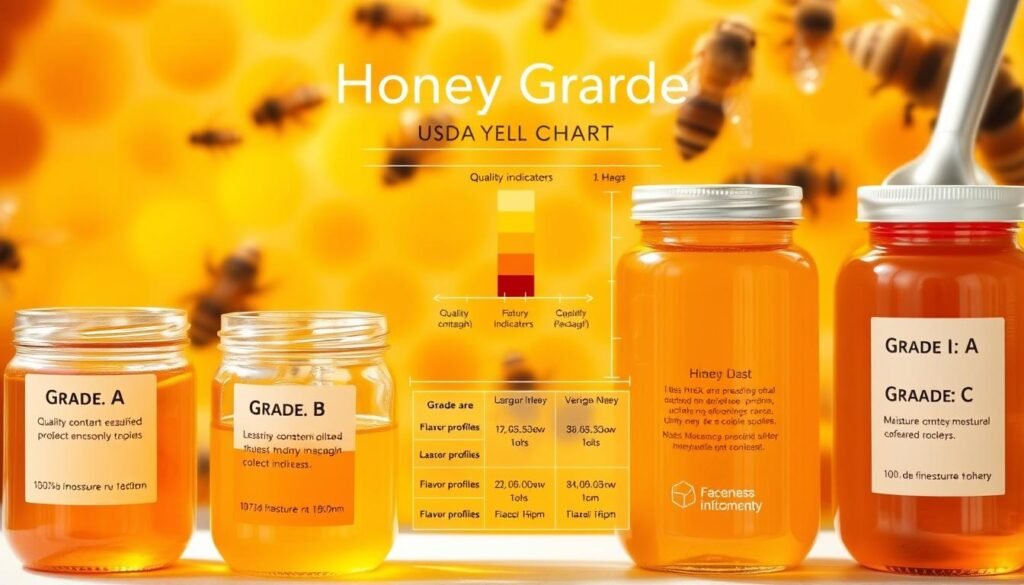
USDA grading uses a point system to rate extracted product. A Grade A requires at least 90 points; Grade B needs 80; Grade C requires 70. Scores below 70 are substandard.
How scores are determined
Panels evaluate flavor, aroma, and cleanliness/clarity. Each factor deducts points for defects such as off‑flavors from overheating or particulates that cloud the jar.
Practical steps—filter after settling, control holding temperatures, and use hygienic handling to protect sensory qualities.
Using grades on the label
Displaying a grade can help consumers compare product tiers and reassure retailers. Keep test records and internal score sheets (SC-364-31) to support any claim.
“Use the SC-364-31 score sheet and the Grading Manual for consistent evaluations.”
| Grade | Minimum Points | Key Drivers |
|---|---|---|
| Grade A | 90 | Clean aroma, strong flavor, excellent clarity |
| Grade B | 80 | Good flavor, minor defects, acceptable clarity |
| Grade C | 70 | Fair flavor, noticeable defects, reduced clarity |
| Substandard | <70 | Off‑flavors, poor aroma, visible particulates |
Tip: run annual internal audits, align SOPs with grade goals, and treat grading as optional but valuable for consistent market positioning.
Color standards and the Pfund scale
Color gives consumers a first impression, but classification exists to describe appearance rather than assign quality.
Official USDA color designations
The Pfund scale is the standard tool. USDA-recognized bands include:
- Water White: 0–8 mm
- Extra Light: 8–16 mm
- Light: 16–34 mm
- Extra Light Amber: 35–50 mm
- Light Amber: 51–84 mm
- Amber: 85–114 mm
- Dark: 115–140 mm
Why color is separate from grade
Color varies naturally with floral source and season. Citrus honey often reads Extra Light; heather tends toward Amber.
Practical guidance: reference a color band on the label using clear terms (for example, “Light Amber”) and pair that call with tasting notes. Do not imply a higher grade by citing a lighter or darker shade.
- Measure color consistently with a calibrated Pfund grader for each lot.
- Document assignments and keep records for retail claims.
- Use color in merchandising to group like-flavored jars on shelf.
“Color helps shoppers choose flavor, not to judge product safety or grade.”
For testing methods and grading context see the grading guide.
“Local” honey claims across states
A jar marketed as local can carry real advantages in retail and institutional markets. Rules for calling a product local vary by state, and New England jurisdictions often lead with stricter tests.
How rules differ
Connecticut, Maine, New Jersey, New Hampshire, and Vermont commonly require the item to be produced and packaged in‑state or within a defined radius of the selling point.
Other states use looser definitions that still let producers qualify for school or agency programs if they document local sourcing.
Leveraging programs and guidance
Documented local status can open promotional programs and preferred supplier lists. Use resources from the National Honey Board, including white papers, to map opportunities.
“Verify state rules before using local claims; proof prevents enforcement and retailer disputes.”
| Rule Type | Typical Requirement | Benefit |
|---|---|---|
| Strict (CT, ME, NJ, NH, VT) | Produce & package in-state or within radius | Access to state marketing & institutional bids |
| Flexible | Documented local sourcing; variable radius | Broader market access with proof |
| Imported | Must still state country of origin | Local claim cannot replace origin declaration |
- Verify specific state requirements before labeling.
- Keep lot-level records for audits and retailer requests.
- Ensure local language does not obscure federally required label elements.
For a practical compliance checklist, consult this comprehensive guide.
Packaging materials and label durability for honey products
Label durability starts before filling. Choose containers and facestocks that keep required text readable from production to the store shelf.
Plastic containers benefit from BOPP or vinyl facestocks. These resist wrinkling when squeezable bottles flex during handling.
Outgassing can cause bubbles beneath labels. Use fine adhesive carriers to let trapped gases escape and reduce flagging.
Glass jars need simple curves and clear placement. Allow 1/8–1/4 inch overrun so the label fully adheres to the jar body and avoids lifting.
Print-and-apply systems add black-and-white variable data, such as production or best-by dates, right before application. Data can come from a local PLC or a central server for consistency across SKUs.
- Test label stocks in real conditions: cold chain, humidity, and drop handling.
- Validate line setups to prevent wrinkles, flags, or obscured principal display text.
- Coordinate label dimensions with container geometry early in design to save time and space on the PDP.
| Component | Strength | Common Issues | Quick Fix |
|---|---|---|---|
| Plastic (BOPP/Vinyl) | Flexible, wrinkle-resistant | Outgassing bubbles | Fine adhesive carriers |
| Glass jars | Premium look, stable surface | Flagging on curves | 1/8–1/4″ overrun, simple placement |
| Print-&-apply | Fast variable data | Misaligned prints | PLC control and regular calibration |
Durable labels protect required information and help customers and inspectors read critical data over product life.
Scaling up: bulk and foodservice labeling considerations
Industrial buyers need clear, durable labels on pails that make procurement, traceability, and handling easier.
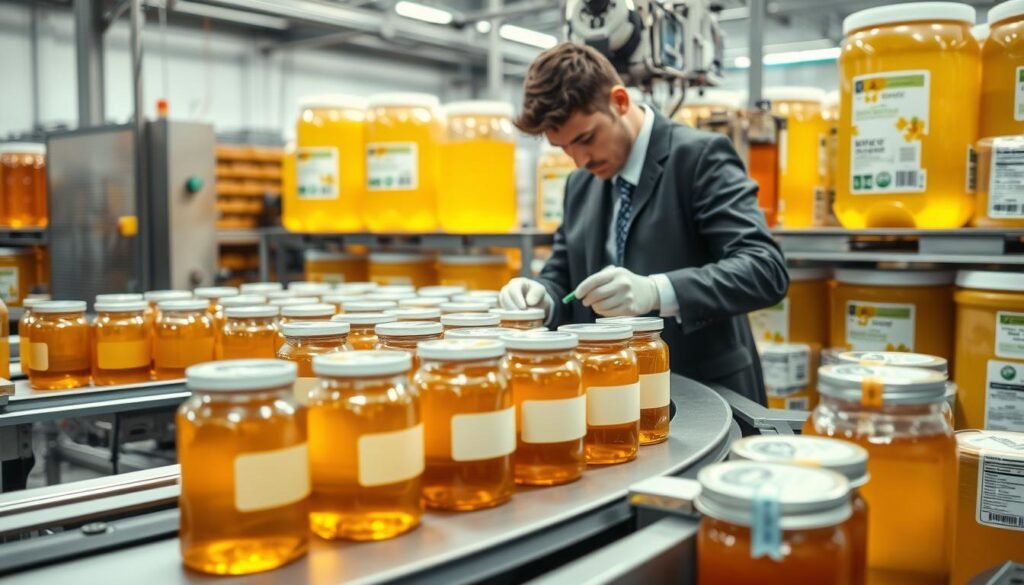
About 65% of sales move in bulk, so labeling systems must handle 5-gallon pails and larger drums used by foodservice and manufacturers.
Labeling large containers for industrial customers
Scale the principal elements—common name, net weight, and contact—so they remain legible from a distance and scannable at receiving docks.
Common issues include curvature, adhesion on textured plastics, and abrasion during pallet handling. Choose facestocks and adhesives rated for temperature swings and condensation.
Equipment: use robust applicators and print-and-apply units for consistent placement and variable data like dates and lot codes.
- Attach spec sheets or certificates when buyers request extra documentation.
- Align label content with procurement specs to speed vendor approval and repeat sales.
- Capture feedback from farmers, co-ops, and industrial customers to refine layout for operational use.
| Concern | Solution | Benefit |
|---|---|---|
| Curved surfaces | Contour labels or larger panels | Better adhesion, readable text |
| Temperature swings | High-tack, cold-rated adhesive | Durable through transit |
| Variable data | Print-and-apply integration | Traceability and compliance |
Checklist: confirm legible common name, dual-unit weight, contact details, lot code, date, and buyer specs before high-volume runs.
Business setup for honey producers: permits, spaces, and equipment
Early planning for permits, workspace, and equipment prevents costly delays when harvest time arrives.
Licensing landscape: check local ordinances for beekeeping, review state food rules, and confirm federal registration or facility requirements that apply to harvesting, bottling, and sales.
Home kitchens and approved facilities
Many jurisdictions restrict bottling in home kitchens. Locate a certified commercial kitchen or a licensed packer. Document approval before running label proofs or accepting large orders.
Essential equipment and safe handling
- Core tools: smoker, bee brush, extractor, settling tanks, and heat control for gentle handling.
- Sanitation: written SOPs, staff training, and cleaning records reduce health risk and support audits.
- Supplier vetting: verify container and label vendors for consistent materials and lead time.
Build a business plan that covers products, marketing, competition, ownership, and finances. Factor in space rental, equipment costs, and time for peak extraction, labeling, and sales setup.
Tip: consult local associations and mentors to speed approvals and avoid common setup errors.
Designing compliant labels that win at the store and online
Good label design balances legal clarity with brand appeal. A practical front panel starts by placing the common name prominently, followed by the dual-unit net quantity within the bottom 30% of the principal display panel.
Principal display panel best practices for readability and order
Blueprint: common name at top, clear brand mark, net weight (oz / g) low on the PDP, then contact details. Keep this order consistent across SKUs for quick retail checks.
Balancing required details with brand elements
For glass jars avoid complex curves; allow a 1/8–1/4 inch overrun so the label lies flat and resists flagging. Use print-and-apply systems to add lot codes and best-by dates at application.
- Place Nutrition Facts or grade statements on a side panel so the PDP stays uncluttered.
- Reserve floral claims like “clover honey” for jars backed by pollen analysis or sourcing records.
- Choose high-contrast typography, legible sizes, and simple icons to guide customers fast.
“Test front-of-jar hierarchies with A/B image trials and preflight checklists before any print run.”
National Honey Board, industry resources, and federal references
Authoritative resources turn grading rules into usable checklists for label teams and QA staff.
Where to find grading manuals and inspection aids
Key USDA documents include U.S. Grade Standards for Extracted Honey, the Grading Manual for Extracted Honey, the SC-364-31 score sheet, plus Certification, Condition of Container, General Processed Procedures, Safety, Sampling, and Sanitation manuals.
How these help: use the Grading Manual together with the score sheet to standardize sensory checks before making any grade claim on the label.
NHB data and white papers to inform producers and marketers
The National Honey Board offers market data and a white paper on local claims. These materials guide product positioning, marketing language, and compliance messaging.
- Integrate manuals into SOPs so teams apply the same rules to product checks and label text.
- Keep current manuals on file; track updates that could alter requirements.
- Use NHB education to support marketing without making health claims that exceed evidence.
Citing credible references strengthens retailer and regulator confidence in your labeling practices.
Build a compact resource library for product, labeling, and QA teams. For operational safety and quality guidance see this detailed guide: production safety and purity.
31. honey bottling and processing standards USA
Treat core federal requirements as fixed anchors; build floral, nutrition, and packaging choices around them.
Federal label basics and small-producer exemptions
Federal rules require three items on every retail jar: the common name, a dual-unit net weight on the principal display panel, and clear contact information for the responsible firm.
Producers with under $500,000 in annual sales who make no health claims may qualify for limited exemptions. Keep written proof of eligibility to show inspectors.
Floral claims, Nutrition Facts, and infant guidance
Floral-source statements need substantiation such as pollen analysis or documented apiary sourcing. Back any specific floral name with lot records.
The Nutrition Facts panel, when present, must include the added-sugars footnote (typical serving ~17 g, ~34% DV per tablespoon). A simple infant warning—“Do Not Feed Honey to Infants Under One Year Old.”—is recommended on retail jars.
Packaging, equipment, and clarity practices for compliance
Choose BOPP or vinyl facestocks for flexible plastic containers to resist flexing and outgassing. For glass jars allow a 1/8–1/4 inch label overrun to prevent flagging.
Clarity and absence of defects affect USDA scoring and consumer trust. Proper settling, filtration, and gentle handling protect visual quality.
Systems approach: align product formulation, package choice, and application process to keep required text readable and defensible.
- Use print-and-apply for lot codes and dates to reduce errors.
- Select adhesives rated for container type and transit conditions.
- Document exemptions, floral evidence, and label decisions for audits.
For grading details and official procedures consult the USDA extracted honey standard.
Go-to compliance checklist for U.S. honey labels and packaging
Before your next order, run through this compliance checklist to catch missing or mis-sized label items.
Must-have items: confirm the common name is correct and prominent on the principal display panel. Place net weight in dual units within the bottom 30% of the PDP. Add clear contact information for the responsible firm.
- Ingredients: if not pure, list ingredients in descending weight; if pure, document the exemption.
- Nutrition facts label: include a full panel and the required added-sugars footnote when used.
- Infant warning: include the warning as a best practice for retail jars.
- Origin & dates: declare country of origin for imports; decide on best-by/production dates and use print-and-apply for variable data.
- Floral source claims: keep pollen analysis or sourcing records to support any floral-source honey name.
Quick tip: validate grade points (Grade A ≥90, B ≥80, C ≥70) before using grade claims and keep supporting test records.
| Item | Status | Action |
|---|---|---|
| Common name | Mandatory | Prominent on PDP; verify wording |
| Net weight (dual units) | Mandatory | Bottom 30% of PDP; legible size |
| Ingredients | Conditional | List when additives present; descending weight |
| Packaging material | Best practice | BOPP/vinyl for plastic; 1/8–1/4″ overrun for glass |
For facility-level preventive controls and related rules, review 21 CFR Part 117 for context and recordkeeping expectations.
Conclusion
Wrap up: follow federal anchors—common name, dual-unit net weight on the principal display panel, and clear contact—then add sensible disclosures where useful.
Optional items such as an infant warning, the Nutrition Facts added-sugars note, origin statements for imports, and best-by dates increase transparency and protect health.
Use USDA manuals and National Honey Board papers to train teams and back floral or grade claims. Bulk sales dominate the market, so build durable labels and scalable systems that move from jars to pails with the same controls.
Run periodic audits, collaborate with farmers and co-packers to verify sourcing, and keep a living checklist so your teams can adapt quickly while reducing relabeling and speeding time to market.
Strong, clear information presented the right way helps products stand out and meet federal and state expectations—apply this guide to your next label cycle.
FAQ
What federal labeling requirements apply to jars of honey sold in the United States?
The principal display panel must show the common name, net weight in both ounces/grams and pounds/kilograms, and the identity of the packer, manufacturer, or distributor with contact information. The Nutrition Facts label is required when a product makes a nutrition or health claim or for certain retail situations. Floral source claims such as “clover” must be truthful and substantiated. Country of origin must be shown for imports. Follow FDA and USDA guidance and consult the National Honey Board for industry-specific aids.
When can producers omit an ingredients list on a jar of pure honey?
Single-ingredient, pure honey sold without additives may omit an ingredients statement under FDA rules, because the common name already declares the product. If blended with other sweeteners, flavors, or ingredients (including syrups), you must list each component by common name and, when required, declare allergens and percentages by weight where relevant.
How should I label mixtures or blends that include honey and other sweeteners?
Blended products cannot use the single-word common name “honey” alone. Use descriptive names like “honey blend” and list all ingredients in descending order of predominance by weight. You may need a Nutrition Facts panel and to clearly identify any added sugars. Ensure any floral source or varietal claims aren’t misleading.
What are the USDA honey grades and do I have to display a grade on retail packaging?
The USDA grade standards (U.S. Grade A, B, C, and Substandard) describe score-based quality factors such as flavor, aroma, and clarity. Grading is voluntary; you are not required to display a USDA grade on retail jars. However, using grades can help signal quality to buyers and foodservice customers.
How do I substantiate a floral source claim like "clover honey"?
Use laboratory pollen analysis, beekeeper records, and harvesting windows to support botanical origin claims. A dominant floral source should be demonstrated; vague or unsupported varietal claims can be viewed as misleading by regulators and consumers. The National Honey Board provides guidance on claims and testing resources.
What rules cover color and clarity descriptions on labels and marketing materials?
Color descriptions may reference the Pfund scale (Water White to Dark) but should not imply grade. Statements about clarity or color must be accurate and not misleading. Provide objective measurements when making technical claims, and avoid suggesting superior quality based solely on color.
Are there special label requirements for imported honey or products with foreign ingredients?
Imported honey must include country of origin on the label and meet U.S. identity and safety standards. Documentation for traceability, testing, and import permits may be required by USDA or FDA. If you blend imported and domestic product, label must reflect accurate origins and ingredient statements.
When is a Nutrition Facts label required for honey products?
Plain, single-ingredient honey sold in retail packaging generally follows standard labeling exemptions, but a Nutrition Facts panel is required whenever the product makes nutrient content or health claims, is part of certain retail programs, or when the manufacturer chooses to provide full nutrition information. Added sugars must be declared when other sweeteners are present.
What infant safety warnings are recommended for honey products?
Manufacturers should include guidance that honey should not be fed to infants under 12 months due to the risk of infant botulism. While this warning is not always legally mandated on pure honey, it is widely recommended by public health agencies and helps protect consumers and reduce liability.
How should contact information appear on a label?
Provide the name and domestic business address of the manufacturer, packer, or distributor, or a phone number or website where consumers can obtain further information. This must be clear and legible so buyers and regulators can reach your business for traceability and inquiries.
What are best practices for packaging materials and label durability?
Choose containers and labels that resist outgassing, flexing, and oil migration. BOPP and vinyl films work for many plastic jars, but test for compatibility. Glass jars need careful label placement to conform to curves and allow space for headroom. Use print-and-apply systems for variable data like lot codes and production dates to maintain legibility.
How do state "local" honey claims vary and what should vendors check?
States have different definitions and enforcement for “local” or “locally produced.” Connecticut, Maine, New Jersey, New Hampshire, and Vermont each have nuances in allowed claims, labeling, and farmers market rules. Check state agriculture departments and market managers, and follow National Honey Board recommendations for consistent, honest claims.
What labeling changes when selling bulk containers to foodservice or manufacturers?
Large containers like 5-gallon pails should include product identity, net weight in appropriate units, lot numbers, and supplier contact information. Ingredient transparency and traceability are critical for industrial customers. Ensure bulk labeling and documentation meet buyer specifications and food safety requirements.
What permits and facility requirements apply to small-scale producers bottling at home?
Many states restrict sale of food from home kitchens. Producers must check local health departments for licensing, required inspections, and approved facility standards for extraction and bottling. Commercial kitchens or licensed packing facilities may be required for retail sales. Maintain records of sanitation and equipment maintenance.
What equipment is essential for safe extraction and packaging at scale?
Core items include sanitary extractors, filters, heated settling tanks, calibrated scales, and sealing equipment. Line cleaning systems, storage tanks with traceability tags, and appropriate packaging machines (filler, capper, labeler) support food safety and efficiency. Design workflows to avoid cross-contamination.
How do I design a principal display panel that meets legal and marketing needs?
Prioritize legibility: common name, net quantity, and brand should be easy to read. Place mandatory information in required locations and use contrasting fonts and sizes. Keep brand elements balanced with required details so the label passes inspection and appeals on shelf or online.
Where can producers find grading manuals, inspection aids, and technical resources?
The USDA publishes honey grading standards and inspection guides. The National Honey Board offers industry data, white papers, and marketing resources. State departments of agriculture also provide labeling guidance, and local extension services can help with small‑business compliance and testing contacts.
What are common pitfalls that lead to noncompliant honey labels?
Frequent issues include missing or incorrect net weight units, unsubstantiated floral claims, failure to list added ingredients, unclear manufacturer contact information, and omission of infant safety guidance when appropriate. Test labels against FDA/USDA checklists and get legal or regulatory review before printing.
How should best-by and production dates be handled on jars and bulk containers?
Best-by dates are generally recommended for inventory control but are not federally mandated for pure products. Production or lot codes are essential for traceability and recall management. Use clear, durable printing methods for dates on both retail jars and bulk packaging.
Who enforces compliance and what inspections should producers expect?
The FDA enforces federal labeling laws for most packaged foods; USDA handles grading and some inspection programs. State and local health departments inspect facilities and markets. Third-party audits from buyers or certification programs may also require documentation and on-site checks.
How can I substantiate claims about flavor, aroma, and clarity?
Combine sensory panels, laboratory tests, and production records to support claims. Keep objective measures (Pfund scale for color, moisture content, pollen analysis) and tasting notes on file. Avoid subjective or absolute statements unless backed by documented testing.
Where can I get help creating compliant Nutrition Facts panels and label specs?
Use FDA guidance and the USDA resources for layout and content rules. Nutrition labeling software, registered dietitians, or private label consultants can generate accurate panels. Verify declaration of added sugars and serving sizes per current regulatory standards.
What steps should I take before launching a new jarred product to market?
Conduct a label compliance review, confirm packing and storage protocols, test packaging materials, secure necessary permits and insurance, and prepare traceability documentation. Pilot small runs at retail and gather consumer feedback while ensuring all contact and safety information is present.