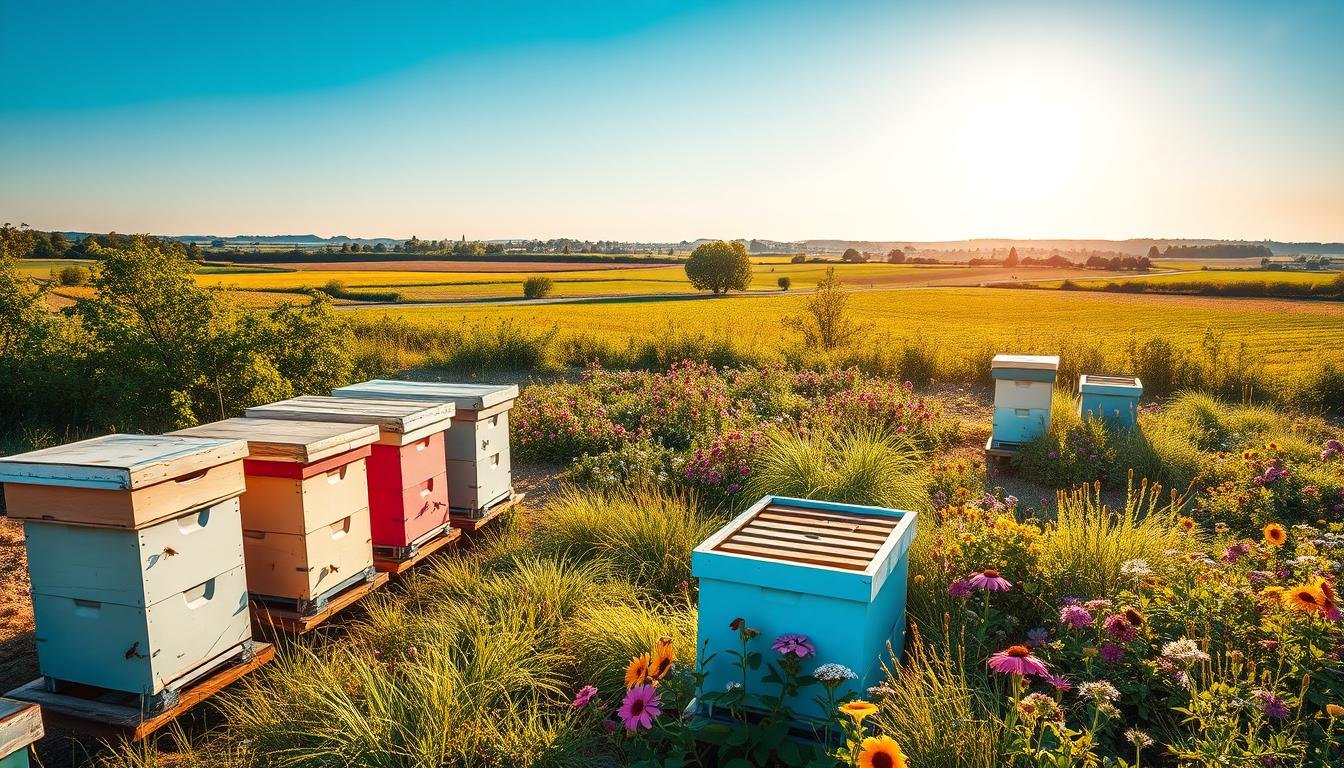
This introduction sets the scope for a practical resource on how land use rules, local codes, and animal control shape where hives can sit on private property in a city or suburban setting.
The decline in honey bees since 1947 threatens crops and food production, so clear rules matter for communities and local food systems. Responsible hive placement helps protect people, livestock, and neighborhood plants while supporting authentic honey production.
The guide defines zoning terms like accessory use and conditional use permits, outlines common requirements such as setbacks, flyway barriers, and water access, and maps national trends to local practice. For examples and model policies, see resources on city ordinances and practical benefits of keeping bees in communities via local ordinance guidance and a summary of benefits at beekeeping benefits.
Key Takeaways
- Land use and zoning determine where hives can be placed on private property.
- Setbacks, water supply, and flyway barriers reduce conflicts with people and animals.
- Clear rules support local honey production and protect food systems.
- Local codes vary; check city planning staff or local associations before installing hives.
- Responsible management balances benefits for agriculture and community safety.
Why Beekeeping Zoning Laws Matter Now in the United States
As managed colonies shrink, local policy plays a bigger role in keeping pollination strong for crops and neighborhood plants.
Declines in honey bee numbers reduce pollination for more than 130 fruits and vegetables. That loss cascades into lower food production and tighter local food access. Cities and towns use land and property rules to balance pollination benefits with community safety.
Municipal standards make it possible for keeping bees to support agriculture and honest honey production. Local regulation can encourage artisanal markets, education, and neighbor engagement while limiting nuisance risks.
Urban and suburban areas often offer diverse forage across properties, which can boost colony production versus some rural monocultures. At the same time, setbacks, flyway barriers, and water rules protect people, animals, and livestock from conflicts.
“Supporting honey bee health aligns with broader municipal goals for resilient food supply chains and community benefits.”
- Property and land use guide hive siting to protect people.
- Evidence-based standards help beekeepers be good neighbors.
- Local efforts tie bee health to community food security.
Understanding the Legal Framework: Zoning vs. Animal Control
Cities often split oversight of hive operations between planning codes and animal control offices. That split determines whether keeping bees is handled as a land use question or an animal permit issue.
How codes classify the activity
Zoning may treat apiaries as an accessory use allowed by right or as a conditional use requiring hearings and findings. When conditional reviews apply, applicants must show setbacks, site plans, and how the use fits the property and neighborhood.
Animal control route
Many cities route hive oversight through animal control. That path usually needs a beekeeper permit and enforces requirements like limits on colonies per lot, hive size, setbacks, and flyway barriers.
Nuisance, state roles, and compliance
Nuisance standards intersect with permits to prevent interference with neighbors’ normal use. State statutes set overall authority, but local regulations set details. Documenting hive placement and routine management often becomes part of compliance.
- Permit triggers: new colonies, added hives, or a change in operation.
- Species limits, including bans, are enforced under animal control rules.
- Choose zoning or animal control based on district, lot layout, and scale of production.
For model policy context, review materials on zoning for urban agriculture.
Core Regulatory Elements Cities Commonly Use
Municipal regulations target specific risks from urban apiaries by limiting colonies, hive size, and flight paths.
Counts, setbacks, and size caps. Many cities cap the number of hives per lot and scale limits with land or property size to manage neighborhood density. Typical rules set a maximum colonies per lot and require clear spacing from property lines and public areas.
Setbacks reduce contact between bees and people, animals, or livestock. Size and height limits keep hives compatible with the surrounding use and ensure emergency access.
Flyway barriers and flight management
Flyway barriers—often six feet high and made of wood, lattice, or dense vegetation—redirect bees upward so bees fly above adjacent activity. Rooftop placements may get exemptions when elevation already alters how bees fly.
Water supply and pool conflicts
Cities often require stable water at the apiary to stop bees from visiting pools. Simple landing platforms and seasonal checks meet this requirement and reduce neighbor complaints.
Species limits and compliance
Some jurisdictions ban Africanized honey bees as an animal safety measure. Beekeepers should document inspections, water provision, barrier installation, and hive counts to show compliance and lower enforcement risk.
Tip: Keep dated photos and a short log of routine management to demonstrate adherence to local regulations.
Permits, Notifications, and Hearings: How Approvals Work
Local permit processes set clear steps for approving hive proposals on private property. They ensure people near a proposed site get notice and a chance to raise concerns.

Neighbor notification windows and public input
Applications typically trigger mailed or posted notices to nearby property owners. Public input matters because it surfaces safety concerns and fosters community buy-in.
For example, Milwaukee mails notice to owners within 200 feet and allows a 14-day written objection period.
Conditional approvals, timelines, and compliance checks
When objections occur, cities often schedule a hearing within 14 more days and issue a decision soon after. Conditional approvals set explicit requirements like setbacks, flyway barriers, and water supply.
Inspections and renewals may be tied to those conditions to confirm ongoing compliance and to limit nuisance risks.
“Predictable timelines protect applicants and neighbors, reduce disputes, and support fair enforcement.”
- Prepare: site plan, setback measurements, flyway barrier details, and water source info.
- Keep dated photos and a short log of operation milestones for inspections.
- Communicate early with neighbors and associations to avoid objections.
| Step | Typical Timeframe | Common Requirements | Next Action |
|---|---|---|---|
| Notification | 14 days | Mailed notice to nearby property owners | Collect objections or support |
| Hearing & Decision | Hearing within 14 days; decision within 10 days | Review site plan, setbacks, barriers | Issue approval, conditional terms, or denial |
| Compliance Review | Periodic (annual or on change) | Inspection, documentation, renewals | Recheck conditions or enforce remedies |
Case Study: Milwaukee, WI — Permits, Flyway Barriers, and Two-Hive Limits
Milwaukee’s rules frame hive placement around property buffers, neighbor notice, and practical time limits for review. The city mails notice to property owners within 200 feet. Neighbors have 14 days to object. An objection triggers a hearing within 14 days, and the city issues a decision within 10 days.
Permit details matter for how land is used and how colonies are managed on a lot. The ordinance caps two hives per lot to limit colony density and keep production compatible with nearby uses.
Setbacks, barriers, and water
Setbacks require clear measurement from property lines and places of human activity. Applicants should map distances on a site plan.
A flyway barrier at least six feet tall is required unless the hive sits 10 feet above ground, which uses height to change how bees fly. The code also requires a constant supply of fresh water with a landing surface, except in winter, to keep bees from seeking neighborhood pools.
| Requirement | Detail | Practical Tip |
|---|---|---|
| Notification radius | 200 feet; 14-day objection window | Mail early and keep proof of service |
| Hive limit | Two hives per lot | Plan colony placement and expansion in advance |
| Flyway & setbacks | 6 ft barrier or 10 ft elevation; measured setbacks | Photograph barriers and mark distances on plans |
| Water | Continuous fresh supply with landing platform | Install a shallow basin and log maintenance |
Nuisance prevention underpins enforcement: hives that create unhealthy conditions or interfere with normal use can be ordered changed or removed. Document barriers, setbacks, and water features to speed approval and avoid delays in time-sensitive seasons.
Case Study: Boston, MA — Zoning, Setbacks, and Rooftop Hives
Boston treats small apiaries as a conditional use in most zones. Applicants must show that the proposed hive location keeps at least a 50-foot separation from any residential building on another lot. If a new building later reduces that distance below 50 feet, the use must cease.
Size limits, counts, and ground siting
The city caps two hives per property and enforces size limits: a maximum height of five feet and volume not to exceed twenty cubic feet. Inspectors verify size during the review and compliance checks.
Ground-level rules require a five-foot setback from adjacent property lines unless a flyway barrier is installed. Hives are not allowed in front or side yards and must sit at least ten feet from public sidewalks.
Entrances, flyways, and rooftop standards
If a hive is within twenty feet of a building opening, the entrance must face away from that opening or include a flyway to direct flight above pedestrian areas. Rooftop hives follow the same entrance protections and must be placed at least six feet from roof edges.
Documentation and coordination
Submit a site plan that shows property lines, building openings, setback dimensions, and rooftop access routes. Include photos and a brief maintenance schedule to support approval.
| Requirement | Detail | Why it matters |
|---|---|---|
| Separation | 50 ft from neighboring residences; cease if reduced | Protects nearby residents and reduces complaints |
| Hive limits & size | Two hives per property; ≤5 ft tall; ≤20 cu ft | Controls density and visual/physical impact |
| Ground setbacks | 5 ft without barrier; no front/side yards; 10 ft from sidewalks | Keeps bees away from high-traffic public areas |
| Rooftop placement | 6 ft from edge; entrance rules same as ground | Prevents falls and directs flight safely |
Practical tip: Coordinate with building management for rooftop access, safety gear, and a maintenance window. Clear documentation and early coordination reduce enforcement risk and improve chances of a smooth approval.
Additional City Examples and Trends Across Communities
Across the country, municipal rules strike different balances between production goals and neighborhood safety.
Chicago: accessory use and five-colony allowance
Chicago classifies apiaries as an accessory use in many residential zones. That status lets property owners keep up to five colonies on a lot when they meet setback and hive standards.
Cleveland: species limits for public safety
Cleveland takes a public safety approach by prohibiting Africanized bees. That prohibition shows how animal-focused regulations can limit specific species to protect communities and animals.
Minneapolis: animal control permitting
Minneapolis handles hive oversight through animal control. Permits tie approvals to inspections, colony counts, and ongoing operational standards for beekeepers.
“Accessory use, conditional review, and animal control pathways each shape what a property owner must do to keep colonies safely and legally.”
Trends show three common models: accessory use allowances, conditional land use reviews, and animal control permitting. Each model affects how quickly approvals proceed and what documentation officials expect.
- Where agriculture or nearby crops exist, cities often allow more colonies to support pollination and local production.
- Definitions and standards live in municipal codes and animal control ordinances; check both to confirm which applies to your property.
- Regional climate and local plants influence hive siting and seasonality, but consistent protections for people and property remain standard.
Practical step: talk with planning and animal control staff early to learn which model your city uses before you buy equipment or expand colonies.
State Considerations, Preemption, and Planning Consistency
State statutes can limit what a city or county may require when siting hives on private property.
Preemption occurs when a state law occupies a field and removes local authority. Municipal codes must not conflict with those higher rules. Check enabling statutes and recent case law before drafting local standards.
The difference between land use authority and animal regulation matters. Planning staff set lot-based use and setbacks. Animal officers handle species limits, permits, and public health controls. Both roles should be coordinated.
Practical step: consult the state department agriculture and legal counsel early to confirm authority and avoid invalid provisions.
“Document policy goals—pollination benefits, production support, and community protection—to strengthen legal defensibility.”
- Verify consistency with the comprehensive plan and zoning map.
- Keep a short checklist of statutes, code sections, and counsel sign-off.
- Engage the public so policies reflect local priorities and reduce enforcement disputes.
For a concise statutory and planning primer, review this land-use primer.
Tax and Land-Use Incentives That Affect Urban and Suburban Beekeeping
Tax programs and land-use incentives can lower costs and unlock urban property for small-scale agriculture. Local tools make it easier to site hives, add forage, and boost local food production.
California AB 551: Urban Agriculture Incentive Zones
AB 551 lets cities and counties create zones where owners sign five-year contracts to dedicate parcels to agricultural use. Eligible parcels range from 0.1 to 3 acres, must have no dwellings, and allow only structures that support production.
The assessment ties to NASS irrigated cropland values. If a contract ends early, owners must repay tax benefits. Zones must lie inside qualifying urban areas and not have Williamson Act coverage in the prior three years.
The Williamson Act and long-term assessments
The Williamson Act uses 10-year rolling contracts inside designated preserves. Assessment reflects actual agricultural use, and most California counties participate. Property owners apply through local planning departments and watch for filing deadlines.
| Program | Term | Parcel Limits | Key Benefit |
|---|---|---|---|
| AB 551 | 5 years | 0.1–3 acres; no dwellings | Lower property assessment based on cropland value |
| Williamson Act | 10-year rolling | Varies by preserve | Assessment tied to actual agricultural use |
| Local coordination | Varies | Check zone maps and ordinances | Confirms allowed use for bees and crops |
Practical step: contact your planning department early to confirm area eligibility, review program requirements, and integrate hive siting into site plans. These incentives can lower costs and support productive urban agriculture while aligning benefits for local bees and honey production.
Siting, Operations, and Safety: Meeting Legal Requirements in Practice
Practical siting balances forage access, water availability, and everyday safety for people and animals. Good placement protects neighbors, reduces pest pressure, and supports steady production on the land.
Urban vs. rural siting, forage, and water
Urban suburban areas often offer diverse plants and better overwintering than some rural monocultures. Rural property may need supplemental feeding when forage is scarce.
Provide year-round water with a shallow landing surface so bees do not visit pools. If bees favor a chlorinated pool, consider moving hives or adding a nearby basin to reduce conflicts.
Orientation, wind breaks, sun, and pests
Face hive entrances east to south and place wind breaks to the north. Avoid flood-prone or dense understory sites that raise small hive beetle and Varroa pressure.
Balance sun exposure: more sun helps winter survival but can increase pest activity in hot climates.
Safety near people, livestock, roads, and public areas
Keep clear access for equipment and avoid siting near roads or penned livestock. A 6-foot barrier along public paths directs bees fly paths upward and lowers contact with people and animals.
Borrowed farm space and daily operation
When you keep hives on farm land, agree on pesticide notifications and fair compensation such as shared honey. Space apiaries about 3 miles apart to cut robbing and disease spread.
Tip: Monitor pest loads, plan safe transport routes across the property, and align practices with local permit terms. For climate-specific siting and overwintering advice, see beekeeping in different climates.
20. beekeeping zoning laws guide: Compliance Checklist and Resources
Start compliance work by mapping your parcel and noting all nearby entrances and public paths.
Regulatory checklist: permits, setbacks, flyways, water, and hive counts
Confirm which office controls your site: planning or animal control. Identify whether the activity is an accessory use or requires conditional review.
Verify on the property: maximum colonies, lot-based setbacks, required flyway barriers or rooftop exceptions, continuous water source, and any hive size limits.
- Prepare a site plan showing property lines, buildings, entrances, barriers, and water locations.
- Note neighbor notification radius and proof of service if required (example: Milwaukee §78-6; Boston standards for separation).
- Assemble permits, photographs, and a maintenance log for inspections and renewals.
Authoritative resources: USDA, city ordinances, and model codes
Keep a compliance file per site that tracks approvals, conditions, renewal dates, and neighbor communications. Engage local beekeepers and community groups to update practices as production and community needs change.
“A clear file of approvals and dated management actions reduces dispute risk and speeds enforcement reviews.”
| Action | What to include | Why it matters |
|---|---|---|
| Authority check | Planning vs. animal control citation | Determines application steps and requirements |
| Site documentation | Scaled site plan, photos, barrier details | Supports setbacks, flyway, and water claims |
| Ongoing management | Inspection logs, renewal dates, neighbor notes | Shows compliance and prevents nuisance claims |
Conclusion
Practical standards for setbacks, water, and flight paths turn potential conflicts into community benefits. Clear rules let land and property owners support pollination, protect people and livestock, and keep operations compatible with nearby buildings and public areas.
Success depends on alignment: match local use requirements with everyday operation. Thoughtful siting, a reliable water source, and effective flyway barriers reduce complaints and boost production of honey and crop pollination.
Keep records, follow permit terms, and engage neighbors early. Seek incentives where available and coordinate with planning staff so your effort supports local communities and stands the test of time.
FAQ
What are the main differences between zoning rules and animal control ordinances for keeping honey bees?
Zoning rules govern land use—where hives can be placed on residential, commercial, or agricultural lots, and may set setbacks, lot-size minimums, or rooftop exceptions. Animal control ordinances focus on public safety and nuisance standards, such as aggressive colonies, swarm response, and permit requirements. Together they determine if and how you can operate a hive on your property.
How many colonies can I usually keep in an urban or suburban yard?
Many cities limit colony counts per lot or per property square footage. Typical urban allowances range from two to five colonies for residential parcels. Local codes may vary by district, so check your municipal ordinance or planning department for exact limits and any conditional use rules.
Are there standard setback and barrier rules I should expect?
Yes. Common standards include setbacks from property lines and sidewalks, and requirements for flyway barriers (often six-foot fences or dense shrubs) to direct bee flight above head height. Rooftop hives sometimes have tailored setback exceptions but may require additional safety measures.
Do I need to notify neighbors or get a permit before installing hives?
Many jurisdictions require neighbor notification windows or a public hearing for conditional permits. Some communities use a simple permit process with proof of notification and a site plan. Always confirm timelines and documentation needs with local planning or animal control offices.
What water provisions do cities often require for hive siting?
Municipal codes frequently require nearby water sources to prevent bees from seeking water at neighbors’ pools, fountains, or gutters. Acceptable options include a shallow, maintained water station on your property or access to agricultural water sources if allowed.
Are Africanized honey bees or other species restricted?
Several cities and states prohibit keeping Africanized honey bees or require reporting and special handling due to public-safety concerns. Local ordinances may also limit non-Apis species or require registration with the state department of agriculture.
What happens if a neighbor objects to my hives during the approval process?
Objections can trigger public hearings, mediation, or conditional approvals with extra conditions such as reduced colony counts, additional setbacks, or mandatory flyway barriers. Timelines for appeals and hearings vary, so check your municipality’s procedure for filing and resolving disputes.
Can rooftop hives meet the same standards as ground-level colonies?
Rooftop hives can be allowed but often need specific measures: secure entrances, elevated fly paths, railings or barriers, and structural clearance. Cities like Boston and Milwaukee provide models where rooftop installations meet unique setback and access requirements.
How do state laws affect local rules on keeping bees?
Some states preempt local regulations by setting minimum standards for colony health, registration with the state department of agriculture, or movement restrictions. Others leave beekeeping largely to local planning and animal control. Coordinate with state agencies to ensure compliance with both levels.
Are there tax or land-use incentives that support urban beekeeping?
Yes. Programs such as California’s AB 551 Urban Agriculture Incentive Zones and agricultural preserve tools like the Williamson Act can make urban or peri-urban pollination projects more attractive. Local planning departments can advise on eligibility and contract options that affect property taxes and land use.
What should I include in a compliance checklist before installing hives?
A practical checklist includes: permit requirements and application timelines, lot and colony limits, required setbacks and flyway barriers, water source plans, notification or hearing steps, and registration with state agriculture where applicable. Also document pest-management and neighbor communications.
Who enforces hive rules and responds to nuisance complaints?
Enforcement typically falls to municipal planning, code compliance, or animal control departments. Some areas coordinate with county extension services or the state department of agriculture for colony inspections, disease control, and education.
How can beekeepers reduce risks to people and livestock nearby?
Use best practices: orient hive entrances away from public areas, establish flyway barriers, maintain strong colony health to limit swarming, provide accessible water on-site, and communicate proactively with neighbors and nearby livestock owners about management plans.
Where can I find authoritative resources and model codes?
Authoritative sources include the USDA, state departments of agriculture, county extension offices, and model municipal codes published by organizations like the American Planning Association. Local city ordinances remain the final authority for property-specific rules.