This research review examines how sensory systems, circuits, and neuromodulators support precise signaling and decoding on the hive floor.
The waggle dance is a symbolic communication system in the honey bee. It uses a waggle-run and a return run on vertical comb to transmit vector information about direction and distance to food.
Followers perceive airborne and substrate vibrations, oscillating air jets, and shifts in electrostatic fields while tracking the performer from behind or the side.
This introduction previews peripheral sensors (antennae, Johnston’s organ, neck hairs), first-order processing in the AMMC, and central sites such as the mushroom bodies, optic lobes, and central complex.
We also preview how neuromodulators like octopamine and dopamine tune foraging drive and the chance a bee will perform or follow a dance, linking colony state to individual choice.
Key Takeaways
- This review synthesizes evidence linking sensory inputs to decoding in recruited flights.
- Multiple signal channels—vibrations, air jets, electrostatic cues—guide followers to resources.
- Peripheral sensors and central circuits jointly shape how information is encoded and read out.
- Neuromodulators adjust motivation and dance probability according to colony needs.
- New methods (connectomics, 3D atlases, automated decoding) are speeding discoveries.
Scope and significance: a research review of honeybee waggle dance accuracy
This review links the dancer’s floor code to recruits’ search flights to measure how information survives transmission. It covers the full pathway from sensory capture on the comb, through central processing, to field decoding by recruits.
A radar-video approach quantified encoding (waggle runs) and decoding (recruits’ flights). Researchers created 2D density heatmaps to compare dancer vector endpoints with recruits’ search fixes. These maps reveal non-linear distance coding and strong effects of local landscape on search patterns.
Key results show recruits search more precisely than would be predicted by endpoint spread alone. This suggests averaging across multiple runs and the use of landscape memory during flight. Methodological rigor included timing, sun-azimuth vector conversion, kernel density, concentric-ring analyses, and survival modeling using Cox regression.
Practical significance: aligning dance-floor encoding with harmonic radar decoding removes experimenter bias from known feeder locations and yields objective fidelity metrics. The review integrates behavioral ecology, sensory physiology, and computational analysis to reframe how colony context and neuromodulatory state influence whether bees recruit or rely on private information.
| Method | Data Output | Primary Insight | Statistical Tools |
|---|---|---|---|
| Radar-video tracking | 2D density heatmaps | Direct comparison of encoding vs decoding | Kernel density, Cox regression |
| Concentric ring analysis | Radial search distribution | Non-linear distance mapping | Ring-wise survival models |
| Training experiments | Recruits’ flight precision | Evidence for averaging & landscape memory | Comparative density metrics |
For detailed methods and primary results, see the comparative radar analysis in this harmonic radar study.
Foundations of the honeybee waggle dance: encoding distance, direction, and quality
On the vertical comb, the dancer encodes a flight vector by angling its straight, vibrating run relative to gravity. This angle specifies outbound direction relative to the sun’s azimuth at that moment.
The linear run also carries distance cues. Duration of the waggle phase and the number of waggles correlate with range, though some parameters show nonlinearity at specific distances. Short trips often produce a round dance with truncated linear phases and greater scatter in direction.
Quality signals appear as vigor: more repeats and shorter return runs boost recruitment. Followers sample multiple circuits from behind or lateral positions to sample air jets, substrate vibration, contact cues, and electrostatic shifts. They average runs and commonly ignore the first and last circuits to reduce error.
Dance-floor context matters. Low light, comb substrate, and crowding change signal clarity and follower attention. Modern IR camera and CNN pipelines confirm the vector code while revealing real-world scatter and an average decoding error on the order of ~3°.
| Feature | Signal Component | Behavioral Effect |
|---|---|---|
| Direction | Body angle vs gravity | Specifies sun-relative bearing |
| Distance | Waggle duration & count | Correlates with flight range; nonlinear zones |
| Quality | Repetition & vigor | Modulates recruitment intensity |
| Context | Substrate, light, crowding | Alters clarity and follower sampling |
Neural mechanisms behind waggle dance accuracy
Sensory inputs on the comb are routed through a compact pipeline that transforms contact and air signals into directional cues for recruits.
From sensory capture to central processing: an overview
Mechanosensory signals from Johnston’s organ and antennal sensors reach the AMMC, where interneurons encode vibration timing and duration. Neck hairs add a gravity reference that reports body angle on the vertical comb.
Olfactory and gustatory channels in the antennal lobe (AL) and subesophageal ganglion (SOG) supply odor and reward context. These streams converge with temporal cues to create a richer packet of information for downstream circuits.
Bridging encoding and decoding: accuracy versus precision in recruits
The optic lobes (OL) and dorsal rim inputs deliver optic flow and polarization cues that feed the central complex (CX) for compass and steering. Mushroom bodies (MBs) support associative and time-dependent memory that links dance-derived vectors to past foraging experiences.
Key gap: how timing/duration codes in the AMMC route to CX direction circuits remains unresolved. This missing link limits full explanation of how in-hive signals become flight headings.
| Stage | Main Inputs | Functional Role |
|---|---|---|
| Peripheral capture | Johnston’s organ, antennae, neck hairs | Vibration timing, gravity, contact cues |
| First-order processing | AMMC, AL, SOG | Timing coding, odor/reward integration |
| Central integration | MBs, OLs, CX | Memory, optic flow, compass steering |
Neuromodulation by octopamine, dopamine, and sNPF adjusts circuit gain. These biogenic amines change motivation, attention-like filtering, and the chance a bee will perform or follow a dance.
Despite variable encoding on the floor, recruits often outperform single-run variance. They likely average multiple circuits and apply landscape memory to refine headings. Multimodal central processing thus helps de-noise peripheral inputs and produce precise search behavior in the field.
Multisensory inputs that carry waggle dance information inside the hive
Several concurrent sensory streams carry information across the crowded dance floor and help recruits decode a foraging vector.
Mechanical channels start with substrate vibrations that run through the comb. Wagging movements and wingbeats also create airborne vibrations and oscillating air jets that followers detect close by.

Airborne and substrate vibrations, oscillating air jets, and electrostatic fields
Oscillating air jets synchronize with wingbeats and produce short-range flow patterns. These flows, combined with comb-borne vibrations, give timing and intensity cues about the signaler’s motion.
Electrostatic field changes around the dancer’s body add a distinct modality. Followers near the performer sense these fluctuations during wing strokes and body waggles.
Chemosensory cues from trophallaxis and body contacts
Trophallaxis transmits nectar samples and scent signatures that convey resource quality. These chemosensory exchanges change gustatory responsiveness and support associative memory.
Close contact, antennation, and brief mouth-to-mouth transfers reinforce the vector with odor and taste. Such exchanges guide recruits about food type and probable profitability.
- Followers position themselves behind or lateral to the performer to best sample air jets, vibrations, and electrostatic shifts.
- Redundant channels make the communication robust under crowding or noisy comb conditions.
- Relative importance of mechanical versus chemical cues varies with colony state, substrate, and local distribution of bees.
| Signal Type | Primary Source | Functional Role |
|---|---|---|
| Substrate vibration | Comb transfers of waggle motion | Timing and intensity of runs |
| Airborne flow | Wingbeats and body waggles | Short-range directional cues |
| Electrostatic fields | Body and wing charge changes | Close-range modality for contact detection |
| Chemosensory exchange | Trophallaxis and antennation | Quality, scent, and reward information |
Together, these multisensory sources distribute unevenly across the floor. Followers sample selectively to form a more reliable decoded signal than any single cue would provide.
Peripheral sensors and first-order pathways: antennae, Johnston’s organ, and neck hairs
Peripheral receptors on the head and neck form the first processing layer that converts comb signals into usable timing and orientation codes.
Johnston’s organ to AMMC: timing and duration of vibrations
Johnston’s organs in both antennae detect high-frequency airborne pulses and rapid electric-field fluctuations produced during the waggle phase.
Afferents from these sensors project directly to the antennal mechanosensory and motor center (AMMC). There, interneurons encode pulse timing and waggle duration, a first-order transformation that links temporal patterns to perceived distance.
Gravity sensing via neck hairs: decoding body orientation
Neck hairs act as gravity sensors that report body tilt on the vertical comb. Their signals also feed the AMMC, letting followers combine orientation with vibration timing to infer direction.
- Bilateral sensing by paired antennae sharpens temporal resolution and reduces local noise on the floor.
- Mechanical coupling through the comb complements airborne detection and widens dynamic range.
- Variable hive substrates can change amplitude and spectral content, affecting peripheral transmission.
Reliable encoding of timing, duration, and orientation in these pathways is essential before central integration in AL/SOG, mushroom bodies, optic lobes, and the central complex.
Central neural circuitry: AL, SOG, mushroom bodies, optic lobes, and central complex
Central circuits link smell, taste, vision, and reward to turn hive cues into navigational choices. Olfactory inputs routed to the antennal lobe (AL) and gustatory signals to the subesophageal ganglion (SOG) meet octopaminergic reinforcement from VUMmx1. This coupling assigns value to floral odors and nectar samples conveyed during the dance.
Odor and gustatory pathways integrating with reward circuits
AL and SOG processing creates labeled sensory tokens that reflect odor and taste features. VUMmx1 releases octopamine across AL, SOG, and the mushroom body (MB) calyx to reinforce profitable cues.
Result: value-tagged sensory packets are more likely to trigger recruitment or recollection during foraging decisions.
Mushroom bodies for associative memory and time-memory
The MBs store associations of odor, taste, time-of-day, and reward. Time-specific foraging alters immediate-early gene expression such as Egr-1 in MB, AL, and optic lobes, linking temporal context to stored memories.
These memories bias whether a bee follows social information or relies on private search experience.
Optic flow, polarization vision, and direction encoding in the central complex
Optic lobes extract optic flow that supports distance estimation during flight. Dorsal rim area (DRA) ommatidia encode polarized skylight and project to the central complex (CX), which serves as a compass and steering hub.
The CX integrates visual compass input and likely receives timing cues from mechanosensory streams, though specific AMMC-to-CX routing remains unresolved.
- Reward prediction via octopamine and dopamine modulates sensory gain and memory retrieval.
- Multimodal integration in MB, OL, and CX de-noises variable peripheral input, improving behavioral precision.
- Models are needed to capture AL/SOG–MB–OL–CX interactions during recruited flight and search.
| Region | Primary Role | Key Data |
|---|---|---|
| AL / SOG | Olfactory/gustatory encoding | VUMmx1 reinforcement; Egr-1 changes |
| Mushroom bodies | Associative & time-memory | Stores odor-time-profit links |
| Optic lobes / DRA | Optic flow & polarization | Distance cues; compass inputs to CX |
Neuromodulators in dancers: octopamine, dopamine, and sNPF as foraging drivers
Colony nutritional state tunes who advertises and how strongly through a small set of modulatory signals. These transmitters link recent feeding, trophallaxis, and social cues to the choice to perform a dance and to its vigor.
Octopamine: reward, dance probability, and activation
Octopamine (OA), released by VUMmx1, reinforces odor–reward learning and raises the chance that foragers will advertise a profitable patch.
Pharmacology shows causality: OA antagonists like mianserin block OA-driven increases in round dance counts, demonstrating a direct role in promoting recruitment.
Dopamine: motivational gating at initiation
Dopamine (DA) correlates with “wanting.” Levels rise with colony starvation and show brief surges at dance onset.
DA antagonists such as fluphenazine reduce outbound foraging and subsequent dance rates, linking dopaminergic tone to initiation and persistence.
sNPF: hunger signaling and restored responsiveness
Starvation upregulates sNPF and its receptor, increasing sucrose responsiveness and food intake. sNPF restores antennal lobe activity to a high-attention state seen in starved bees.
- Integration: OA, DA, and sNPF coordinate appetitive state, sensory salience, and motor output to set who advertises and how persistently.
- Genetic modulation: Lower Amfor expression predicts reduced dance activity under poor rewards, linking genes to thresholds for advertising.
| Modulator | Main effect | Evidence |
|---|---|---|
| Octopamine | Reinforces reward; raises dance probability | VUMmx1; mianserin blocks effect |
| Dopamine | Gates initiation; increases under starvation | Transient surges; fluphenazine reduces foraging |
| sNPF | Boosts feeding responsiveness; restores AL activity | Upregulated with starvation; enhances sucrose response |
Testable prediction: colonies or individuals primed with OA/DA/sNPF signals should show higher dance probability and improved recruitment when food is scarce.
Neuromodulators in followers: attention, perception, and decision to recruit
Peripheral control at the antennae shapes which signals a follower will act on. Antennal expression of dopamine (DA) and serotonin (5-HT) genes rises in bees that attend strongly to floor communication. This shift boosts sensory gain and raises the chance a follower decodes and uses a vector from the dance.
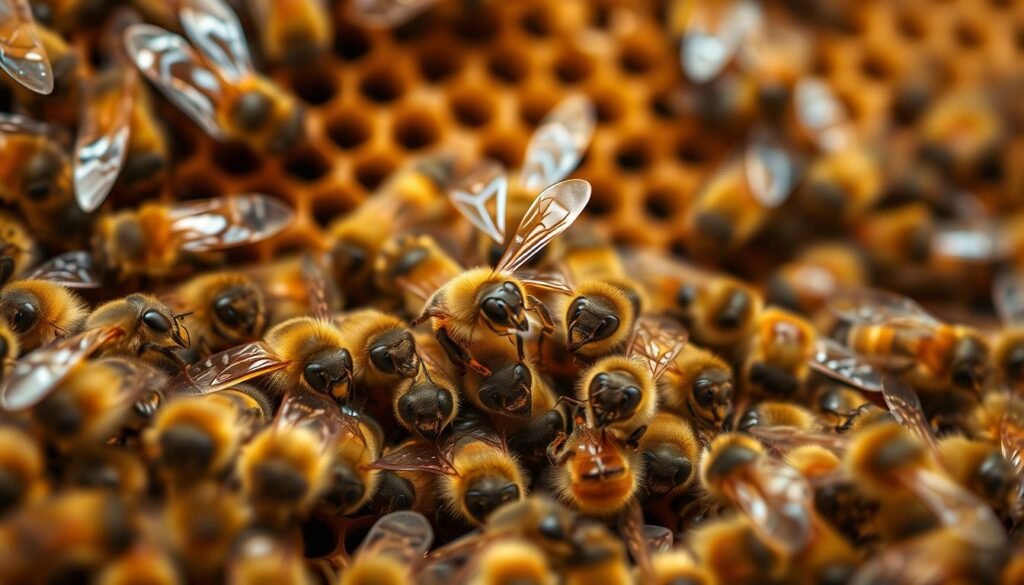
Antenna-based modulation by DA and 5-HT during in-hive communication
Antennal biogenic signaling acts as a gatekeeper. DA and 5-HT gene changes align with higher attention in crowded, noisy conditions. In contrast, central brain amine expression shows smaller differences between social and private information users.
Experience-dependent thresholds for using social versus self-acquired information
Field-experienced followers often discount spatial vectors and rely on learned odors from profitable sites. Network diffusion analysis finds recruits to novel feeders depend on dance-derived vectors, while reactivation of known sites relies more on olfactory memory (Kennedy et al. 2021; Grüter & Ratnieks 2011).
- Sucrose responsiveness, prior success, and internal state bias the threshold to follow social cues.
- Attention-like modulation prioritizes high-vigor dance signals for rapid colony recruitment.
- Heterogeneous follower roles support exploration versus exploitation across the colony.
| Level | Main Marker | Functional effect |
|---|---|---|
| Antennae | DA & 5-HT gene shifts | Increases sensory gain; gates social information |
| Central brain | Minor amine differences | Less distinguishing; integration hub |
| Behavioral | Sucrose response & experience | Biases use of dance vs odor memory |
Experimental test: manipulating antennal amine signaling should shift the balance between social and private information use and thus alter recruitment patterns at the colony level.
Encoding-to-decoding fidelity: harmonic radar evidence on recruits’ search precision
Linking comb-recorded vectors to airborne tracks gives a direct, experimenter-independent test of communication. Video at 50 Hz converted waggle run kinematics into sun-referenced vector endpoints. Researchers then compared those endpoints to harmonic radar tracks of recruits to measure real-world fidelity.
Nonlinear distance code, landscape-dependent search, and training effects
2D kernel density maps and concentric-ring analysis revealed a non-linear mapping between number of waggles per run and recruits’ search centroids. Short and long distances do not scale identically, so distance coding is range-dependent.
Search distributions shifted with landscape features such as hedgerows and paths, showing that recruits combine the floor vector with remembered terrain. Dancers trained on specific sites conveyed signatures that altered recruits’ distribution and success rates.
Averaging over multiple runs as a mechanism for high precision
Central finding: recruits searched more precisely than predicted by single-run endpoint spread. Modeling best fit suggested followers average about eight waggle runs to form a refined vector.
Vector flights often led to tortuous searches with sharp transitions defined by ≥60° turns. Cox proportional hazards and ring-based survival models quantified decay of search density from centroids and confirmed improved targeting.
- Methods: 50 Hz video → vector endpoints; harmonic radar → flight tracks; 2D kernels, ring densities, Cox PH for analysis.
- Implication: averaging reduces error downstream and refines information before flight.
- Proposed test: experimentally vary the number of followed runs and measure resulting search precision to causally test the averaging model.
| Metric | Method | Key result |
|---|---|---|
| Endpoint dispersion | 50 Hz video vectors | Predicts wide spread |
| Search precision | Harmonic radar tracks | Higher than predicted by endpoints |
| Run averaging | Model fit | ~8 runs to reach observed precision |
Landscape memory and cognitive mapping during recruited flights
Radar tracking shows recruited flights split into distinct behavioral legs: an initial straight vector, a tortuous search phase, and a fast homing return.
Vector flights, search transitions, and homing trajectories
Canonical segmentation emerges from radar data. Bees begin with a straight flight following the signaled bearing. They then enter a dense, tortuous search near the target area. After search or success, homing is rapid and direct.
Objective parsing uses sharp turns (≥60°) and fix-based trajectory breaks to mark phase transitions. These criteria give repeatable, quantitative labels for outbound, search, and return legs.
Approaching the source from varied bearings: implications for map-like representations
Displacement experiments show followers first adopt the danced direction, then deviate and converge on the feeder from varied bearings. This pattern implies recruits access stored location information beyond a single vector.
“Approaching a site from multiple angles suggests a map-like spatial memory that updates heading during search.”
Landmarks, elongated ground structures, and learned paths guide corrections during the search phase. Celestial compass cues and optic flow provide distance and orientation, while landscape familiarity steers fine-scale adjustments in the central complex.
| Phase | Radar marker | Behavioral signature |
|---|---|---|
| Vector | Straight line, low turns | Initial directed flight following waggle information |
| Search | Sharp turns, tortuous track | Local area exploration; landscape correction |
| Homing | Direct return path | Fast, straight flight back to hive |
Implication: Memory-guided correction helps reconcile noisy dance signals with high field precision. Prior exploration of the area likely boosts recruits’ ability to use map-like cues. Experimental shifts in landmark salience would test effects on approach bearings and search efficiency.
Tuned error versus inherent constraint: what explains dance variability?
Not all variation in the waggle output is adaptive; much reflects physical and environmental limits.
Dance environment, substrate effects, and daylight versus in-hive conditions
Two views compete: a “tuned error” hypothesis proposes that some spread in signals helps colonylevel search strategies. The alternative sees the spread as an outcome of biomechanical and sensory constraints.
Empirical work shows angular error falls with increasing distance, yet this pattern fits physiological limits better than strategic tuning. Daylight, direct sun view, and mesh combs reduce variability. Dances on empty comb draw more followers than those on brood or stores, indicating substrate matters (Preece & Beekman 2014).
Why followers average runs and ignore early/late circuits
Followers often discount the first and last circuits and average mid-run vectors. This behavioral rule removes transient noise and yields sharper direction and distance estimates in flight.
Combined with landscape memory, run averaging explains why recruits reach targets more precisely than single-run variance predicts (Wario et al. 2017).
“Recognizing environmental constraints prevents over-interpreting variability as an evolved error distribution.”
Practical note: standardized substrates and controlled lighting would help quantify intrinsic precision in honey bees. For observational context on dim versus bright floor signaling see dancing in the dark.
Gene expression and sensory plasticity: antennae as gatekeepers of social information
Gene expression in peripheral sensory tissue can shift which information sources a bee prioritizes on the dance floor. Antennal transcriptomes show strong, repeatable differences in biogenic amine pathways between individuals that use social vectors and those that rely on private search.
Differential biogenic amine signatures in followers
Dopamine (DA) and serotonin (5-HT) genes are elevated in antennae of social-information users. Central brain regions show far smaller changes, which focuses plasticity at the sensory periphery.
Amfor, sNPFR, and gustatory sensitivity
Amfor expression correlates negatively with dance activity under low reward, suggesting a genetic brake on recruiting. By contrast, sucrose responsiveness alone did not predict how intensely a bee will dance.
sNPF receptor expression rises with starvation, shifting antennal and central circuits toward higher appetitive readiness and greater likelihood to follow or advertise sources.
“Antennal plasticity functions as a molecular gate, biasing whether a follower will act on social cues or on private memory.”
- Antennal amine changes gate attention to dance signals.
- Peripheral plasticity explains behavioral heterogeneity among followers.
- Targeted manipulation of antennal pathways could shift colony foraging strategies.
| Marker | Location | Effect on behavior |
|---|---|---|
| Dopamine / 5-HT genes | Antennae | Increase sensitivity to social information |
| Amfor | Whole insect / antennae-linked | Lower expression → more dance under low reward |
| sNPFR | Antennae & central | Upregulated by starvation; boosts foraging readiness |
Developmental and experiential factors: learning, memory, and precision over time
Young bees that follow many floor signals develop sharper internal templates for mapping food sites. Early-life exposure to active dancers improves later competence in encoding and transmitting spatial vectors during foraging.
Early following and later transmission
Evidence shows that individuals who follow dances as hivemates later produce more precise signals. These bees encode distances and bearings with less scatter when they begin to advertise.
Time-specific training and gene dynamics
Training bees to forage at set times elevates immediate-early gene expression, such as Egr-1, across the mushroom bodies, antennal lobe, and optic lobes. This pattern marks active consolidation of time-memory and spatial associations.
Experience-dependent plasticity modifies olfactory and visual circuits. Odor–time pairing strengthens odor maps in the AL, while repeated flights refine optic flow calibration in visual pathways. Together, these changes improve the fidelity of waggle duration coding for distances.
| Factor | Change | Behavioral effect |
|---|---|---|
| Early following | Improved encoding templates | Higher later signal precision |
| Time-specific training | Egr-1 upregulation in MB, AL, OL | Consolidates time-memory and retrieval |
| Cumulative foraging | Optic flow & compass calibration | Better flight execution after recruitment |
These developmental effects shape both the production and use of social information. Trained individuals tend to persist in advertising profitable honey sites for more days. Over time, however, as bees accumulate landscape knowledge, the immediate effect of training wanes.
Research suggestion: track marked cohorts longitudinally to quantify how early exposure alters later dance vigor, recruiting success, and colony-level foraging efficiency. Identifying sensitive windows could help explain how experience sculpts communication in the hive.
Colony state and resource context: starvation, profitability, and recruitment dynamics
Hunger at the colony level triggers molecular cascades that raise foraging drive. Starvation elevates dopamine and sNPFR expression, which increases appetitive responsiveness and mobilizes workers to search for food.
Trophallaxis spreads both quantitative and qualitative cues about nectar and honey, tuning gustatory thresholds and memory. This social transfer biases which sources attract followers and influences recruitment decisions.
Octopamine links perceived profitability to the decision to advertise. Higher octopamine boosts the probability a forager will perform a vigorous dance and persist in recruiting others.
On crowded floors, higher-quality sources provoke more vigorous displays and draw more followers. Resource scarcity often shifts colonies toward exploratory recruitment to novel sites, increasing reliance on dance-derived vectors until known feeders regain profitability.
- Fluctuating nectar flows change the balance between exploration and exploitation.
- Antennae-level plasticity speeds how quickly colonies pivot recruitment under stress.
- Monitoring neuromodulatory markers could forecast shifts in recruitment strategy.
| Driver | Effect | Behavioral outcome |
|---|---|---|
| Starvation (DA, sNPF) | Higher appetitive sensitivity | Increased foraging activation |
| OA signaling | Profit-driven activation | More vigorous dance and followers |
| Trophallaxis | Food quality spread | Bias toward profitable sources |
Modeling suggestion: couple colony internal state, octopamine-driven dance probability, and antennal responsiveness to predict allocation of foragers across sources. Such models can help forecast how colonies respond when honey and food availability change.
Methods accelerating discovery: from SBEM connectomics to automated dance decoding
.
New imaging and tracking tools now let researchers connect cellular wiring to real-world foraging outcomes in honey colonies.
SBEM and 3D atlases are resolving interneuron paths that link antennal, gravity, and visual inputs. Serial block-face EM plus virtual atlases map candidate circuits for how in-hive cues become actionable information.
Field tracking and statistical pipelines
Harmonic radar provides 1–3 s fixes with ~0.5–0.75 nm range, enabling clear segmentation of vector, search, and homing legs. Video-derived polar vectors are converted to Euclidean endpoints to build encoding heatmaps.
2D kernel density and concentric-ring quantification compare encoding and decoding distributions. Cox proportional hazards models then analyze decay from high-density search centroids to test targeting success.
Automated vision and reproducibility
Dual-IR webcams plus CNNs detect ~90% of dances with ~3° mean directional error. Automated pipelines ignore first and last circuits to reduce noise and produce consistent parameter sets.
| Method | Key feature | Benefit |
|---|---|---|
| SBEM / 3D atlas | Interneuron maps | Pathway identification |
| Harmonic radar | 1–3 s fixes | Trajectory segmentation |
| Video → vectors | Polar→Euclidean | Encoding heatmaps |
- Calibration: sun-azimuth tools (e.g., Astropy) and controlled lighting improve cross-lab comparability.
- Open pipelines accelerate meta-analyses and reproducible model testing across sites and labs.
- Future work should pair synchronized electrophysiology in followers with radar-guided field validation.
Modeling frameworks for waggle dance information processing
Computational models can connect peripheral timing codes, reward signals, memory, and compass outputs to predict where recruits search and how colonies allocate foragers.
Integrative models linking sensory pathways, neuromodulation, and behavior
A useful framework couples AMMC timing and orientation coding with AL/SOG reward modulation, mushroom body memory, and central complex compass outputs. State variables for octopamine, dopamine, and sNPF gate sensory gain and decision thresholds in real time.
Include an averaging module that combines ~eight runs to reduce noise in direction and distances estimates before flight. Add a landscape memory term that biases search toward learned landmarks and preferred path corridors.
Open problems: AMMC-to-CX routing and circadian compensation of direction coding
Critical unknowns remain. The anatomical route from AMMC to the central complex is not identified, which limits mechanistic translation of a floor vector into steering commands.
Models must also implement circadian compensation for sun-referenced direction coding so predicted headings stay accurate across the day. Calibrate and test these frameworks using radar-derived ring-density decay and known non-linear distance mappings (Stone et al. 2017).
- Validate by varying the number of runs available to followers and measuring search precision in the field.
- Scale models to colony-level simulations that link internal state to recruitment across multiple advertised sites.
- Use the provided computational reference for implementation details in a compact computational model.
“Multi-scale models can bridge circuit motifs to emergent foraging patterns measurable with radar and automated decoding.”
| Component | Role | Data for Calibration |
|---|---|---|
| AMMC timing | Peripheral timing & orientation | Video vectors, run durations |
| Neuromodulators | Gate sensory gain | Pharmacology & antennal gene data |
| Landscape memory | Bias search paths | Radar tracks & landmark maps |
Conclusion
, This review shows how peripheral sensing, central integration, and motivated behavior combine to make colony-level recruitment reliable.
Key conclusion: recruits’ search precision often exceeds vector endpoint spread. Followers average multiple runs and use landscape memory to refine direction and improve foraging success.
Antennae act as gatekeepers: antennal DA and 5-HT shift attention and bias who uses social information. AL/SOG reward signals, MB associative and time-memory, and CX compass circuits together turn floor cues into flight plans.
Variation on the comb largely reflects physical and environmental constraints; behavioral rules (averaging, selective following) compensate. Advances like SBEM, harmonic radar, and automated decoding now let models tie sensors, neuromodulation, and behavior to colony outcomes.
Open targets include the AMMC-to-CX route and circadian compensation for direction coding. Pairing in-hive recordings with field tracking will test how neural dynamics predict real-world search and recruitment.
FAQ
What is the waggle dance and what information does it convey?
The waggle dance is a symbolic movement performed by forager honey bees to communicate a distant food source to nestmates. It encodes direction relative to the sun, distance through waggle-run duration, and resource quality via tempo and vigor. Followers decode this combination to guide their search flights.
How do bees encode distance and direction on the vertical comb?
Bees translate the sun‑referenced bearing into angle on the vertical comb and use the length and duration of the waggle run to signal distance. Polarization-sensitive eyes supply directional cues, while optic flow during flight helps calibrate distance estimates.
What sensory channels carry waggle dance signals inside the hive?
Multiple channels transmit dance information: airborne and substrate-borne vibrations, short air jets from wing strokes, electrostatic cues, chemical signals from trophallaxis, and direct body contact. These inputs let followers extract temporal and spatial features of the signal.
Which peripheral organs first detect waggle-related cues?
Antennae detect air and electrical signals and sample odors. Johnston’s organ in the antenna pedicel senses near-field vibrations and oscillation timing. Neck hairs and proprioceptors provide gravity and body-orientation data when the dancer moves on the vertical comb.
Which brain regions process dance information?
Early sensory centers such as the antennal lobes and subesophageal ganglion handle odor and gustatory inputs. Mushroom bodies support associative memory and time-linked learning. The optic lobes and central complex integrate visual direction cues and route vector information for spatial guidance.
How do neuromodulators affect dancers and followers?
Biogenic amines modulate motivation and perception. Octopamine raises foraging drive and dance probability. Dopamine shows phasic rises at dance initiation, influencing motivation. Short neuropeptide F (sNPF) links hunger state to appetitive responsiveness. In followers, dopamine and serotonin alter antennal sensitivity and attention to social cues.
Why do recruits sometimes search around the advertised location?
Recruits average variable runs and combine social vectors with personal experience and landscape cues. Noise in the distance code, nonlinear encoding of range, and environmental heterogeneity produce search distributions. Averaging multiple waggle runs improves precision but does not eliminate landscape‑dependent search spread.
What evidence supports how accurately recruits find advertised sites?
Harmonic radar and displacement studies show recruits often head near the indicated bearing and distance but then perform systematic searches. Precision improves with multiple runs and training. Tracking data and 2D density heatmaps quantify search patterns and reveal landscape effects on success.
How does colony state influence dance output and recruitment?
Colony needs, resource profitability, and starvation level strongly shape recruitment. Low resources increase dance rates and neuromodulatory signals promoting foraging. Conversely, abundant food reduces recruitment intensity and changes thresholds for social information use.
Do genetics and experience change how bees use dance information?
Yes. Gene expression in antennae and brain areas correlates with reliance on social versus private information. For example, variation in amfor and biogenic amine pathway genes links to sucrose responsiveness, foraging tendency, and whether a bee follows dances or prefers personal scouting.
How do developmental factors affect transmission fidelity?
Early-life experience with following dances improves later ability to decode and transmit spatial information. Time‑specific training and expression of immediate‑early genes support consolidation, so both maturation and practice refine accuracy and decision thresholds.
What methods accelerate discovery about dance communication?
Modern approaches include SBEM connectomics and 3D brain atlases to map circuits, harmonic radar to track flights, automated machine‑vision pipelines to decode dances, and survival and search modeling to quantify recruitment outcomes. Together they link neural circuits to behavior.
What are current open questions in dance information processing?
Key gaps include mapping AMMC outputs to the central complex, how circadian compensation maintains direction coding, the exact interplay of multimodal cues during decoding, and how neuromodulation gates attention versus private information use. Integrative models remain a priority.