This introduction sets expectations for a practical, step-by-step way to turn blank land into a working bee area. You will learn site selection, ground prep, hive orientation, fencing, water, first-season equipment, and core management that keeps bees productive and healthy.
Start with sensible spacing. A compact 9×9 ft yard with about two feet of clearance around each hive and roughly 27 1/4 inches between stands gives the beekeeper smooth access during checks. Orient entrances to the southeast so bees warm early for foraging and to support brood development.
Level stands using inexpensive pavers on rolling hills, leaving a slight forward tilt for runoff. Suppress vegetation with landscape fabric, damp newspaper or cardboard, and mulch to cut chemical use and ease inspections.
Safety and equipment matter. Plan electric fencing with a Parmak Deluxe Field Solar-Pak 6, 6-ft t-posts, plastic insulators, aluminum wire, gate handles, and grounding rods offset from paths. This keeps people and colonies safe while protecting honey yields and long-term colony health.
Key Takeaways
- Use a 9×9 ft working area with two-foot clearances for easy inspections.
- Point hive entrances southeast to help foraging and brood growth.
- Level stands with pavers and a slight forward tilt for water runoff.
- Suppress vegetation with fabric/newspaper/cardboard plus mulch.
- Plan fencing and equipment—Parmak solar chargers and proper grounding—so people avoid accidental contact.
- Prioritize varroa control, nutrition, and correct frame choices to support colony and honey production.
Understanding Your Goals and Bee Biology Before You Build
Before you set any hives, clarify what you want to achieve and learn basic bee roles. Your purpose—hobby honey, pollination, or education—shapes how much time you commit and the management schedule you follow.
Colony basics
Colony roles: queen, workers, drones, brood
The colony centers on one queen whose job is to lay fertilized eggs. Worker bees (all female) handle feeding, foraging, and hive maintenance.
Drones are males that mate in flight and usually leave or are expelled when nectar flow ends. Brood appears as eggs, larvae, and capped pupae; healthy brood shows a solid pattern across frames.
Expectations for new beekeepers
What a beginner should expect in time and management
Plan on opening hives every 1–2 weeks to check for eggs, larvae, and capped brood. Use an inspection sheet to record findings and track the number of frames covered with bees as an objective measure of strength.
- Stings: Regular stings occur; confirm you are not allergic and practice calm movements.
- Seasonal risks: During dearth, robbing rises—reduce entrances and consider feeding.
- Health checks: Early varroa awareness and routine monitoring prevent decline.
| Topic | What to watch | Action |
|---|---|---|
| Queen | Steady laying, spot of eggs | Confirm by weekly inspections |
| Brood | Solid pattern, capped cells | Replace poor frames, check for disease |
| Forage & stores | Honey and nectar levels | Add supers or feed during dearth |
| Varroa | Monitor counts | Treat before brood declines |
Choosing the Right Location on Your Property
Place hives where early sun greets entrances and prevailing winds are blocked by hedges or buildings. Morning light helps bees warm up and begin foraging. Afternoon shade can protect brood in hot, humid climates, but deep damp shade may invite small hive beetles.
Sun, shade, and wind
Orient entrances southeast so colonies catch sunrise warmth. Tilt stands slightly forward so water drains away from the entrance and landing board.
Distance from people and neighbors
Keep colonies away from high-traffic areas. Buffer hives from play zones and seating so flight paths stay above head height. Verify setbacks and HOA rules, and document neighbor lines to avoid disputes.
Avoid pesticide drift and bright lights
Position the site near flowers and a reliable water source, but out of reach of pesticide spray and bright night lighting. Use hedges or screens to raise flight paths and reduce interactions with people and pets.
- Set entrances southeast for early warmth.
- Balance sun and afternoon shade by region.
- Leave several feet of clear space in front of each entrance for inspections.
- Choose a site you can reach in all seasons and that supports heavy honey lifts.
For practical hive spacing and stand setup examples, see this bee yard setup reference.
Space Planning: How Much Room Does a Small Apiary Need?
Start by mapping where you will walk, lift, and stage tools before placing any stands or boxes. This lets you see how much space and room you truly need for safe work.
Working clearance between and around hives
Maintain roughly two feet of clear space in front, back, and on outer sides so you can lift supers and set down tools without brushing bees. Keep an open lane behind each hive so you never have to stand directly in the flight path during inspections.
Example footprints: single hive, two hives, and a 9×9 ft yard
For two hives, a compact 9×9 ft (81 sq ft) yard provides stable footing and wheelbarrow access while keeping inspections efficient. Between stands leave about 27 1/4 inches; that spacing lets you pull frames, pivot boxes, and kneel comfortably.
Tip: Level each stand with four pavers and tilt slightly forward for runoff. Reserve a small staging corner for lids and supers so parts stay clean and within reach during longer checks.
Ground Prep: Leveling, Drainage, and Vegetation Control
Start site prep by setting firm footing for each stand so you can check level and stability before adding boxes.
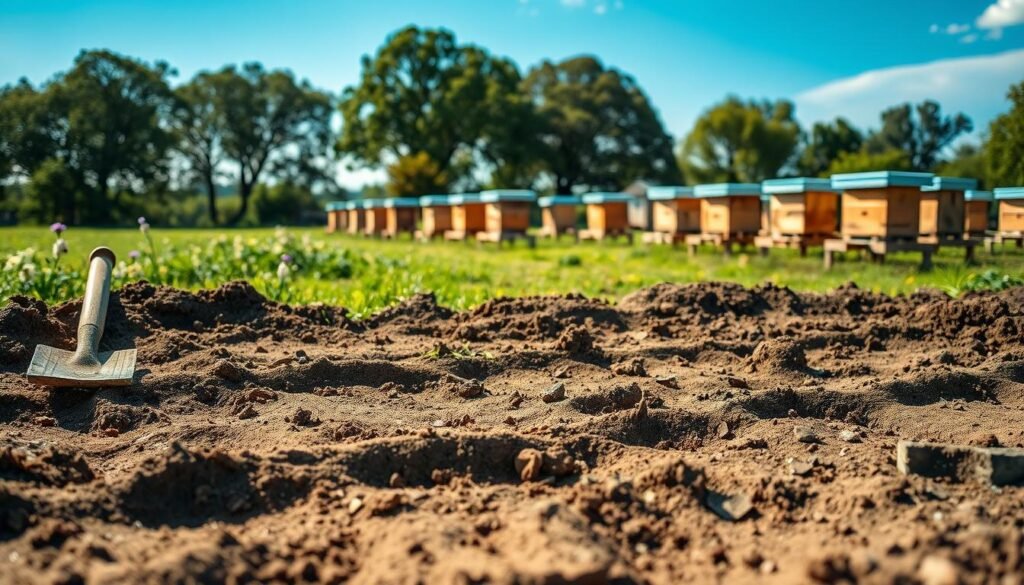
Use pavers under each stand to create a stable, level base on uneven terrain. Set the hive on the stand and fine-tune with shims until the entrance tilts slightly forward. That forward tilt sheds rainwater away from the entrance and landing board.
Make sure the surface will not turn slick when wet. Firm footing reduces slips while carrying boxes or frames and keeps your work area safe for both you and the bees.
Lay premium landscape fabric around stands to suppress weeds. Fill gaps beneath stands with damp newspaper or cardboard for full coverage, then add two to three inches of mulch to smother vegetation.
If the property slopes, install a single-course retaining edge to keep mulch from washing away during storms. Mulch also removes the need to use string trimmers near entrances, cutting flying debris that can harm bees.
- Keep enough room in front of the entrance so you can crouch without standing in the flight path.
- Choose rust-resistant stand hardware to keep wood off damp soil and prolong equipment life.
- Store extra pavers or gravel nearby to re-level a hive after heavy rain or freeze-thaw cycles.
Hive Orientation and Layout Patterns for Smooth Inspections
Good orientation makes inspections faster and lowers stress for both beekeeper and bees. Face each hive entrance southeast so foragers warm early and return on sunny mornings.
Stagger hives so entrances do not line up. This prevents drift and keeps foragers from crowding one landing zone. In hot regions, allow afternoon shade but avoid deep shade that invites pests.
Standardize stand heights so boxes align evenly. A consistent work height helps you lift frames safely and reduces back strain during longer checks.
- Work from the back or side to stay out of flight paths and lower defensive behavior during the day.
- Use light, timed smoke at the top bars and entrance before the first frame lift; pause if bees face you and add a gentle puff.
- Stage lids and supers in a clean parking zone to keep parts organized and protect brood and honey.
Build habits: open stacks the same way each time. Plan paths so two hives can be open without collisions, and keep an empty box nearby to set frames temporarily.
For notes on early colony care and practical checks, see first-year care for your nuc.
Step-by-step site marking, spacing, and staging
Place temporary markers for each stand, then practice the motions of lifting and setting down a box before permanent stands go in. Mark a 9×9 ft square if room allows, then measure stand centers to reach roughly 27 1/4 inches between two hives for comfortable working.
Make sure you keep at least two feet of clearance around fronts and outer edges so you can pivot with supers and step out of flight paths. Stage essentials—pavers for level stands, extra frames, a smoker, a spare nuc or box—so transfers follow the same way each inspection day.
Set stands on pavers, confirm a slight forward tilt toward each entrance, and align fronts to the southeast for early takeoff. Verify access paths allow a straight route in and out with full supers; count the number of steps and plan a cart if the route is long.
- Place lids and covers in a clean staging zone to avoid dirt on brood or honey frames.
- Offset any electric fence so you won’t back into it while working; test gate flow before trusting it.
- Do a dry run: open both hives and move between them to check that you can set down boxes without blocking your path.
Document the layout and number stand positions so you can replicate the same efficient pattern if colonies expand. This saves time, reduces errors, and keeps inspections predictable for both you and the bees.
Safety and Deterrence: Electric Fence Planning
A secure, well-grounded electric perimeter protects hives and keeps bears from learning your honey is an easy meal.
Charger, posts, insulators, and wire: Choose a solar-powered charger sized for small yards, such as the Parmak Deluxe Field Solar-Pak 6 (6V). Mount it to a 6-foot t-post on a board so it stays visible and stable. Use plastic t-post clips, 2-inch extender insulators, and 15-gauge aluminum wire to keep lines tidy and taut.
Grounding rods and placement for consistent voltage
Drive three 6-foot grounding rods into damp soil, spaced about 10 feet apart. Connect them to the charger’s ground with insulated steel wire. Improper grounding reduces effectiveness and can make the fence a weak deterrent against bears.
Gate handles and offsets so you won’t back into the fence
Fit plastic or rubber gate handles with conductive cores so you can open access without dropping voltage. Offset the fence from stand lines far enough that you can step back from a hive during inspections.
- Place the charger where sunlight is unobstructed and you can read the indicator.
- Trim vegetation under the fence so grass does not bleed off voltage.
- Install the fence before bears find hives; once they learn the reward, damage rises.
| Item | Recommendation | Why it matters |
|---|---|---|
| Charger | Parmak Deluxe Field Solar-Pak 6 (6V) | Solar power sustains voltage with low maintenance |
| Posts & insulators | 6-ft t-posts, plastic clips, 2-inch extender insulators | Secure lines and keep tension around corners |
| Grounding | Three 6-ft rods, 10 ft apart, insulated connectors | Consistent shock output deters bears and protects bees |
| Gate handles | Plastic/rubber with conductive core | Safe access without losing fence voltage |
For more on installing a practical bear deterrent, see the bear deterrent fence reference.
Water Source Strategy: Keeping Bees Out of Pools
Provide a dependable drinking spot near your hives to keep bees from using neighbor pools and pet bowls.
Place the water close but off main walkways. A nearby water source intercepts returning foragers before they find neighbors’ pools. Position stations so bees do not fly over seating areas or paths used by people.

Use shallow basins with stones, corks, or textured surfaces so bees can land and drink without drowning. Some beekeepers report attraction to lightly chlorinated or very diluted bleach water, which may train bees to prefer your station.
Maintain stations often. Refill before they run dry, refresh to prevent algae, and stabilize containers against wind or animals. In hot spells or dearth periods, check daily so foragers keep the habit and your honey yields do not suffer.
| Feature | Recommendation | Why it matters |
|---|---|---|
| Placement | Near the apiary, away from neighbor pools | Reduces nuisance complaints and conflict |
| Design | Shallow basin + landing stones | Prevents drownings and eases access for bees |
| Maintenance | Refill & refresh frequently; winterize | Keeps water reliable during peak demand |
| Stations | Multiple small sources | Ensures availability across the property |
Track flight lines and adjust stations if bees cluster where they bother neighbors. For further reading on resources and books that help new keepers, see this beekeeping resources.
Equipment Essentials for the First Season
Equip each colony with reliable hardware before the first nectar flow to avoid rushed purchases on inspection day.
Start with a standard Langstroth kit per hive. Two deep brood boxes with 16–20 deep frames give room for brood and stores. Choose 8-frame boxes for lighter lifts or 10-frame boxes to reduce the number of boxes you handle.
Prepare core parts for every colony: bottom board, entrance reducer, mouse guard, inner cover, telescoping outer cover, and a feeder matched to your climate. Paint and assemble woodware ahead of time, then let it air out.
- Carry a veil or jacket and sting-resistant gloves.
- Keep a smoker and fuel you can light and sustain.
- Have 1–3 hive tools and a spare box ready for pulled frames.
Track brood and frame counts at each inspection so equipment additions follow colony growth, not the calendar. Keep a simple day checklist: smoker lit, fuel on hand, tool and gloves ready.
| Item | Recommendation | Purpose |
|---|---|---|
| Brood boxes | 2 deep per hive | Space for brood and early stores |
| Frames | 16–20 deep; 16–20 medium/shallow | Support brood and honey supers |
| Protective gear | Veil/jacket, gloves | Safe inspections for beekeeper |
| Accessories | Entrance reducer, mouse guard, feeder | Control traffic and protect colonies |
Selecting Bees: Nuc vs Package and Apiary Startup Count
Deciding whether to start with a nuc or a package shapes your first season and the pace of colony growth. Choose stock adapted to your region and plan pickup so you can be present the day they arrive.
Advantages of a nucleus for beginners
What a nuc offers: four to five frames with a laying queen, brood, and food. That means faster build-up and fewer early losses.
When a package makes sense and how to install
Packages contain a caged queen plus workers in a screened box. They cost less but take longer to form steady brood patterns.
- Pick up locally; do not accept shipped bees to reduce mortality.
- Ask for a marked queen to find her during inspections.
- Start with two or three colonies so you can equalize resources if one has a problem.
| Option | Speed | Cost | Starter tip |
|---|---|---|---|
| Nuc | Fast (frames with brood) | Higher | Transfer frames in same order; center brood |
| Package | Slower (queen release time) | Lower | Install queen cage correctly; minimize disturbance |
| Startup count | Moderate | Varies | Begin with 2–3 colonies for comparison |
Track brood, temperament, and forager traffic so the beekeeper can spot early issues and plan equipment needs. Expect limited honey in year one while colonies establish strength.
Setting Up Langstroth Hives: Box Sizes and Frame Choices
Choose consistent box and frame sizes so transfers and inspections remain predictable across your yard. Standardizing saves time and helps when you need to move brood or honey between colonies.
Start with two deep brood boxes to give the queen ample laying room and keep the brood nest organized before adding honey supers. Above those, use medium or shallow boxes for honey depending on how much you can lift.
8-frame vs 10-frame: 8-frame boxes are lighter and easier to handle. They may require more boxes. 10-frame boxes hold more honey per box but are heavier to lift.
- Keep size choices uniform across all hives to simplify swaps and repairs.
- Assemble frames so foundation is straight and secure to encourage proper comb build-out.
- Add space only when most frames are worked and covered with bees—this times super additions correctly.
- Maintain spare frames and supers so you can act quickly during a strong flow.
Practice returning boxes in the same order to keep brood centered and honey arcs intact. For seasonal timing and box changes, consult seasonal beekeeping tasks for a practical checklist.
Core Management Fundamentals Inside a Small Yard
Make routine inspections the backbone of yard work. A steady habit helps you time feeding, add boxes, and catch pests early.
Manage space by adding boxes when most frames are covered with bees. This keeps the brood nest open and lowers swarm pressure.
Managing space, nectar timing, and feeding decisions
Time super and feeder additions to local nectar flows so colonies expand when forage is abundant. Feed in early spring, during fall build, or whenever weight checks show stores low.
Protecting entrances, robbing, and skunks
Reduce the entrance during dearth so fewer guards can defend the colony. Elevate stands to deter skunks and fit mouse guards in cool months.
- Keep food off the open air—no spilled syrup or exposed honey near hives.
- Equalize frames of brood or food between colonies when one lags.
- Track brood patterns and hive weight by hand to guide quick decisions.
As a beekeeper, keep visits predictable and brief. Document each check so your management improves every season and your bees stay productive and calm.
Varroa and Mite Management: Non-Negotiables for Healthy Colonies
Consistent mite counts let you treat on time and protect brood before patterns break. Establish a monitoring cadence using alcohol washes or sugar shakes starting by late June and repeat through the season. Record each test: date, method, sample size, and mites per 300 bees.
Act before decline. When counts reach local thresholds, choose safe, effective treatments that suit brood presence and ambient temperatures. Combine chemical and non-chemical options when appropriate to slow resistance.
Practical checks and preventive steps
- Build a fixed schedule for testing and stick to it.
- Plan treatment windows so honey supers remain uncontaminated.
- Boost nutrition during and after treatment to help the colony recover.
- Share timing and findings with nearby keepers to reduce reinfestation.
| Check | When | Action |
|---|---|---|
| Alcohol wash/sugar shake | Every 2–6 weeks from late June | Quantify mites per 300 bees; log result |
| Treatment selection | At threshold or rising trend | Choose product for brood/no-brood and temp |
| Nutrition | Before & after treatment | Feed pollen substitute or fondant as needed |
Record keeping, timely action, and neighbor coordination protect your bees and the surrounding beekeeping community. For broader yard growth and coordination tips, see beekeeping expansion tips.
Seasonal Flow in the United States: Layout Tweaks and Task Timing
Each season alters sun angles and forage availability, so tweak stand placement and tasks accordingly. Morning sun and afternoon shade remain important year-round for healthy brood and steady foraging.
Early spring, summer dearth, and fall prep
Early spring: Add space slowly as brood expands and feed during cold snaps to help colonies build until nectar becomes regular. Watch honey stores and heft boxes by hand to check weight.
Summer dearth: Reduce entrances to reduce robbing, move or add water stations, and note forager traffic day to day. This is the time for late-summer varroa checks so mites do not spike while winter bees are formed.
Fall: Align treatment windows and feeding so each colony enters winter with adequate stores and strong brood for long-lived bees.
Winter access and checks
Keep safe access to the apiary, clear snow from entrances, and verify ventilation without disturbing the cluster. Use short, purposeful inspections when weather allows and follow a seasonal checklist to save time.
- Reassess windbreaks and shade screens as sun angles change.
- Track honey and feed when hefts show low reserves.
- Plan inspection days around warm windows to reduce stress on bees.
For starter resources on timing and early-season tasks, see how to start beekeeping.
Neighbor Relations, Legal Considerations, and Good Apiary Etiquette
Confirm local rules and discuss plans with nearby residents before you place any hives on your property. Check city ordinances and HOA rules for setbacks, limits on colonies, and required permits.
Talk early and often. Tell neighbors where water will sit and how you will screen flight paths. This prevents surprises over pools, pet bowls, or play areas.
Place visual screens or shrubs that lift bee flight above foot traffic. Orient entrances away from sidewalks and playgrounds while still aiming for morning sun.
- Mark electric fence lines and offset them so you don’t back into live wire when moving boxes.
- Keep the perimeter clean of spilled honey and wax to avoid robbing and wasp complaints.
- Post small signs that note caution and who to contact, keeping tone informative, not alarming.
| Action | Why it matters | Practical tip |
|---|---|---|
| Research ordinances | Avoid fines or required removals | Call local ag office or zoning |
| Communicate with neighbors | Build trust and reduce complaints | Share water plans and inspection days |
| Screen and redirect flight paths | Keep people comfortable in shared areas | Plant tall hedges or install lattice |
| Fence placement & marking | Prevents accidental contact | Offset gates, label electrified lines |
Conclusion
Wrap up your work by focusing on repeatable habits that protect colonies and simplify inspections. strong.
Consistency matters. Monitor varroa on a schedule, feed when forage is thin, and keep brood areas centered in each hive. These steps protect the colony and promote steady honey yields.
Keep stands level, face entrances southeast, and leave about two feet of clear space so checks stay fast and safe. A compact 9×9 ft yard with measured spacing makes lifting and staging easier across times of heavy work.
Standardize equipment and notes so any beekeeper can step in when needed. Refine water placement and screens to keep bees focused on forage, not pools or paths.
Use this guide as your checklist and make small improvements each season. Over time, steady habits produce calm hives, healthier colonies, and better honey harvests.
FAQ
What should I know about bee colony structure before placing hives?
A healthy colony has one queen, thousands of worker bees, and seasonal drones. Workers handle foraging, brood care, and hive maintenance. Brood (eggs, larvae, pupae) requires stable temperature and space. Understanding these roles helps you schedule inspections, manage space, and recognize when a colony needs a new queen or extra boxes.
How much time will a beginner beekeeper need for basic management?
Expect weekly or biweekly checks during spring and summer, and monthly in fall and winter. Inspections take 10–30 minutes per hive depending on tasks. Early season requires more time for swarm prevention, feeding, and adding supers. Plan your calendar around nectar flows and local bloom timing.
How do I choose the best location on my property for hives?
Pick a spot with morning sun and afternoon shade, protected from strong winds. Orient entrances to the southeast when possible. Keep hives away from high-traffic areas, playgrounds, and property lines. Ensure the site avoids pesticide drift and bright night lights.
How much space do I need around and between hives?
Leave at least 3–4 feet between hive rows for easy lifting and inspections, and 2–3 feet on the sides for airflow. For a single hive, a 4×4 foot footprint is fine; two hives need a bit more room. A small yard layout of about 9×9 feet can host multiple hives if you keep clear working lanes.
What ground prep helps keep hives dry and level?
Use pavers or stands to level hives on rolling terrain. Tilt the hive slightly forward or use a small spacer under the back to promote rain runoff from the entrance. Landscape fabric with mulch prevents weed growth and keeps the area tidy without obstructing hive access.
How should I orient and pattern hives for smooth inspections?
Arrange hives in a single row or back-to-back with entrances offset to reduce drifting. Align hive stands so frames lift straight out. Leave a clear working path in front of entrances and position heavier boxes closer to you to minimize awkward lifting during inspections.
What are the first steps when setting up an apiary site?
Mark your site, measure distances between stands, and stage tools and equipment nearby. Set stands at consistent heights, face entrances as planned, and verify access for vehicles and wheelbarrows. Confirm you have nearby water and a shaded area for hot days.
Do I need an electric fence and when is it necessary?
Use an electric fence where bears or persistent predators exist. Choose a proper charger, sturdy posts, insulators, and multiple high wires. Grounding rods and correct placement keep voltage consistent. Include gate handles and offsets to avoid accidentally backing into the fence.
How can I keep bees from using my pool as a water source?
Provide a dedicated water source near the apiary with floating materials like corks, rocks, or sponge to give bees landing sites. Refresh water regularly and add simple attractants like a small pinch of salt or a drop of molasses during hot, dry periods.
What equipment essentials do I need for the first season?
Start with complete hive bodies, frames with foundation, an inner cover and outer cover, feeders, entrance reducers, and mouse guards. Add protective gear, a smoker with fuel, hive tool, and a bee brush. Buy quality frames and at least one spare box for swarm control or honey storage.
Should I start with a nuc or a package of bees?
A nucleus (nuc) hive offers an established queen, brood, and drawn comb—making it easier for beginners. Packages are less expensive but require more work to build comb and accept a queen. Choose a nuc if you want faster buildup and simpler introduction into Langstroth equipment.
What box sizes and frame choices work best for Langstroth hives?
Use deep boxes for brood to give larvae space and insulation. Mediums or shallows work well for honey supers to reduce lifting weight. Decide between 8-frame and 10-frame: 8-frames are lighter and easier to manage; 10-frames hold more honey but weigh more when full.
How do I manage space and feeding during nectar dearths?
Monitor stores and add feeders or supers when frames look light. During dearths, reduce entrance size to limit robbing and provide supplemental sugar or fondant. Time feedings to avoid encouraging pests and remove feeders when natural forage returns.
What are the basics of varroa mite monitoring and treatment?
Perform regular alcohol wash or sugar shake checks to estimate mite levels. Treat when counts exceed recommended thresholds for your region. Use integrated pest management: mechanical methods, screened bottom boards, timely chemical treatments, and brood breaks when appropriate.
How should my layout and tasks change with the seasons?
In early spring focus on build-up and swarm control. Summer needs honey management and mite monitoring. In fall, prepare for winter by ensuring adequate stores and insulation. Clear snow from entrances and check food in winter during warm spells.
What legal and neighbor considerations should I address?
Check local ordinances for setbacks, registration, and hive limits. Communicate with neighbors about flight paths and safety steps. Use signage, visual screening, and place hives so bees fly upward away from walkways. Good communication prevents complaints and builds community support.
How can I protect entrances from robbing and skunks?
Use entrance reducers during weak nectar flows to limit access. Install hardware cloth or small ramps to deter skunks from reaching entrances at night. Keep strong colonies and timely feeding to reduce the incentive for robbing behavior.
How often should I check for queen health and brood pattern?
Inspect for queen presence and a solid brood pattern every 3–6 weeks during active seasons. Look for consistent, centralized brood with minimal spotty areas. Replace or requeen if brood patterns are poor or the queen is missing or failing.
What should I consider when placing hives near property lines or public paths?
Maintain recommended setbacks and orient flight paths upward and away from neighbors. Add screens or plant hedges to guide bee traffic and reduce direct crossings of walkways. Keep hives accessible for maintenance without crossing busy areas.