This introduction explains how continuous beehive sound becomes useful data. It shows how sensors and analysis turn noise into clear signals that guide timely management actions in precision beekeeping.
A recent open-access PLOS ONE study used AudioMoth recorders and Hidden Markov Models to detect pesticide stress and to tell individual colonies apart. That work shows improved results when models are tailored to each colony, revealing stable acoustic “fingerprints.”
Readers will learn about standardized audio capture, annotation, feature extraction, and machine learning pipelines that move research into the field. The methods emphasize reproducible practices that scale from experiments to on-farm use.
The goal is practical: give U.S. beekeepers reliable, non-invasive tools to spot stress, automate alerts, and target interventions early. This section sets the stage for background, data collection, signal processing, models, evaluation, and system implementation.
Key Takeaways
- Acoustic approaches can reveal pesticide stress and colony identity under field-like conditions.
- Standardized audio capture and annotation are essential for reproducible results.
- Hive-specific models often outperform general models in accuracy.
- Machine learning extracts structure from complex soundscapes to enable early action.
- These methods support non-invasive, continuous sensing in precision beekeeping.
Abstract and Research Aim: Bioacoustic monitoring for hive diagnostics
This study tested whether recorded colony sounds could signal short-term pesticide impact and also serve as unique colony identifiers. The aim was to evaluate whether acoustic data can detect chlorpyrifos-induced changes and support continuous, non-invasive monitoring hive strategies that reduce disturbance and speed response.
Study focus and methods
Researchers placed AudioMoth recorders in eight Tetragonisca fiebrigi nests, labeling baseline audio and samples 30 minutes to 2.5 hours after exposure. Hidden Markov Models were trained on labeled segments using MATLABHTK and run through recognition routines to classify exposure and identity.
Combined-hive results were modest (accuracy 0.6757; specificity 0.8420; precision 0.7632; recall 0.5093; F1 0.6109). When models were tuned per colony, F1 scores exceeded 0.83, which supports the idea of stable acoustic fingerprints and the value of personalized baselines.
Practical implications: the 30 min–2.5 h detection window offers a short operational window for timely alerts. Sensitivity and specificity trade-offs will shape thresholds and escalation rules in deployed systems. This reproducible approach, reported in a plos one study, positions machine learning as an actionable tool to track colony health status and guide precision management.
Background: Pollinator decline, colony losses, and the rise of precision beekeeping
Increasing winter and summer colony losses have made data-driven care essential. Pollinator declines stem from habitat loss, pathogens, climate shifts, and rising pesticide exposure. These pressures raise urgency for resilient, low-impact approaches that reduce mortality and speed intervention.
Non-invasive monitoring to mitigate stressors and support hive management
Precision beekeeping combines sensors, analytics, and alerts to protect honeybee colonies at scale. Continuous, non-invasive sampling reduces inspection stress and builds baseline behavior profiles.
When sound data are paired with weight, temperature, and humidity, managers gain a multimodal view that detects disease, queen events, and environmental impacts early. Early indicators let beekeepers act before declines become irreversible.
| Goal | Benefit | Scale |
|---|---|---|
| Reduce colony losses | Timely interventions | Apiary to regional |
| Continuous baselines | Detect deviations fast | Per-hive models |
| Low-power devices | Lower cost, wider access | Commercial & hobby |
This research helps bridge the gap between periodic checks and real-time dynamics. Better tools improve outcomes for bee colonies and support sustainable beekeeping across seasons.
Bioacoustics of social insects: communication, acoustic patterns, and vibroacoustic signals
Social insects use a layered soundscape to coordinate work and flag sudden threats. Wings, body motion, and thoracic muscle contractions create vibroacoustic cues that travel through comb and air. These cues act as a sensitive proxy for internal colony state.
From swarm activity to sentinel behavior
Core acoustic patterns include ventilation hums, brood-care clicks, recruitment buzzes, and heating pulses. Each pattern shifts with workload, nectar flow, or stress. Short disturbances, like water or pesticide sprays, often trigger retreat and then a return to normal in roughly six minutes.
Linking sound to behavior and status
Guard bees change tempo and intensity when entrances are threatened. These brief changes appear as spikes and bursts in recordings and help identify alarm and defense responses.
- Communication social insects rely on sound, touch, and scent to share information fast.
- Acoustic signals mix individual and group sources, so robust feature extraction is essential.
- High temporal resolution is needed to capture sub-second events tied to pre-swarming or queenless shifts.
Combining time-of-day and environmental context with acoustic markers improves inference of colony states. This foundation leads into feature engineering that maps sound into labels usable by classification models.
Honey bees versus stingless bees: species context for acoustic monitoring
Most acoustic research has focused on the European honey bee, yet tropical stingless bees show different sound patterns that require separate study. Apis mellifera work informs sensor placement, feature design, and alert timing.
Stingless bee colonies use distinct nest architecture and flight behavior. These differences change background noise, temporal rhythms, and responses to stress. Many stingless species also show higher sensitivity to pesticides than honey bee colonies do.
Practically, that means models must be species-aware. Transferable features include queenright cues and swarm-related tempos, but thresholds and feature weights need adjustment per species and apiary style.
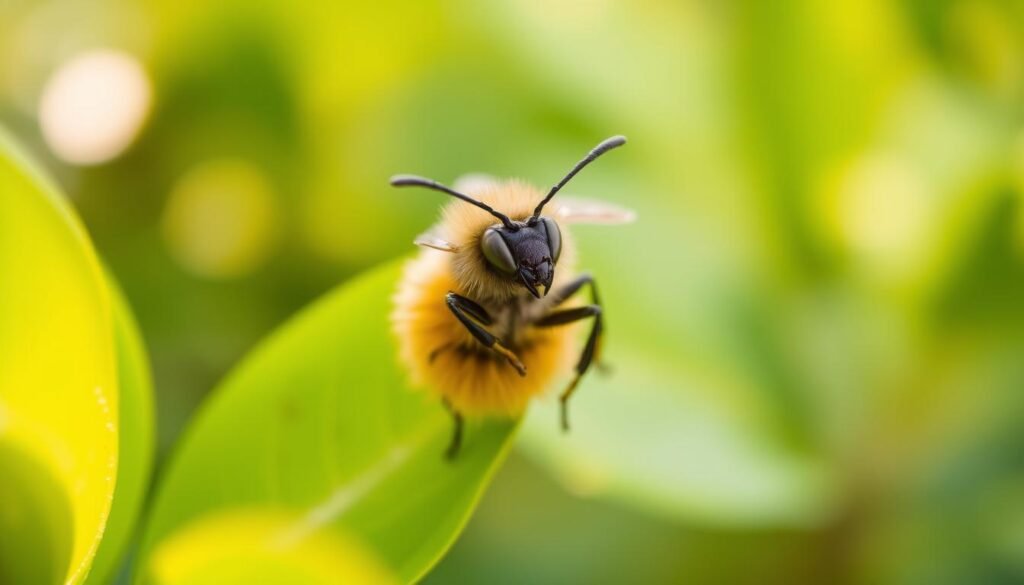
Growing meliponiculture in the Americas increases the need for tailored diagnostics. Research priorities include multi-species datasets, cross-region sampling, and protocols that reflect local regulations and exposure risks. Honey bee evidence remains a solid foundation, yet robust tools demand calibration to local bee species and management practices.
Data acquisition: beehive acoustics, audio samples, and environmental conditions
High-quality, repeatable audio capture starts with microphone placement and a consistent sampling schedule. In this study, AudioMoth devices recorded at 48 kHz with medium gain. Recorders captured thirty-second clips every minute from 12:30 PM to 5:30 PM to create dense, midday beehive audio samples that reduce diurnal variability.
In-hive placement and timing
Microphones were installed adjacent to brood frames to maximize signal-to-noise and protect devices from debris. Clips of 30 seconds balance storage and battery life while preserving transient events tied to bee activity.
Device clocks were synchronized across eight colonies to support controlled comparisons. Consistent gain and a simple calibration tone before deployment maintained comparability between audio samples over days.
Beekeeping in real-world conditions
Semi-contained tunnel setups localized spray exposure yet allowed ambient environmental conditions to influence recordings. Pre-recording criteria required presence of a queen and healthy brood, honey, and pollen stores to ensure comparable baselines.
- Secure recorders and mount to reduce vibration artifacts.
- Log metadata: location, time, temperature, and weather at each clip.
- Plan sessions in stable weather and midday windows to limit confounding bee activity shifts.
Careful protocol and consistent metadata improve data integrity and make downstream labeling and model training more reliable.
Signal processing foundations: from Mel spectra and MFCCs to HHT
Perceptual spectral representations help map beehive sound into behavior-linked descriptors. Mel spectra and MFCCs capture spectral envelopes that align with how humans and many classifiers perceive energy across frequency bands.
Why Mel and MFCC? They compress spectral shape and reduce sensitivity to pitch shifts. That makes them robust for activity acoustic classification when background noise or recorder gain varies.
Extracting activity acoustic features for robust classification
Short bee pulses need transforms that respect sub-second detail. The Hilbert-Huang Transform (HHT) decomposes signals adaptively and highlights transient components that Fourier methods can miss.
Windowing choices matter. Small windows preserve bursts but raise variance. Longer windows smooth events but can smear transients. Use overlapping frames and multi-scale analysis to balance this trade-off.
- Key features: spectral centroid, band energies, modulation rates, harmonicity metrics.
- Preprocessing: denoising, normalization, segment-level aggregation to stabilize acoustic data.
- Robustness: device calibration and augmentation support cross-device generalization.
| Step | Purpose | Typical Params | Outcome |
|---|---|---|---|
| Mel/MFCC | Capture perceptual spectral envelope | 23–40 mel bands, 25 ms frames | Low-dim spectral descriptors |
| HHT / EMD | Reveal non-stationary transients | Adaptive IMFs, instantaneous freq | Transient feature tracks |
| Temporal features | Track modulation and burst rates | 10–100 Hz modulation bands | Behavioral correlates |
| Calibration & Augment | Improve generalization | Gain scaling, noise injection | Robust models across sites |
Align features with label granularity: frame-level cues suit sequence models, while clip-level aggregates work with HMMs or simpler classifiers.
Validate feature sets against known events (queen status, swarm cues) to confirm biological relevance and improve classifier trust. For implementation guidance and model choices, see related work on deep models for embedded recognition at deep learning for embedded acoustic recognition.
Machine learning models for beehive monitoring: HMMs, deep neural networks, and beyond
Temporal patterns in colony sound maps naturally onto sequence models that capture behavioral state changes. Hidden Markov Models (HMMs) explicitly model state transitions and suit situations where behavior follows ordered stages.
Hidden Markov Models with MATLABHTK
HMMs treat acoustic frames as emissions from latent states, helping to detect shifts in colony activity over time. In practice, labeled .wav segments train per-state models with train HTK, and recognise HTK assigns states to new clips.
This MATLABHTK workflow is reproducible and lightweight. It runs on modest hardware but needs careful label curation and state definition. Per-hive HMMs often outperform pooled models because they reduce inter-colony variability and tighten baselines.
When to consider deep neural networks and hybrid models
Consider deep neural networks when datasets grow and relationships become non-linear. CNNs and RNNs learn robust embeddings from raw spectra and support multi-label or hierarchical inferences, such as swarming and queen-status cues.
Hybrid pipelines combine CNN feature extractors with HMM sequence decoding to get the best of both worlds: strong representation and explicit temporal structure.
- Constraints: data volume, compute budgets, and interpretability shape model choice.
- Automatic recognition: edge or cloud inference can enable near real-time alerts when latency and power budgets are managed.
- Maintenance: recalibration, drift detection, and transfer learning keep models accurate across seasons.
| Model Type | Strength | Typical Use | Compute |
|---|---|---|---|
| HMM (per-hive) | Interpretable, low data needs | State sequencing, small datasets | Low |
| CNN / DNN | Powerful feature learning | Complex patterns, multi-label | High |
| Hybrid (CNN + HMM) | Temporal + rich embeddings | Robust recognition with sequence constraints | Medium |
| Edge lightweight DNN | On-device inference | Real-time alerts, constrained power | Low–Medium |
Benchmark consistently: use standardized splits, report precision, recall, specificity, and F1, and run ablation studies. Match model choices to practical goals: reliable alerts, low false alarms, and easy integration into beekeeper workflows.
Experimental design in context: remote beehive monitoring and pesticide exposure
Field trials placed eight colonies inside semi-open tunnels to recreate spray drift while keeping recordings controlled. This setup supports remote beehive monitoring validations that reflect agricultural application patterns without uncontrolled background noise.
Chlorpyrifos exposure protocol and water-spray controls
Colonies had two undisturbed days before treatments. Operators applied water from 1 m as a mechanical control, then sprayed three colonies with a dose tied to LC50 and kept three as water controls.
Sprays used a pressure sprayer: 13 pump strokes, an 18-second pass at 60 cm height. Using a commercial formulation and consistent spray distance preserved safety and realism.
Capturing acoustic data under real-world conditions
Recorders were synchronized before, during, and after exposure to isolate causal effects. Teams logged temperature, wind, and other environmental conditions to reduce confounds.
Observers noted guard bees retreating after spray and activity returning about six minutes later. These brief behaviors create transient acoustic shifts that must be captured in immediate post-exposure windows.
- Use tunnel setups to mimic real-world conditions while limiting variability.
- Replicate across days and hives to support statistical strength.
- Document protocol steps so field teams can reproduce results across regions.
Annotation and labeling strategy: classifying beehive audio by exposure and identity
A robust labeling scheme pairs every audio sample with time-aligned state files and metadata to avoid confusion. classifying beehive audio requires labels that encode both exposure status (0 = baseline, 1 = exposure) and colony ID (1–8).
Store labels as paired .txt files beside each .wav clip. Include start/end times, event markers, and a clear stamp for treatments. This keeps beehive audio and metadata synchronized for reliable training.
Decision rules matter. Use a per-file majority vote where the state with most frame-time defines the clip label. For finer detail, apply frame-level voting or sliding-window consensus to reduce masking of brief events.
Design colony states with clear boundaries to limit label noise. Separate exposure detection datasets from identity datasets to avoid leakage and to preserve clean evaluation splits.
- Quality control: inter-annotator checks, audit logs, and waveform spot checks.
- Aggregation: sum recognized-state time, tune thresholds to balance precision and recall.
- Scalability: add tags for queen events or swarm precursors without changing core schema.
Adopt simple toolchains that support batch labeling, validation, and export. Good tooling speeds verification and strengthens downstream automatic recognition and operational use.
Evaluation metrics and analysis: precision, recall, specificity, and F1
Clear, actionable metrics let teams turn classifier outputs into real-world alerts that beekeepers trust. Metrics map model outputs to practical risk decisions and help balance false alarms against missed detections.
Core metrics and operational meaning
Precision reduces false alarms so beekeepers do not waste time on spurious alerts.
Recall ensures true exposures are detected and not overlooked.
Specificity measures baseline stability and guards against triggering on normal activity.
F1 summarizes balanced performance when precision and recall trade off.
Handling class imbalance with resampling
Class imbalance was corrected by random baseline downsampling to match exposure counts. The procedure ran 1,000 repeats and reported mean metrics to stabilize estimates.
This repeated resampling produces fair comparisons and reduces variance from single splits. It also yields empirical distributions useful for confidence intervals.
Interpreting results and deployment advice
The combined dataset showed high specificity (0.8420) and precision (0.7632) but modest recall (0.5093) and F1 (0.6109). That pattern signals a conservative detector that avoids false positives but misses many true events.
Per-hive models improved recall and F1, demonstrating better sensitivity in activity acoustic classification when colony-specific baselines are used.
- Report uncertainty: publish confidence intervals and empirical percentiles from the 1,000 repeats so operators see expected variability.
- Tune thresholds: use cost-sensitive learning or threshold calibration to reflect beekeeper risk tolerance.
- Stratify evaluation: test across hives, times of day, and weather to find edge cases before field rollout.
Maintain reproducible pipelines, version datasets, and include out-of-sample seasons and locations during validation. Doing so lets automatic recognition integrate into a monitoring system with predictable alert behavior and clear escalation rules for operational use.
Results: acoustic monitoring detects pesticide exposure and hive “fingerprints”
Across colonies, audio patterns shifted predictably after spray events, but tuning models per colony markedly improved detection.
All-hives combined performance showed modest overall accuracy (0.6757) with strong specificity (0.8420) and precision (0.7632). Recall lagged (0.5093), producing an F1 of 0.6109. These numbers indicate few false exposure alerts but a meaningful rate of missed events at the population-model level.
All-hives combined versus hive-specific performance
Per-hive models delivered much higher sensitivity and reliability. F1 scores exceeded 0.83 in per-hive experiments, with some recalls reaching 0.9780. This supports the idea that each colony carries an identifiable acoustic fingerprint that classifiers can exploit for both exposure detection and identity assignment.
Implications of higher specificity and variable recall
Higher specificity reduces false alarms and increases operator trust in beehive monitoring alerts. Yet low recall on pooled models means some exposures go undetected without per-colony tuning.
- Per-colony fingerprints likely arise from structural, behavioral, and micro-environmental differences that shape the soundscape.
- Robust colony identity classification enables asset tracking and routing of models by hive during deployment.
- Variable recall argues for personalized baselines, adaptive modeling, and threshold calibration during onboarding.
- Confidence-weighted alerts and aggregating evidence across clips can stabilize detection at the all-hives level.
These results, reported in plos one, extend acoustic change findings beyond Apis to the stingless bee context and broaden the applicability of acoustic monitoring as a diagnostic signal. Public data and code availability on Zenodo support replication and individualized calibration workflows.
Discussion: hive-level variability, acoustic identity, and model generalization
Hive construction, brood layout, and forager age structure create lasting differences in colony sound that affect classifier decisions.
These physical and social factors shape acoustic patterns and make pooled models brittle. Rapid shifts in colony states—from calm to alarm—add temporal complexity that a single global model may miss.
Practical machine learning approaches include domain adaptation, few-shot personalization, and hierarchical multi-task models that share information across sites while preserving per-colony nuances.
Onboarding should use short baseline recordings to calibrate a new unit quickly. Continual learning updates models as seasons, management, or queen events alter identities.
| Strategy | Benefit | Maintenance Cost |
|---|---|---|
| Per-colony models | High sensitivity, tailored alerts | High (retraining, storage) |
| Global model + domain adapt | Broader coverage, faster deploy | Medium (fine-tuning) |
| Ensemble (hybrid) | Balanced sensitivity and coverage | Medium–High (orchestration) |
Scale requires balancing personalization against upkeep in a robust monitoring system. Diversity among stingless bee species calls for cross-species datasets and temporally separated test sets to avoid optimistic generalization.
Open benchmarks and shared data will speed progress and let teams compare ensemble and personalization strategies under realistic field conditions.
From lab to field: integrating IoT and a beehive monitoring system for remote diagnostics
Simple device fleets and standardized data flows let beekeepers turn raw sound into operational signals. An end-to-end architecture pairs edge microphones, on-device preprocessing, a local gateway, and cloud services that run automatic recognition and store labeled clips.
Edge-first processing reduces bandwidth and preserves privacy. Devices compress and chunk audio, attach timestamped metadata, and encrypt uploads. Gateways batch data, perform health checks, and forward packets to cloud storage where models score events.
Operational features
- Device management: remote firmware updates, clock sync, and status pings to keep multi-site fleets healthy.
- Data strategy: lossless snippets for training, lossy compressed streams for long-term archiving, and standardized tags to support a monitoring system catalog.
- Streaming analytics: rule engines and dashboards issue near real-time alerts for abnormal activity, enabling remote beehive monitoring at scale.
Design must include encrypted transport, role-based access, and audit logs to meet agricultural data norms. Internet things platforms enable cross-site aggregation, offline buffering for intermittent links, and continuous learning loops that retrain models as new events are labeled.
Cost guidance: small operations can use smartphone gateways and low-cost recorders, while commercial deploys benefit from managed cloud inference and SLAs that lower long-term total cost of ownership. Interoperability with weight, temperature, and VOC sensors enriches decision intelligence and improves alert precision.
Practical implications for beekeepers: precision beekeeping workflows and alerts
Acoustic cues can act as an early warning layer that helps prioritize hive visits and conserve labor. Use models that map Mel, MFCC, and HHT features into simple, actionable alerts. Keep thresholds conservative at first, then tune per unit.
Swarm cues and queenright versus queenless signals
Swarm activity often shows rising modulation and persistent ventilation changes. Models flag a clip when burst rates and low-frequency energy exceed baseline by a set margin.
Queenright colonies present steady heating and brood-care tempos. Queenless signatures include lower rhythmicity and increased agitation bursts. Use these markers to decide requeening or resource shifts.
Actionable thresholds and workflow rules
Set initial thresholds that prioritize precision to avoid false alarms. Then personalize using two weeks of daytime clips and weekly reviews.
- Require 3 positive clips within 30 minutes before issuing a high-priority alert.
- Apply a 15–60 minute cooling-off window before auto-escalation.
- Record metadata and outcome after each physical inspection to refine thresholds.
| Alert Type | Trigger | Immediate Action |
|---|---|---|
| Swarm precursor | Elevated modulation > baseline + model score | Schedule inspection within 24 hours |
| Queenless signature | Loss of steady brood hum & agitation bursts | Inspect brood frame; consider requeening |
| Transient disturbance | Single clip spike, no persistence | Log event; monitor next 12 hours |
Integrate alerts into mobile notifications and dashboard summaries. Use service tickets for larger operations to track follow-ups. Train staff to pair acoustic alerts with visual checks and records.
Seasonal re-baselining and documented outcomes improve model calibration. Over time, this workflow reduces unnecessary openings and helps protect colony health status.
Limitations, ethics, and future research: scaling acoustic monitoring across bee species
Moving from small experimental sets to broad deployments reveals clear limits and ethical choices. Sample size, class balance, and limited site diversity reduce confidence in wide generalization across bee species.
Data constraints: Many studies, including work reported in plos one, use few colonies. That boosts per-unit performance but limits transferability. Researchers should test how increasing numbers of units changes metrics and error bounds.
Personalized models versus cross-colony transfer
Personalized baselines often outperform pooled models, yet they add operational overhead in multi-site deployments. Teams must weigh gains in sensitivity against costs of onboarding, retraining, and storage.
- Standardize protocols and open repositories to speed replication.
- Study transfer learning to adapt models to new honeybee hives and stingless bee species with minimal labeled data.
- Run controlled, seasonal experiments across landscapes to map environmental effects on acoustic variability.
| Trade | Benefit | Cost |
|---|---|---|
| Per-colony models | High accuracy | High upkeep |
| Global model | Easy deploy | Lower sensitivity |
| Hybrid | Balanced | Medium complexity |
Ethics and validation: Minimize disturbance during trials, handle chemicals safely, and practice responsible data stewardship with clear sharing agreements. Combine acoustic signals with pathogen screens and colony health markers to ground predictions in biology.
Finally, evaluate fairness across management styles and strengths, and build partnerships between academia, industry, and beekeeper groups. Rigorous peer review and transparent data sharing will scale evidence and practical tools.
Conclusion
Practical adoption hinges on turning short audio shifts into clear, timely actions that beekeepers can trust.
Using acoustic sensing gives a non-invasive lens into colony dynamics and pairs well with weight and temperature data. Evidence shows HMM-based analysis can detect pesticide impact and reveal stable acoustic signals that identify individual colonies; per-colony models boost recall and F1.
Machine learning converts raw acoustic signals into actionable alerts that support precision beekeeping. Start with standardized midday sampling, careful labeling, and pilot deployments that tune thresholds and dashboards.
Share baselines and open methods (see the PLOS ONE study) to speed cross-species calibration, continuous improvement, and scalable acoustic monitoring that protects pollinators at scale.
FAQ
What is the main goal of using acoustic approaches in hive diagnostics?
The main goal is to detect changes in colony health and behavior by analyzing beehive sound. This helps identify pesticide stress, disease indicators, swarm activity, and colony identity. The approach supports precision beekeeping by enabling early intervention and continuous remote hive surveillance using audio samples and automated classification.
How do acoustic signals reflect pesticide exposure or stress in a colony?
Pesticide exposure often alters flight activity, guard behavior, and vibrational patterns inside the hive. These changes appear as shifts in spectral content, call rates, and temporal structure of hive audio. Machine learning models trained on labeled samples can classify exposure states with measurable precision and recall.
Do honey bees and stingless bees produce different acoustic signatures?
Yes. Species differences affect frequency ranges, call shapes, and activity rhythms. Apis mellifera tends to show distinct flight and waggle-related sounds, while stingless bee species present different vibroacoustic patterns. Species context matters when building classifiers or deploying monitoring systems across diverse apiaries.
What equipment and placement are recommended for collecting reliable beehive audio?
Deploy compact recorders like AudioMoth inside or just above the brood box to capture in-hive acoustics while minimizing disturbance. Use standardized sampling windows (time of day and duration) to reduce diurnal variability. Protect devices from moisture and temperature extremes to ensure consistent data quality.
Which signal processing features work best for classifying hive activity?
Commonly used features include Mel spectra, MFCCs, and time–frequency transforms such as the Hilbert–Huang transform (HHT). These extract spectral and temporal patterns tied to activity acoustic features. Combining features can improve robustness across environmental conditions.
What machine learning models are effective for hive audio classification?
Hidden Markov Models (HMMs) suit temporal sequence modeling and have proven effective with toolkits like MATLAB HTK. Deep neural networks and hybrid models (CNNs, RNNs, or transformer-based architectures combined with HMMs) can deliver higher accuracy when trained with adequate labeled data and augmentation to handle real-world noise.
How do researchers handle class imbalance in colony-state datasets?
Common strategies include resampling (oversampling minority classes or undersampling majority classes), class-weighted loss functions, and synthetic sample generation. Evaluation should report precision, recall, specificity, and F1 to transparently capture performance across imbalanced labels.
Can acoustic analysis identify individual hive “fingerprints” or hive identity?
Yes. Acoustic signatures often carry hive-level variability tied to colony size, queen status, and nest architecture. Studies have shown classifiers can distinguish hive identity to some degree. However, generalization across sites requires careful model design and transfer learning approaches.
How do you design experiments to test pesticide exposure effects acoustically?
Use controlled exposure protocols (for example, chlorpyrifos versus water-spray controls), randomized hive assignments, and replicate sampling across days. Collect audio under real-world conditions and standardize logger placement and recording schedules to isolate treatment effects from environmental noise.
What annotation and labeling practices improve model training?
Label audio by exposure condition, hive identity, time window, and observable behaviors (swarming, foraging bursts, queenless cues). Use a consistent taxonomy and inter-annotator checks. Frame-level labels or short segments facilitate temporal models like HMMs and RNNs.
What performance metrics should be prioritized for operational systems?
Emphasize precision and specificity to reduce false alarms, while tracking recall to ensure true events are captured. F1 score balances precision and recall. In deployed systems, consider operating points that meet beekeepers’ tolerance for missed events versus false alerts.
How can IoT pipelines support continuous beehive audio surveillance?
Integrate edge recording devices with low-power connectivity to stream compressed audio or extracted features to cloud servers. Implement automated preprocessing, model inference, and alerting workflows. Secure and scalable IoT design helps deliver near real-time diagnostics and historical trend analysis.
What practical thresholds and alerts are useful for beekeepers?
Set actionable thresholds for sudden increases in specific activity bands, prolonged low activity indicating brood loss, or acoustic cues associated with swarming. Combine acoustic alerts with temperature or weight sensors to reduce false positives and guide timely hive inspections.
What are the main limitations and ethical considerations?
Limitations include environmental noise, device failures, and variability across species and hive designs. Ethically, ensure data privacy for apiary locations and avoid interventions that harm colonies. Future research should focus on scalable models, cross-colony transferability, and species-inclusive datasets.
How should beekeepers start deploying acoustic systems at scale?
Begin with a pilot across a few hives, use standardized recorders and sampling protocols, and collect labeled events during routine inspections. Iterate models locally before scaling. Pair acoustic data with management records to refine alert thresholds and integrate alerts into existing workflows.