This piece examines how warming trends are reshaping the seasonal supply of floral resources that sustain bees and other pollinators. It links floral biology to farm yields and wild ecosystems across the United States.
Why it matters: three-quarters of global crops rely on insect pollinators, a service worth hundreds of billions of dollars annually. Recent studies show shifts in bloom timing and lower sugar in nectar as temperatures rise.
This article offers a data-backed guide to mechanisms — temperature stress, extreme weather, and timing mismatches — and points to practical steps for farmers, beekeepers, and land managers. You will find U.S.-focused examples, from Maryland phenology records to urban heat island impacts, and clear actions to help stabilize pollination services.
Key Takeaways
- Pollination supports food systems: insect pollinators drive major crop value and biodiversity.
- Warming alters flowering dates and nectar sugar, changing foraging patterns for bees.
- Practical steps—water management, native plantings, habitat corridors—boost resilience.
- Data from recent studies and conferences guide on-the-ground strategies for growers and beekeepers.
- Local actions and policy can help sustain pollination services across U.S. landscapes.
What readers will learn today about nectar flows and climate-driven change
Quick guide: this section summarizes the core lessons you will gain about seasonal floral rewards and warming impacts on pollinators.
Learning objectives: understand what a nectar flow is, how rising temperatures and extreme events alter bloom timing and floral rewards, and why those shifts matter for bees and plants.
Recent meta-analyses and field data show pollen germination and viability fall sharply with heat, while nectar volume often drops during hot spells. Evidence also points to earlier bloom relative to pollinator emergence, creating timing mismatches.
- What nectar flow means for colony growth and crop visits.
- How temperatures and extremes change pollen and nectar quality.
- Which biological responses are strongest in current research and datasets.
This guide synthesizes peer-reviewed study results and observational data. Later sections link these findings to practical steps for farms, apiaries, and community planning.
| Feature | Nectar response | Pollen response | Implication |
|---|---|---|---|
| Volume/Viability | Often reduced | Strong decline | Lower rewards for foragers |
| Timing | Earlier bloom in many species | Reproductive stages more heat-sensitive | Risk of mismatch with bees |
| Evidence strength | Mixed field results | Consistent meta-analysis signal | Prioritize pollen monitoring |
| Management takeaway | Stagger plantings | Monitor flowering and pollen health | Plan adaptive actions |
For practical guidance and baseline monitoring tools, see the FAO pollinator guidance.
Defining nectar flow and why it matters for bees, crops, and ecosystems
Nectar availability shapes seasonal food webs and sets the rhythm for hive growth and farm yields. A clear period of accessible sugars and amino acids across a landscape defines the nectar flow that foragers use to build stores and feed larvae.
Nectar versus pollen: distinct rewards, shared vulnerabilities
Nectar supplies quick energy and some amino acids. Pollen supplies proteins and lipids needed for brood and long-term colony health.
Both rewards determine attraction to particular flowers and influence foraging choices. Temperature and moisture shifts can cut nectar volume and reduce pollen viability, a pattern shown in multiple studies.
How nectar flow timing drives colony growth and crop pollination
Timing is critical: nectar windows must align with brood rearing and crop bloom. Small shifts in bloom dates or reward amount can reduce pollination and lower seed or fruit set.
- Predictable flows support hive weight gain and honey harvests.
- Unpredictable windows force bees to travel farther, raising stress.
- Farmers and gardeners benefit from mixed plantings and adaptive calendars.
| Resource | Role | Sensitivity |
|---|---|---|
| Nectar | Energy, foraging attraction | Often lower with warming and drought |
| Pollen | Brood nutrition, reproduction | Viability drops sharply under heat |
| Phenology | Timing of bloom and emergence | Key driver of pollination success |
For practical planting ideas and seasonal planning, see this foraging for nectar guide.
41. how climate change affects nectar flows
Rising baseline temperatures are reshaping when and how much floral rewards are available across U.S. landscapes.
Rising temperatures: direct and indirect pressures on flowers and foragers
Elevated temperature stresses floral physiology. Studies show nectar volume falls in most species and sugar concentrations often drop under controlled warming.
Higher heat shortens peak bloom periods. That compresses the seasonal window when bees can find rich forage and raises the cost of foraging for colonies.
Extreme weather, drought, and heat stress shaping floral rewards
Warming also drives stronger evapotranspiration and drought risk. Prolonged hot, dry conditions reduce flower abundance and alter nectar chemistry.
Heatwaves and sudden freezes create boom‑and‑bust supply: tissues are damaged and pollen viability declines, cutting seed set and future floral returns.
- Direct effect: less secretion and lower sugar per bloom.
- Indirect effect: compressed bloom windows and altered foraging patterns for bees.
- Landscape risk: fewer flowers over longer stretches of dry, hot conditions.
- Context matters: responses vary by species, microclimate, and field vs. greenhouse studies.
Adaptive managers can plan staggered plantings and track local phenology. For regional guidance on planting and hive strategies, see resources on beekeeping in different climates.
Timing mismatches: when bloom and pollinators fall out of sync
Spring warming can shift bloom dates faster than pollinators adjust, creating mismatches that cut early-season forage.
Earlier bloom and shifting bee emergence in warming springs
Many plant species now open flowers sooner in the year as temperatures rise. Bees and other insects do not always shift on the same schedule. That mismatch shortens the window when both partners overlap.
Case insights: Maryland “greening up” earlier and alpine snowmelt cues
Twenty-two years of Maryland bloom logs and hive-weight records show “greening up” advancing by roughly half a day per year. By 2012, flowering came about a month earlier, a pattern reflected in beekeeper hive weights.
In alpine Japan, flowering tracks snowmelt at the surface while bee emergence follows soil warming. When snow melts early but soils remain cool, overlap falls and visits drop.
Risks at season edges: early/late foraging gaps
- Edges of the season—early spring and late fall—offer few alternate floral options.
- Specialist species can be hit hardest: the southeastern blueberry bee has advanced emergence by 44 days over 100 years, risking poor synchronization with short host blooms.
- Missed early sugar reduces brood rearing and weakens foragers before peak season.
Local monitoring matters. Simple tools—bloom logs and hive-weight charts—reveal emerging gaps. Because year-to-year variability is high, region-specific, adaptive calendars and ongoing observation are the best defenses against reduced pollination services and potential early-season yield losses.
Nectar quantity and quality under heat and drought
Rising warmth and dry spells change both how much floral reward appears and what it contains.
Evidence on volume declines: A broad meta-analysis found nectar volume fell in 84% of comparisons under increased temperature. That loss constrains what foragers bring back and raises search costs for bees.
Variable sugar responses: Sugar concentration depends on the setting. In greenhouse trials, soluble sugar often declines. In field conditions, concentration sometimes rises because foragers remove dilute nectar and microclimate concentrates sugars.
Drought-stressed buckwheat: fewer visits, lower seed set
A focused study of drought-stressed buckwheat recorded 42% less nectar and a shift to lower sucrose-to-hexose ratios. Pollinator visits fell by nearly half and seed mass declined.
“Short nectar windows and altered chemistry compress colony nutrition and force longer foraging trips.”
- Heatwaves shorten secretion windows and can cause midday dropouts.
- Species vary; diversity buffers landscape risk.
- Manage water and microclimate to support output at field scale.
- Measure both volume and concentration for true soluble-solids estimates.
Practical note: plant drought-tolerant nectar sources and align phenology tracking with weather forecasts to anticipate dearths and plan supplements.
Pollen under pressure: the often-overlooked driver of reduced pollination
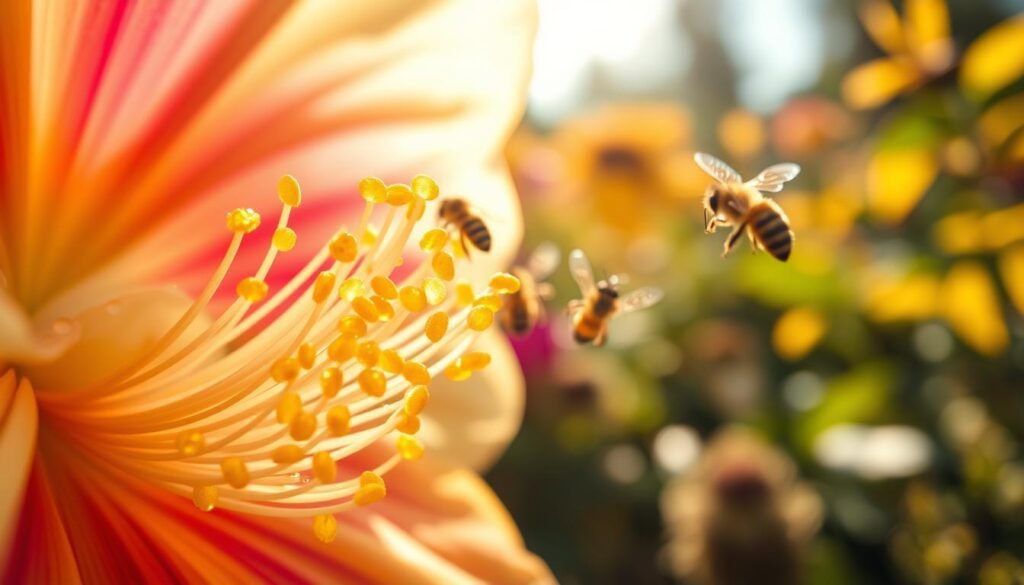
Pollen is the literal link between flower and fruit. When pollen fails, fertilization drops and yields fall.
High sensitivity of pollen viability and germination
Brief exposures to heat can cut pollen germination and viability dramatically. A quantitative synthesis reports Hedges’ g = -2.19 for germination and g = -2.41 for viability under warming.
Declines intensify with larger temperature increases and fall sharply beyond about +8°C. These functional losses show up even when flowers look normal.
Crop vulnerability during reproductive phases
Many modern crop varieties prioritize yield over heat tolerance. That breeding focus leaves reproductive stages fragile.
Across multiple studies, impaired pollen links to lower seed set and reduced fruit set—direct hits to farm production and plant health.
- Monitor bloom temperatures and use shade or irrigation to blunt heat spikes.
- Time irrigation and field operations to protect flowers during peak pollen release.
- Select varieties with better reproductive heat tolerance where available.
| Issue | Observed effect | Practical response |
|---|---|---|
| Pollen germination | Hedges’ g = -2.19 (large decline) | Monitor temperatures; protect bloom with shade |
| Pollen viability | Hedges’ g = -2.41; drops beyond +8°C | Adjust irrigation timing; use heat-tolerant varieties |
| Crop set & production | Reduced seed/fruit set across species | Pair nectar support with pollen protection |
For a detailed synthesis of pollen vulnerability and management options, see the pollen vulnerability review.
Species on the edge: heat tolerance and range shifts in bees
Thermal limits set hard boundaries on where different species persist, and rapid warming tightens that range.
Thermal limits and the “climate vise”
Many pollinator species live near their physiological edges. When local temperatures rise fast, some populations cannot move or adapt. This creates a “climate vise” that squeezes southern populations into shrinking refuges.
Regional cases and real-time tests
Bombus vosnesenskii shows this clearly: southern groups vanish rather than simply shift north because they tolerate cold poorly. Field work ties CT max/CT min values to observed abundance patterns.
Urban heat islands as living labs
In Raleigh, NC, total bee abundance fell by 41% per 1°C increase. Species with lower thermal limits saw the steepest decline.
- Chronic heat reduces activity, foraging range, and reproductive health.
- Communities may shift toward heat-tolerant insects, altering pollination networks.
| Factor | Observed effect | Management response |
|---|---|---|
| Thermal limits | Range contraction for heat-sensitive species | Create cool microhabitats and corridors |
| Urban warming | Rapid abundance decline (Raleigh example) | Implement green roofs, tree canopy, water features |
| Community shift | More heat-tolerant pollinators dominate | Monitor species and tailor plantings |
Takeaway: monitor local species, protect elevation and connectivity, and add shaded, diverse forage to support bee health and slow community-level shifts.
From flowers to food: implications for U.S. crops and food security
Brief overview: Shifts in flower timing and reward quality can translate directly into smaller harvests for farms that depend on insect pollination.
Scale of the stake: Three-quarters of global crops rely on insect pollinators, a service valued at up to US$577 billion annually. Reduced overlap between bloom and pollinator activity raises measurable production losses in fruits, nuts, and specialty plants.
Pollinator-dependent crops at risk
Fruit trees (apples, blueberries, pumpkins), many nut orchards, and specialty imports tied to coffee and cocoa analogs face yield drops when pollination and pollen viability fall.
- Early or late bloom shifts reduce fruit set in tree crops and berries.
- Pollen failures cut fertilization even when flowers appear normal.
- Yield variability raises costs for growers and can shrink annual returns.
Economic stakes and community vulnerability
Regions that rely on high-value, pollinator-dependent crops face direct economic risk. Price shocks and supply gaps can ripple through local markets and food availability.
Practical responses: diversify plantings, add habitat around fields, and use risk mapping that includes pollination dependence in farm planning.
“Protecting pollinators and plant resources is a practical pathway to safeguard food outputs.”
For deeper synthesis of pollination impacts and management options, see this pollination review.
How-To: Planning resilient nectar calendars for farms and apiaries
Early planning can turn seasonal gaps into steady forage by sequencing bloom across the year.
Start with local observation. Use simple bloom logs and note when key plants flower. Then build a planting map that spreads reward time for bees and other pollinator species.
Stagger plantings to extend forage seasons
Sequence early, mid, and late bloomers so there is little empty time for foragers. Aim for a 10–12 month calendar that overlaps species by a few weeks.
- Place early bloomers in warm, sunny spots to promote earlier flowering.
- Reserve cooler microclimates for late-season plants to stretch the end of the forage window.
- Use farm-edge strips and flowering fallows to anchor supplies during dearths.
Select heat- and drought-tolerant, pollinator-friendly species
Prioritize native plants and cultivars with proven performance under regional temperature and drought stress.
- Mix shrubs, trees, and forbs to provide varied nectar traits and soluble solids.
- Include cover crops and flowering fallows to add mid-season resources.
- Favor species that keep producing under dry spells to buffer shortfalls.
Track regional phenology and update bloom maps
Match plant choices to observed local trends; shift selections earlier where spring advances.
- Keep annual logs and join regional networks to refine timing.
- Coordinate with neighbors to scale calendars across the landscape.
- Align plantings with colony buildup needs so bees get early forage for growth.
Practical tip: review your calendar each fall. Small adjustments year to year prevent gaps and protect yields.
How-To: Managing heat, water, and habitats to stabilize nectar flows
Practical steps can reduce summer stress on floral strips and keep forage available for pollinators. Focus on three linked actions: retain moisture, cool microclimates, and build habitat connectivity so insects can reach reliable food and nesting sites.
Water and microclimate
Install drip lines or micro‑sprinklers and mulch planting strips to hold soil moisture and support steady secretion during hot spells.
Add shade frames, windbreaks, and layered canopy to lower ground temperatures near sensitive plants. These measures help maintain sugar output when temperatures climb.
Nesting resources and corridors
Create bare‑ground patches, stem bundles, and bee hotels to support diverse nesting needs. Link those patches with native plant corridors to allow movement between cooler refuges and bloom zones.
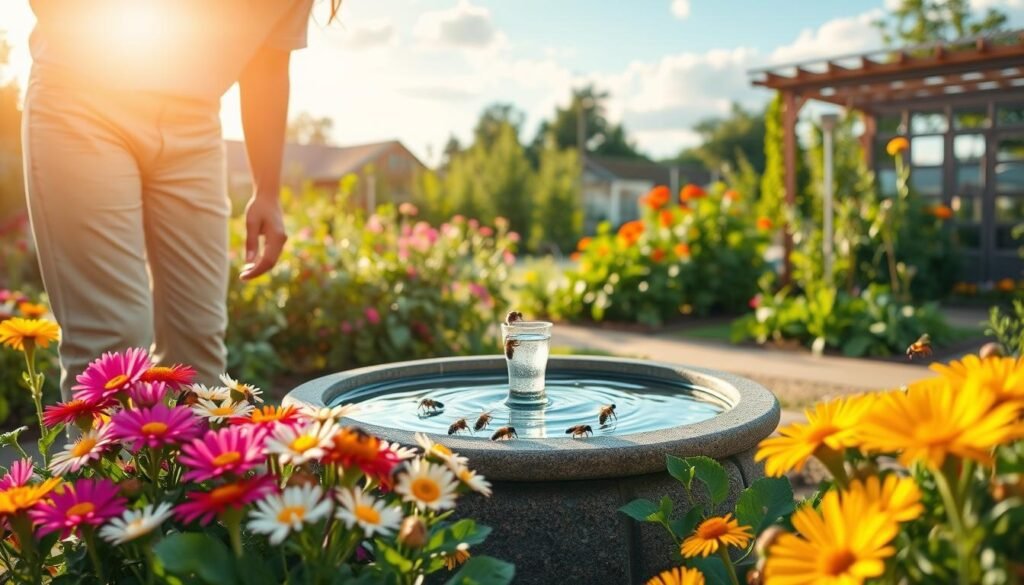
Place moisture pools or shallow basins with landing stones near plantings to help bees hydrate and thermoregulate during heat events.
Reduce pesticide risks
Avoid neonicotinoids and cut overall pesticide use. Apply products only when needed and outside bloom periods to protect foraging insects.
Adopt integrated pest management (IPM) to keep plant health while minimizing chemical exposure for pollinators.
| Action | Why it matters | Simple steps | Expected benefit |
|---|---|---|---|
| Drip irrigation & mulch | Maintains soil moisture; supports secretion | Install micro‑drip; apply 5–8 cm mulch | Higher nectar volume during hot periods |
| Shade and canopy layering | Lowers peak temperatures at flowering | Use tree rows, shade cloth, windbreaks | Extended bloom windows and stable sugar levels |
| Habitat corridors & nesting | Supports species movement and reproduction | Create native strips; add nesting blocks | Greater pollinator diversity and resilience |
| Pesticide reduction & IPM | Reduces chronic insect exposure | Use monitoring, targeted controls outside bloom | Improved pollinator health and visitation |
How-To for beekeepers: mitigating climate stress on colonies
Routine checks and simple site fixes give beekeepers early warning and protection against extreme conditions. Combining shade, ventilation, and weight monitoring helps maintain brood and supports steady honey production.
Shade, ventilation, and water provisioning during heatwaves
Place hives in afternoon shade or use shade cloth to lower direct sun exposure. Light-colored equipment and elevated stands reduce heat absorption.
Ventilate with upper entrances or screened bottoms to let hot air escape. Provide continuous water with floats or stones and refresh often during heat events.
Note: queens and drones are vulnerable—queens exposed to 42°C for four hours showed 56% lower sperm viability; extreme temperature also raises drone mortality. Avoid moving colonies or requeening during such cases.
Monitoring hive weights to anticipate nectar dearths
Use hive scales or routine weight checks to read near real‑time data on inflow. Maryland weight curves have tracked bloom advances and reveal short, intense flows.
- Adjust supering by weight trends to prevent congestion during rapid fills.
- Stage supplemental feeding when weight plateaus or falls to bridge dearths.
- Reduce inspections in hot hours and record weight, bloom, and weather to refine local timing plans.
“Weight tracking and simple shade measures are among the most cost-effective tools to protect colony health and honey yields.”
Data-driven decisions: using research and on-farm monitoring
Linking simple field records to published work helps translate patterns into action. Combine hive-scale and phenology measurements with localized weather to spot shifts early and prioritize responses.
Hive weight curves, bloom logs, and local weather data
Track three streams of information: continuous hive weight, a short bloom log, and nearby station readings.
Maryland offers a clear example: 22 years of hive weights and bloom records matched satellite and model outputs and showed earlier seasonal rewards. Use that kind of paired monitoring to detect year-to-year drift.
Interpreting mixed nectar findings and strong pollen warnings
A meta-analysis of 28 publications found large declines in pollen germination and viability. At the same time, nectar responses vary between greenhouse and field studies. Treat nectar results cautiously and treat pollen losses as higher priority.
- Combine weight curves with bloom logs to map timing and detect shifts.
- Integrate weather station and on-site sensors to link temperature trends and outcomes.
- Document on-farm cases and use regional studies as a benchmark, then refine with site-specific monitoring.
Practical note: source research summaries from extension services and repositories to keep interventions timely and evidence-based.
Policy and community actions that safeguard nectar flows
Coordinated action across towns, farms, and utilities creates the landscape connectivity pollinators need as temperatures rise.
Native plant initiatives, urban greening, and bee-friendly ordinances
Promote native plant programs in parks, streetscapes, and schoolyards to provide continuous forage and shade. Native plants support local pollinators and cool neighborhoods, reducing warming stress and local risk to insects.
Adopt bee-friendly ordinances that expand flowering habitat on public property and limit pesticide use during bloom. Encourage reduced neonicotinoid use and timed applications to protect foragers.
Climate refuges and ecological corridors for pollinator movement
Plan green corridors and refuges to let species move between cooler sites and resource patches. Conservation models warn of steep declines in some species without linked habitat, so corridors are a practical defense.
- Coordinate road verge and utility plantings to extend habitat across jurisdictions.
- Incentivize on-farm conservation strips and water management that stabilize floral resources.
- Integrate pollinator goals into municipal adaptation plans to reduce risk to food systems.
Support and scale: fund pollinator research, extension, and community science so local managers use the best sources and adapt plant lists by region.
“Policy that connects habitat and people makes resilient forage possible.”
Track outcomes with standardized monitoring and adjust policies when data show improvements in pollinator activity and habitat quality. Small, sustained public investments yield measurable benefits to the world of plants and the insects that pollinate them.
Conclusion
Data from hives, phenology logs, and experiments converge on one message: warming multiplies stress on flowers and the insects that service them.
Key takeaways: rising temperatures alter timing, cut reward quantity and quality, and create cascading effects for bees, pollinator communities, and crop production.
Protecting pollen during bloom is critical because heat sharply reduces germination and viability. Practical steps include resilient nectar calendars, staged plantings, water and shade measures, nesting habitat, and reduced pesticide use.
Monitor with hive weights, bloom logs, and local temperature records to guide actions year to year. Diversify plant lists and scale corridors so different species and populations can persist.
Collaborate across farms, towns, and agencies to apply research and local examples. Together we can sustain flowers, pollinators, honey, and food supplies under warming weather patterns.
FAQ
What is a nectar flow and why does it matter for bees and crops?
Nectar flow refers to the timing, quantity, and quality of floral nectar available to pollinators. It drives colony growth, supports foraging bees, and determines pollination service for crops. Reliable nectar supplies mean healthier pollinators and steadier crop yields.
How do rising temperatures alter nectar production and foraging behavior?
Higher temperatures can reduce floral longevity, change nectar secretion rates, and alter sugar concentration. Bees may forage at different times of day or reduce activity during heat, which lowers visitation rates and can reduce pollination efficiency.
In what ways do drought and extreme weather affect nectar quantity and sugar content?
Drought and heat stress often reduce nectar volume and can either concentrate or dilute sugars depending on the species. Prolonged dry spells commonly cut floral rewards and discourage visits, harming both wild pollinators and managed hives.
Can timing mismatches between bloom and bee emergence harm pollination?
Yes. When plants flower earlier or later than historical norms and pollinators do not adjust their life cycles, pollination gaps appear. Those mismatches reduce seed set and crop yields and strain pollinator nutrition at season edges.
Are pollen resources affected the same way as nectar?
No. Pollen is often more heat-sensitive: viability and germination decline with high temperatures. Even when nectar persists, poor pollen quality can limit plant reproduction and reduce food for brood, compounding pollination losses.
Which crops in the United States are most vulnerable to disrupted nectar flows?
Pollinator-dependent crops like almonds, apples, blueberries, and certain vegetables face high risk. These crops rely on peak pollinator activity and adequate floral rewards during narrow bloom windows, making them sensitive to phenological shifts.
How do species differ in heat tolerance and range shifts related to warming?
Some bees tolerate higher temperatures and can expand ranges, while others—especially cold-adapted bumblebees—face a “climate vise” that shrinks suitable habitat. Urban heat islands can highlight these dynamics and sometimes favor warm-adapted species.
What on-farm practices help stabilize nectar availability through heat and drought?
Staggered plantings, adding heat- and drought-tolerant pollinator plants, mulching, and targeted irrigation near floral strips help extend nectar seasons. Creating microclimate refuges and preserving nesting sites also supports resilient pollinator populations.
How can beekeepers mitigate colony stress during nectar dearths and heatwaves?
Provide shade, improve hive ventilation, supply accessible water, and monitor hive weights to detect incoming dearths. Strategic feeding and relocating hives to richer foraging areas can ease short-term losses.
What monitoring tools and data support better nectar management?
Hive weight curves, bloom logs, and local weather records reveal nectar patterns. Combining field observations with published research helps interpret mixed results—such as variable sugar concentrations—and guide adaptive planting and management.
Which policy and community actions help protect floral resources and pollinators?
Programs that fund native-plant restorations, urban greening, pollinator corridors, and farmer incentives for diversified plantings reduce risk. Local ordinances that limit harmful pesticides and promote green infrastructure also strengthen nectar supplies.
Are there documented case studies showing earlier springs or shifted bloom cues?
Yes. Long-term records in several regions show earlier green-up and faster snowmelt in alpine zones, shifting flowering dates. These changes offer real examples of phenological mismatch that affect foragers and crop pollination.
What research gaps remain about warming effects on nectar and pollination?
We need more long-term, species-specific studies of nectar volume and sugar dynamics under combined stressors, clearer links between pollen quality and crop yield, and expanded monitoring across varied landscapes to inform local adaptation.