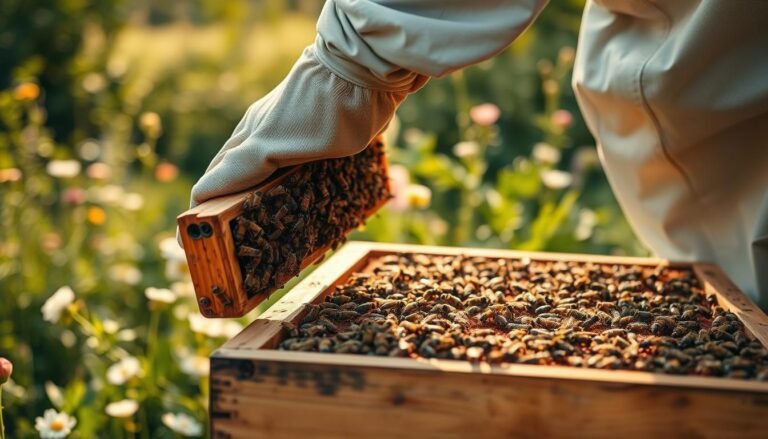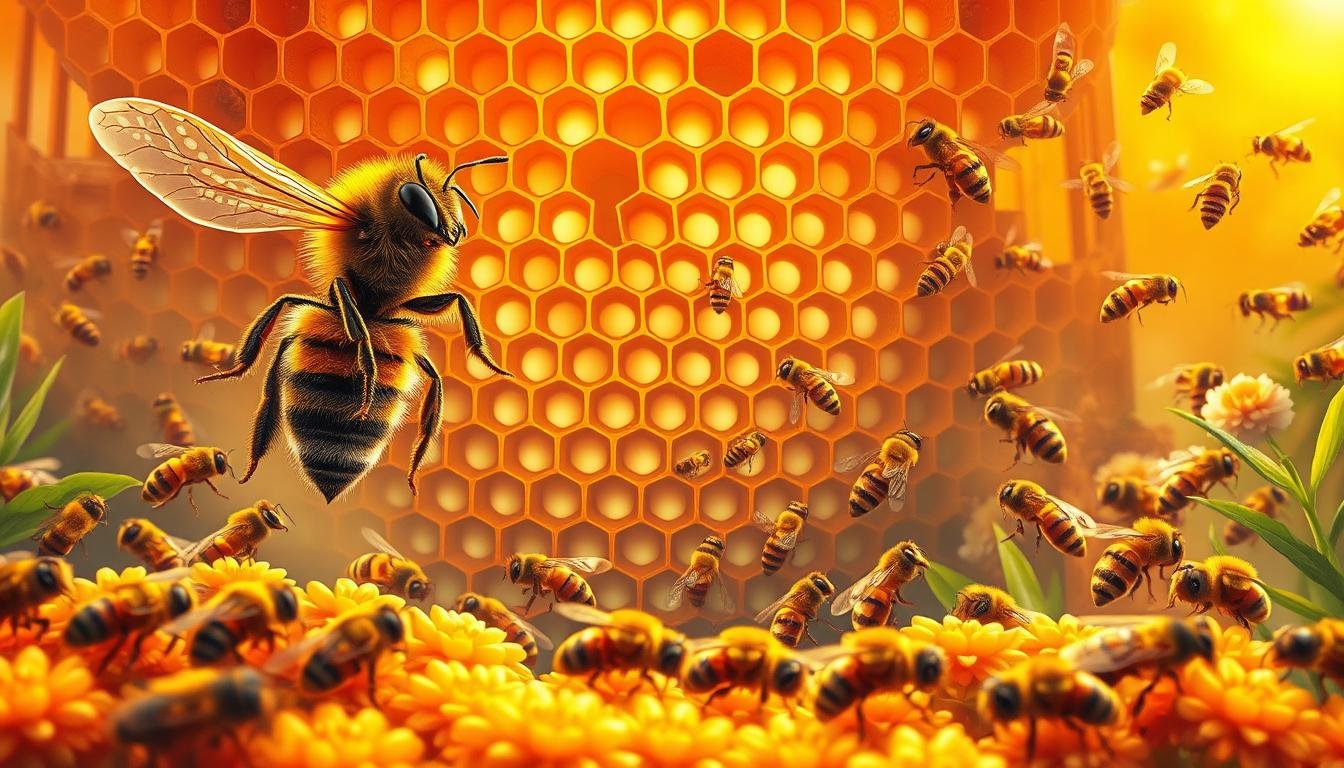
This article opens with a clear premise: the reproductive female at the hive center drives demographics and long-term survival in honey bee societies. Beekeepers and researchers will find a focused, data-forward analysis that links measurable traits to practical outcomes.
We define scope: the queen is the primary egg-layer and chemical signaler in apis mellifera. Her daily output, mating success, and pheromone profile shape worker roles, brood care, and seasonal resilience.
Key themes previewed include fecundity metrics, sperm viability, pheromonal control, nutrition, stressors, and evidence-based management. Data points anchor discussion: queens often live 1–2 years (max ~8), lay 1,500–2,000 eggs per day, and mate with roughly 17 drones.
Why this matters: stark differences between queens and workers — short-lived summer workers versus longer-lived winter bees — inform requeening timing and overwintering strategies. The article synthesizes peer-reviewed studies and extension guidance to offer clear, actionable insights for U.S. apiarists. For deeper background reading, consult this beekeeping resources guide at beekeeping resources and books.
Key Takeaways
- Queen condition drives brood pattern, worker allocation, and colony survival.
- Measured traits include eggs per day, sperm viability, and pheromone output.
- Typical queen life spans and mating averages provide planning benchmarks.
- Management choices like timely requeening affect overwintering success.
- This analysis links experimental data to practical recommendations for U.S. beekeepers.
User Intent and Why Queen Quality Matters for Honey Bee Colonies
Beekeepers and researchers are searching for clear metrics that predict winter survival, spring buildup, and honey yields. They want fast, observable signs that guide requeening, nutrition, and swarm prevention decisions.
What beekeepers and researchers want right now
Field managers aim to prevent winter loss and protect peak production windows. Researchers seek mechanisms that link reproductive health to worker numbers and behavior.
Linking reproductive health to survival and productivity
Stable egg laying and consistent pheromone output expand the worker force. More workers mean better nectar collection, wax production, and larger honey stores during flows.
- Practical stakes: reproductive failure is a recurrent factor in U.S. winter losses, so monitoring matters.
- What to assess: brood pattern, eggs present, and tight laying signal a productive female.
- Management focus: timely requeening, drone health, and forage alignment protect production and survival.
| Indicator | What it signals | Action | Outcome |
|---|---|---|---|
| Even brood pattern | Consistent egg laying | Monitor monthly | Steady worker numbers |
| High brood area | Large workforce potential | Ensure space and feed | Increased honey and pollen stores |
| Declining eggs | Possible failure | Inspect, consider requeening | Reduced peak production risk |
| Strong pheromone scent | Stable worker behavior | Maintain hive stability | Predictable foraging and comb build |
Defining Queen Quality and Colony Lifespan in Apis mellifera
Clear metrics link reproductive output and social signals to long-term hive performance.
Key measures include daily eggs laid, brood pattern, spermatheca stores, and pheromone output. Healthy females can lay 1,500–2,000 eggs per day. Robust sperm stores (up to ~7 million) supply fertilization over 2–4 years.
Brood inspection gives high-resolution feedback. Look for concentric, uniform frames with few skipped cells. That pattern signals steady production and balanced worker demographics.
Colony benchmarks and survival indicators
Winter workers living 150–200 days help bridge dearths and support late-season brood replacement. Strong pheromone profiles suppress emergency rearing and keep worker roles stable.
- Use metrics to decide requeening: falling eggs laid or patchy brood prompt earlier intervention.
- Sperm viability matters: adequate sperm delays drone-laying and protects worker ratios.
| Metric | What to watch | Practical action |
|---|---|---|
| Eggs laid/day | 1,500–2,000 target | Monitor monthly; supplement feed if low |
| Brood pattern | Even, concentric cells | Inspect frames; mark gaps for follow-up |
| Sperm stores | High count and viability | Compare across hives; requeen if depleted |
| Pheromone profile | Consistent worker behavior | Minimize stress and transport |
Queens vs Workers: Lifespan, Fecundity, and the Eusocial Exception
Castes in honey bee societies show stark contrasts in survival and reproductive roles. Queens and workers follow different developmental schedules and life trajectories that shape hive dynamics.
Documented differences are clear: queens develop in about 16 days and average 1–2 years of life, with rare reports up to 8 years. Workers develop in 21 days. Summer workers live roughly 15–38 days while winter workers can reach 150–200 days.
Why the reproductive caste breaks the usual tradeoff
In most animals, high reproduction shortens life. In eusocial bees, the reproductive member escapes that tradeoff. Protected nest conditions and steady resource provisioning let the reproductive female maintain high egg production and extended survival.
“Protected by workers and fed heavily during development, the reproductive female channels energy into both reproduction and longevity.”
- Development timing: 16 days (reproductive) vs 21 days (worker).
- Extrinsic mortality is low for the reproductive caste due to worker defense and shelter.
- Worker lifespan varies by season and task, which matters for overwinter planning and replacement schedules.
Management takeaway: treat replacement timing and assessments for the reproductive female differently than routine worker turnover.
From Diet to Destiny: Royal Jelly, Caste Differentiation, and Developmental Time
Nutrition in early larval stages steers a single developmental fork that sets caste fate.
Royal jelly in the first three days supplies rich proteins and lipids that trigger endocrine shifts. Those nutrients raise juvenile hormone and ecdysteroid activity and engage insulin/TOR signaling. This network prevents ovarian apoptosis and activates the reproductive pathway in apis mellifera larvae.
Larval nutrition, juvenile hormone, and pathway activation
Diet quality drives molecular cascades that cause differentiation. Elevated juvenile hormone steers tissues toward reproductive form. Insulin/TOR integrates growth signals so morphology and ovary development follow.
Developmental timelines: eggs, larvae, pupae, and adult emergence
The timeline is compact: eggs hatch, larvae receive targeted feeding, and pupation follows. The reproductive female emerges faster—about 16 days—while worker development extends to about 21 days.
- Critical window: the earliest larval days set lifelong trajectories.
- Nurse health: hypopharyngeal gland function and nutrition determine royal rearing success.
- Practical marker: tracking developmental days helps plan controlled rearing and evaluation; see methods in this royal rearing methods.
Takeaway: caste outcome is a joint product of diet and hormones, so precise feeding during the decisive days yields predictable development and reproductive potential.
Mating Success, Sperm Storage, and Genetic Diversity Drive Longevity Outcomes
Orientation flights and drone congregation timing determine whether a new reproductive female leaves fully provisioned with viable sperm. Most mating happens 5–6 days after emergence. She takes 1–5 flights over 2–4 days in mid-afternoon fair weather.
Orientation and mating flights
Drones gather in specific congregation areas. Good weather windows matter: wind or rain can cut mating short and reduce success. Placing rearing hives near drone-rich apiaries raises the chance of complete mating.
Spermatheca capacity and fertilization control
The spermatheca can store up to ~7 million sperm. Average mating frequency is about 17 drones, though benefits largely plateau near seven mates. Stored sperm supports 2–4 years of fertilized eggs. The reproductive female controls which eggs are fertilized to keep worker-to-drone ratios balanced.
Polyandry and colony-level effects
Genetic diversity from multiple matings boosts production and reduces brood disease. Mixed paternity improves task specialization and resilience under stress, raising survival odds during dearths and pathogen pressure.
- Ensure abundant, healthy drones during mating season.
- Time rearing and placement to match local weather windows.
- Sustained fertility stabilizes workforce numbers across seasons.
Egg Laying Rate, Brood Pattern, and Worker Force: The Daily Mechanics of Longevity
Patterns on the brood frames tell a daily story about reproduction, resource balance, and workforce momentum. Inspecting frames gives quick, actionable insight into future worker numbers and hive growth.

Assessing brood: concentric rings, skipped cells, and seasonal expectations
High-performing females produce tight, edge-to-edge capped brood with clear concentric age rings. Minimal skipped cells and uniform capping are hallmarks of a strong laying pattern.
Look for concentric rings of larvae and capped brood; random gaps or scattered brood signal stress, disease, or reduced eggs laid. In spring, expect rapid expansion as the hive prepares for main honey production.
Nutrition, space, and adult population as constraints on laying
Daily output — up to about 1,500 eggs in peak periods — depends on three constraints: available open cells, stored protein and nectar, and the size and age structure of the adult workers that rear brood.
If nurse numbers are low, feeding and capping slow regardless of laying drive. Provide additional frames or feeding when brood area outpaces worker capacity to prevent brood loss and stalled growth.
- Assess brood quality: concentric age classes, few skipped cells, and even capping indicate robust laying and predict strong worker numbers.
- Translate to production: steady eggs laid and uniform brood lead to predictable worker force size and higher honey production potential.
- Intervene cues: persistent brood gaps, multiple empty cells in brood frames, or patchy larvae suggest reinspection, supplemental feed, or queen evaluation.
- Seasonal note: spring expansion requires space and resources to capture main flows; delay reduces growth and yield.
| Indicator | What it signals | Immediate action | Expected outcome |
|---|---|---|---|
| Tight capped brood | Strong laying pattern | Maintain feed and space | Steady worker recruitment |
| Scattered larvae | Interrupted laying or stress | Inspect for disease; support nutrition | Restore uniform brood |
| Large brood area, few nurses | Rearing bottleneck | Add nurse-support frames; supplement protein | Recover brood survival and growth |
| Spring rapid expansion | Opportunity for honey production | Ensure adequate supers and forage | Maximize spring honey yield |
Note: routine frame checks and timely interventions compound daily mechanics — egg laying, feeding, and capping — into long-term growth trajectories. For methods on assessing brood and managing rearing constraints, see this practical review on bee reproduction and management at brood and reproductive research.
Pheromonal Control: How Queens Regulate Worker Behavior and Resource Allocation
Pheromones act as the social glue that links individual tasks to hive-level needs. Chemical signals from the reproductive female coordinate work, suppress rival rearing, and steer foraging toward nectar and pollen that feed brood.
Mandibular pheromones inhibit new rearing efforts and lower swarm drive. They also attract drones and reinforce worker sterility by reducing ovary activation.
Nasonov signals guide orientation during mating flights and swarm moves. Workers use Nasonov scent to aggregate and to help the reproductive female return to the hive.
Variation by age, mating, and season
Pheromone output changes with age and mating status. Young, well-mated females emit a broader, stronger blend that stabilizes worker roles.
Seasonal shifts in scent can raise swarming propensity. During heavy nectar flow, reduced pheromonal balance may prompt space management to prevent loss.
- Field cues: increased queen cups, sustained worker restlessness, or sudden rearing signal pheromone decline.
- Management: monitor worker foraging bias toward pollen vs. nectar to gauge scent-driven provisioning.
| Signal | Main effect | Field indicator | Action |
|---|---|---|---|
| Mandibular pheromone | Suppresses rival rearing, promotes worker sterility | Few queen cells; calm brood area | Maintain stable brood care; delay requeening unless brood gaps |
| Nasonov | Orientation and aggregation | Workers fanning and scenting at hive entrance | Watch during swarm season; assist landing locations if needed |
| Seasonal change | Alters swarming and foraging balance | Increased scouting, space-seeking behavior | Provide supers and hive space to reduce swarm risk |
Endocrine and Molecular Foundations of Queen Longevity
Hormones and nutrient signaling create the physiological program that defines caste fate and adult robustness.
Juvenile hormone, ecdysteroids, and nutrient sensing
High juvenile hormone in reproductive-destined larvae blocks ovarian apoptosis and shifts gene expression toward reproductive roles. JH also raises ecdysteroid titers, which activate queen-pathway genes. Insulin/TOR signaling links dietary input to growth and caste differentiation.
Vitellogenin: more than yolk protein
Vitellogenin supports egg production and acts as an immune modulator. Higher vitellogenin levels correlate with greater stress resistance and better oxidative balance. That protein helps buffer free radicals while supporting the reproductive system, linking reproduction with extended adult life.
Oxidative stress and antioxidant patterns
Surprisingly, reproductives show lower antioxidant gene expression with age than workers. Yet they resist paraquat and other oxidative challenges better. This suggests protection comes from integrated endocrine and nutrient strategies, not only from elevated antioxidant transcripts.
- Endocrine profiles differ by caste and stage, producing distinct life histories and fecundity.
- Balanced nutrient signaling enables sustained egg laying with somatic upkeep.
- These molecular traits explain observed robustness in practical beekeeping under stress.
| Pathway | Primary role | Observed effect | Practical implication |
|---|---|---|---|
| Juvenile hormone (JH) | Prevent ovarian apoptosis | Activates reproductive gene sets | Target early feeding regimes to boost JH-driven development |
| Ecdysteroids | Coordinate molting and reproductive programming | Works with JH to secure reproductive fate | Time interventions during larval development for desired outcomes |
| Insulin/TOR | Match nutrition to growth | Controls size and caste differentiation | Maintain nurse health and jelly production for predictable development |
| Vitellogenin | Reproduction, immunity, antioxidant buffer | Correlates with stress resistance and longer life | Breed and feed for higher vitellogenin profiles to reinforce resilience |
These molecular insights guide selection and management. For technical background on reproductive physiology and applied methods, consult this reproductive research.
Nutrition, Nectar and Pollen Flow: Fueling Growth, Brood, and Overwintering
Nurse bees convert incoming nectar and pollen into the proteins and sugars that feed larvae and the reproductive female. Healthy hypopharyngeal glands drive steady royal jelly production and keep brood feeding consistent.
Undernutrition shrinks gland size and cuts jelly output. When glands decline, brood food falls and the queen laying rate can drop. Seasonal dearths therefore present direct risks to hive momentum.
Practical steps to protect production:
- Link nectar and pollen flow to nurse nutrition: ensure access to both to maintain gland health.
- Provide supplemental sugar or pollen patties during dearths to sustain brood rearing and queen performance.
- Monitor forager returns and stored frames; feed proactively when incoming nectar or pollen drops.
- Favor diverse pollen sources—mixed pollen improves brood viability and long-term resilience.
- Time feeding to build growth before main flows and to bolster winter stores.
Field takeaway: consistent diet underpins steady brood production and keeps the queen functioning through seasonal cycles. Proactive feeding preserves gland health and helps meet production targets.
Stressors That Erode Queen Quality: Pesticides, Pathogens, and Transport
Pesticides, pathogens, and movement stress combine to undermine reproductive performance in managed apiaries. Sublethal exposures and infections rarely produce obvious failure at first. Instead, they create slow declines in rearing, brood pattern, and worker behavior that reduce long-term resilience.
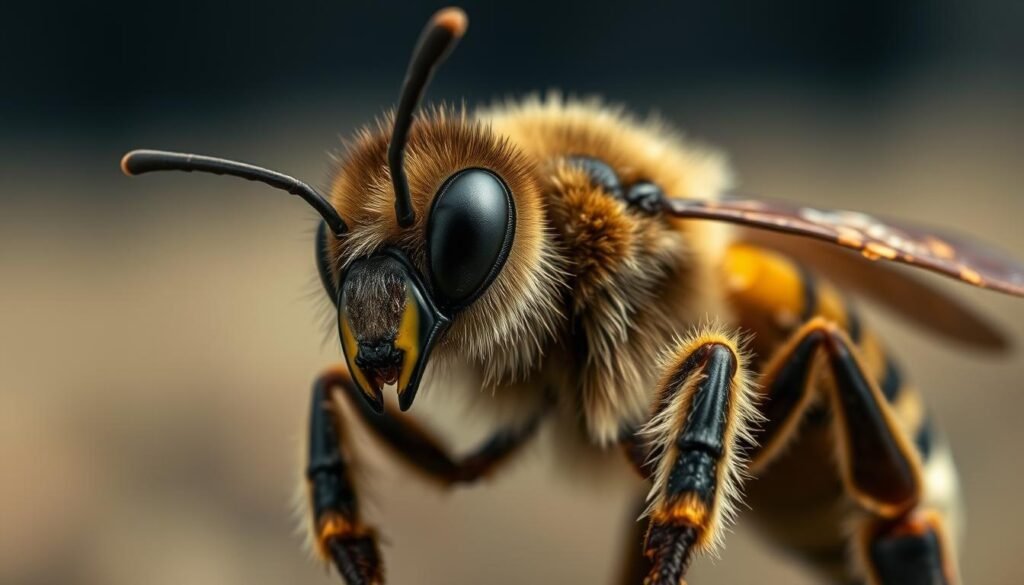
Insect growth regulators and fungicide impacts
Insect growth regulators such as novaluron, pyriproxyfen, and methoxyfenozide disrupt endocrine signaling. These residues can impair oviposition and larval development by altering hormone-mediated development and brood feeding.
Co-formulants in sprays also link to higher viral titers and greater larval susceptibility. Monitor residue sources and time applications away from critical rearing windows.
Viruses, Nosema, and combined syndromes
Viral loads and Nosema ceranae infections change worker physiology and reduce foraging returns. Fewer incoming resources and weaker nurses lower egg care and production.
When parasites and pesticides co-occur, losses rise faster than each stressor alone. That compounding effect shortens productive seasons for honey bees and strains hive recovery.
Physiological stress, transport, and metabolic shifts
Long-distance transport alters energetic metabolism and task allocation. Migratory moves challenge thermoregulation and nutrition continuity, raising stress markers and changing worker roles.
Mitigation focuses on residue awareness, timing sprays outside mating or heavy rearing periods, and bolstering nutrition during stress windows. These steps protect reproductive output and sustain long-term life of managed hives.
| Stressor | Main effect | Practical action |
|---|---|---|
| IGRs / fungicides | Endocrine-mediated developmental disruption | Avoid treatments during rearing; check residues |
| Viruses / Nosema | Reduced foraging and survival | Monitor loads; improve sanitation and nutrition |
| Transport | Metabolic shift and task changes | Limit moves; provide feed and rest periods |
How queen quality affects colony lifespan
Steady reproductive output sets the tempo for workforce renewal and seasonal strength. High egg rates and reliable pheromone signals keep worker age structure balanced. That balance ensures brood care, foraging, and hive maintenance proceed without disruptive shifts.
Direct pathways: fecundity, pheromonal stability, and worker demography
Fecundity determines daily replacement of nurses and foragers. More eggs lead to predictable worker recruitment and steady labor supply.
Stable pheromone output suppresses premature rearing and keeps task allocation coherent. This reduces energy wasted on emergency rearing and preserves production windows.
Indirect pathways: genetic diversity, disease dynamics, and overwintering success
Polyandry increases genetic diversity, which lowers brood disease prevalence and improves task specialization. Diverse paternity links to better overall productivity and resilience.
Late-season laying that produces robust winter workers boosts overwintering survival. Strong winter bees cut turnover and support spring buildup, extending functional hive life.
Concise analysis: measurable metrics—eggs per day, consistent pheromone profile, and mating breadth—predict survival outcomes for apis mellifera. Management that protects these pathways compounds benefits across years and reduces risk of collapse.
| Pathway | Measured metric | Practical action |
|---|---|---|
| Fecundity | Eggs/day, brood area | Monitor frames; supplement feed if declines |
| Pheromonal stability | Worker behavior, queen cells | Limit disturbances; inspect for brood disruptions |
| Genetic diversity | Mating count, paternity mix | Promote healthy drone availability |
| Overwintering | Winter worker longevity, late-season laying | Build stores and minimize late stressors |
For broader context on hive longevity and management strategies that support these pathways, see this detailed guide on hive longevity and survival.
Swarming, Supersedure, and Queen Loss: Turning Points in Colony Trajectories
Spring pulses of reproductive activity change a hive fast. Watch for small cues that precede major shifts in workforce and production.
Early indicators: queen cups, swarm cells, and timing of emergence
Inspect frame margins for empty queen cups and developing swarm cells. In spring, many hives cap 15–25 swarm cells.
Colonies can leave the same day a cell is capped or within 24 hours. Virgin queens typically emerge about a week after capping, starting a short period of intense competition and movement.
Emergency rearing, afterswarms, and recovery timelines
Emergency rearing begins when the reproductive female is lost or failing. Workers rear replacements from eggs or very young larvae to restore breeding capacity.
Afterswarms may follow before a single virgin prevails. Multiple virgin fights or flights can further reduce workforce continuity.
Recovery is slow: from loss to resumed egg laying is roughly 29 days. That period halts new brood production and risks adult population decline during key flows.
- Detect charged swarm cells early and record capping dates.
- Introduce a mated queen or add frames of eggs and very young larvae to speed rearing and shorten the no-egg period.
- Inspect gently: rough handling can destroy queen cells and worsen setbacks.
- Plan interventions before major nectar flows or pollination commitments to protect yield and contracts.
| Signal | Typical timing | Recommended action |
|---|---|---|
| Queen cups become charged | Early spring | Monitor daily; note number capped |
| Many capped swarm cells (15–25) | May trigger swarming same day or next | Provide space, split hive, or rehome frames to reduce swarm loss |
| Virgin emergence (~7 days) | One week after capping | Limit disturbances; consider introducing mated queen if instability persists |
| From loss to new eggs (~29 days) | ~29 days without laying | Add eggs/young larvae or introduce mated queen to shorten gap |
Diagnosing Queen Problems: Evidence-Based Field Indicators
Early, subtle signals in the brood nest often reveal a failing reproductive center before obvious collapse. Use calm, regular checks to spot changes in pattern and behavior.
Field signs to watch
Common indicators: scattered brood gaps, multiple eggs in single cells, drone-only brood, and a loud, restless or “roaring” hive on opening.
Distinguishing laying workers: laying workers deposit many eggs per cell, usually off-center, and produce only drone brood. A failing young female may leave single, well-placed eggs in otherwise normal frames.
Practical on-hive test
Introduce a frame with eggs and young larvae. If workers start emergency cells within a few days, that is strong evidence of queen absence or failure.
Timelines matter: laying workers commonly appear about 23–30 days after loss and then resist introduced queens. Early detection lets you retain control and avoid an intractable state.
- Inspect under good light and steady frames to reliably spot eggs in apis mellifera hives.
- Record signs and dates to track progression and choose timely interventions.
- Act early: replacement or adding young brood reduces lost productivity and protects season goals.
“A focused frame test and routine inspection reveal most reproductive problems before they become irreversible.”
| Sign | Interpretation | Immediate action |
|---|---|---|
| Scattered brood gaps | Reduced laying or stress | Inspect for disease; add feed if needed |
| Multiple eggs/cell | Laying workers present | Consider rehoming frames or combining with strong hive |
| Drone-only brood | No fertilized eggs | Run frame test; avoid introducing a queen until resolved |
| Roaring, agitated hive | Loss of reproductive signaling | Perform quick brood check; add diagnostic frame |
Management to Safeguard Queen Quality and Extend Colony Life
Simple timing and placement decisions yield large gains in mating success and workforce stability.
Ensuring healthy drone populations and optimal mating windows
Produce drones ahead of rearing bouts. Drone rearing ramps up before new females emerge; match brood schedules so drones are plentiful at mating time.
Plan mating nucs near known drone congregation areas and avoid moving nucs during peak afternoons. Under good weather, most mating completes within two weeks post-emergence.
Requeening strategies and acceptance best practices
Scheduled replacement (annual) gives uniform performance across apiaries. Condition-based rearing keeps only those hives that meet brood and pheromone checks.
Introduce mated females in shaded, calm conditions and confine introductions for 3–5 days to improve acceptance. Use nurse-rich foster frames to ease transition.
Space management, swarm prevention, and nutrition control
Add supers proactively during major nectar flows to reduce congestion and swarm drive. Timely supering lowers the risk of mass queen loss or swarming.
Support workers with pollen supplements and sugar feeding during dearths to sustain brood rearing and steady laying. Align splits or artificial swarms with forage peaks to protect honey production.
| Action | Why it matters | Timing / Practical tip |
|---|---|---|
| Boost drone rearing | Maximizes mating success and genetic diversity | Start 2–3 weeks before expected emergences; place drone frames near mating nucs |
| Annual vs condition-based requeening | Balances uniform output vs targeted replacement costs | Annual for production apiaries; condition-based for small-scale or research hives |
| Proactive supering | Reduces swarm pressure during nectar surges | Add supers early in the flow, monitor hive weight and forager traffic |
| Nutrition control | Maintains nurse health and continuous brood care | Provide pollen patties in dearths; feed sugar if stores drop |
Practical outcome: coordinated rearing logistics, drone availability, and space plus timely feeding stabilize performance. These steps help extend practical hive life by keeping the reproductive center productive and worker forces growing.
Conclusion
The data and this article bring a single message: protect reproductive function to turn biological strengths into steady results. Measured fecundity, pheromonal stability, and mating breadth combine to shape worker renewal and long-term performance in managed hives.
Key drivers include nutrition, genetic diversity from multiple mates, and minimizing stressors like pesticides, pathogens, and transport. Diagnostics — brood pattern checks and simple frame tests — guide timely action.
Apply the analysis and management steps here to align seasonal operations with biology. Continuous assessment and prompt interventions are the beekeeper’s best tools to preserve production and extend practical life across colonies and honey bee operations.
FAQ
What key signs indicate a poor reproductive female in an Apis mellifera colony?
Look for sparse, spotty brood patterns, a sudden rise in drone cells, and reduced eggs per frame. Workers may build emergency cells or begin queen-rearing behavior. Inspect sperm stores and queen pheromone strength if available.
How many eggs should a productive laying female place daily in peak season?
During strong forage periods a healthy laying female typically places between 1,000 and 2,000 eggs per day. Seasonal limits, colony size, and nutrition shift that range lower in spring build-up and autumn decline.
Why does diet during larval stages matter for caste pathway activation?
Exclusive feeding with royal jelly and sustained hypopharyngeal gland activity triggers physiological pathways that produce reproductive females. Nutrition alters juvenile hormone levels and gene expression, steering larvae toward reproductive development.
What role does mating success play in long-term hive performance?
Successful mating ensures ample, viable sperm in the spermatheca, enabling consistent fertilization of worker and brood-destined eggs. Limited mating reduces genetic diversity, weakens disease resistance, and shortens productive life.
How does pheromone output influence worker behavior and resource allocation?
Mandibular and other pheromones inhibit queen rearing, coordinate foraging, and maintain social cohesion. Declines or changes in chemical signals trigger replacement efforts, alter foraging rates, and can reduce colony efficiency.
What molecular markers relate to extended reproductive female longevity?
Elevated vitellogenin, balanced insulin/TOR signaling, and robust antioxidant enzyme expression associate with longer life and sustained reproduction. These markers link reproduction, immunity, and oxidative stress resistance.
Which environmental stressors most commonly undermine reproductive female performance?
Sublethal pesticide exposure, viral infections, Nosema, poor nutrition from low pollen diversity, and transport stress all reduce egg laying, sperm viability, and pheromone consistency, shortening colony productivity.
Can supplemental feeding improve laying output and colony survival?
Yes. Strategic pollen substitutes and sugar feeds during dearths support hypopharyngeal glands and brood rearing. Quality supplements help sustain laying rates and worker production, improving overwintering odds.
What field checks confirm queenlessness or failing reproductive females?
Confirm by finding frames with only open brood, multiple eggs in single cells, extended brood gaps, or spotty brood patterns. Absence of eggs and queen cups with no developing queen cells are also indicators.
How do replacement strategies impact colony continuity and production?
Planned requeening during stable nectar flows and ensuring acceptance mitigates productivity dips. Introducing mated reproductives or using queen-right grafting reduces the time a hive spends with poor laying and restores brood patterns faster.
What management keeps drone populations sufficient for mating success?
Maintain forage diversity, allow drone-friendly frames during spring, and avoid aggressive drone removal. Regional coordination among beekeepers to time nucs and mating sites also supports robust drone numbers.
How does polyandry benefit colony resilience and survival?
Multiple-mating increases worker genetic diversity, which improves division of labor, disease resistance, and flexible responses to environmental stress. That diversity correlates with higher productivity and better overwinter survival.
Are there quick indicators of reduced spermatheca viability?
A drop in fertilized worker brood, sudden increases in drone-laying patterns, and declining egg numbers suggest spermatheca issues. Microscopic checks by specialists can measure sperm counts and viability directly.
What seasonal timing is best for rearing replacement reproductives?
Rear replacement reproductives in late spring to early summer when weather favors mating flights and forage is abundant. This timing maximizes mating success and reduces stress on nurse workers.
How do disease dynamics interact with reproductive female health to shape colony survival?
Poor reproductive health lowers brood production and worker numbers, which reduces hygienic behavior and immune function. That change accelerates pathogen spread and weakens overwintering potential.
What practical steps reduce transport and handling stress on reproductive females?
Minimize transit time, maintain stable temperatures, avoid moving colonies during intense brood rearing, and provide syrup and pollen before and after transport. Gentle handling preserves laying rhythm and pheromone stability.
How to judge if a replacement reproductive will be accepted by workers?
Use gradual introduction with queen cages or direct release when worker behavior is calm. Introducing a mated reproductive during daylight forager return reduces rejection. Monitor for worker agitation or aggression signs.