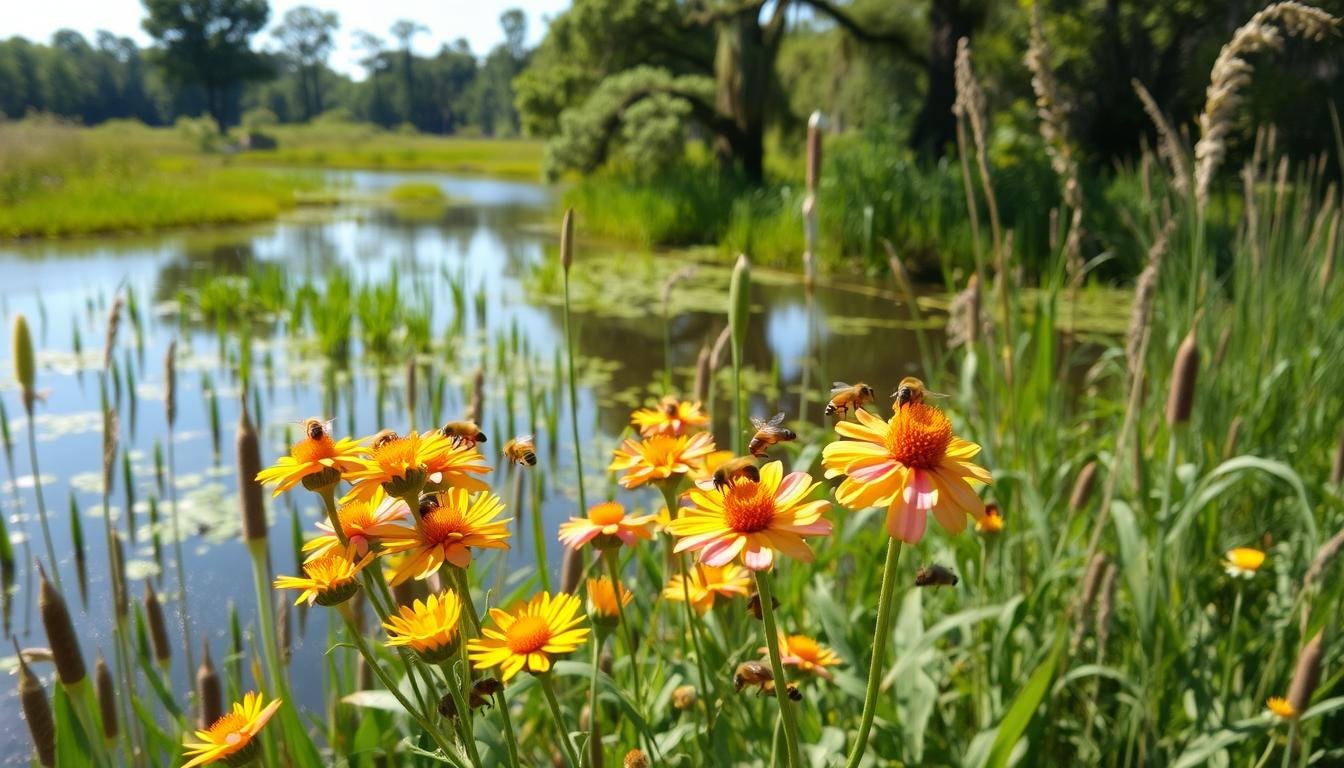
Freshwater wetlands and riparian systems deliver key ecosystem services that support biodiversity, habitat, pollution mitigation, climate regulation, and hydrologic balance. These features sit within farmed landscapes as depressional pockets like Delmarva bays and potholes. Such places connect natural processes with working land and offer practical leverage for conservation.
Recent work challenges old assumptions that ground-nesting bees avoid moist soils. Many species adapt by using hydrophobic lipids to line nests and can nest in fine-grained, damp soils. This shift reframes how habitat management can boost pollinator supply and diversity across mosaics of crops and wetlands.
Pollination ranks as a high-value service: roughly 75% of global crops depend on insect pollination, with large economic value in the U.S. Modeling tools like InVEST translate landscape composition into pollinator supply, abundance, and wild yield indices. These data help guide targeted management to increase resilience and resource value for both plants and people.
Key Takeaways
- Wetlands provide multiple ecosystem services that bolster working landscapes and biodiversity.
- Depressional features in farms can act as practical habitat for ground-nesting bees.
- New evidence shows many bees adapt to moist soils, opening fresh conservation options.
- Pollination delivers major economic value and links directly to land management choices.
- Index-based models like InVEST help translate landscape data into pollinator signals.
Why Wetlands Matter: Ecosystem Services, Biodiversity, and Hydrologic Support
Across agricultural mosaics, wet areas act as living filters for nutrients and sediments. These patches provide ecosystem services that stabilize nearby cropland and support diverse life.
Pollution mitigation and climate regulation in riparian-agricultural mosaics
Wetlands trap sediment and retain excess nitrogen and phosphorus before they reach streams. This nutrient retention improves water quality and reduces downstream treatment costs.
Vegetation and standing water also moderate local temperatures. Microclimate buffering helps crops during heat waves and keeps soils cooler in droughts.
“Well-placed wet patches can lower runoff and cool fields, yielding better crop performance.”
How wetlands underpin plant-pollinator networks
Riparian buffers and depressional areas create habitat heterogeneity that sustains floral resources across seasons. Early- and late-blooming plants in these habitats extend foraging windows for pollinators.
By acting as resource nodes or stepping stones, small wet patches support movement and resilience of species across fragmented landscapes. Despite this, many conservation easements still undervalue pollination benefits for crops.
Management that links wet patches with field margins can thus boost pollination reliability and long-term landscape productivity.
Historical Perspectives on Bees in Wetlands: From Avoidance to Adaptation
Early literature framed saturated soils as lethal traps for ground-nesting bees, and that view shaped habitat guidance for decades.
Many field guides noted that about 70% of wild bee species nest in well-drained, sandy substrates. This statistic made substrate assumptions central to ecosystem planning and conservation.
Legacy assumptions about ground-nesting brood survival
Past studies argued that damp soil raised larval mortality and fungal risk. That led managers to favor dry margins and exclude wet depressions from nesting plans.
Evidence of moisture-tolerant nesting strategies
Newer work documents hydrophobic lipids used by some species to line nest walls. These secretions repel water and protect brood in fine-grained, moist soils.
- Field data now record verified nests within wetland soils, overturning older generalizations.
- The demonstration that many bees can tolerate moist substrates expands viable habitat near riparian and depressional features.
- For restoration, this shift means planners can include wet patches when designing nesting and floral resources.
“Recognizing moisture-tolerant nesting widens the map of potential conservation sites.”
Trend Signals in Pollination Services: From Honey Bees to Wild Bees
Economic signals and field studies now highlight how native pollinators buffer crop risk when honey bee stocks fall. About 75% of global crops need insect pollination, and services are valued between $235–$577 billion worldwide and roughly $34 billion in the U.S.
National stakes and the case for diversity
The national economic stake means a single-managed strategy is risky. Diversified pollinator portfolios lower failure risk and add redundancy to crop production.
Managed hives versus wild communities
Concern over honey bees’ declines has refocused attention on wild bees. Native pollinators have met or exceeded pollination needs in crops such as watermelon and other fruits in documented trials.
“Native pollinators can provide resilience where managed colonies are unstable.”
| Metric | Estimate / Example | Implication |
|---|---|---|
| Crop dependence | ~75% rely on insect pollination | High exposure to pollinator loss |
| Economic value (U.S.) | ~$34 billion | Strong incentive for conservation |
| Interactions | Competition or complementarity varies by crop | Landscape context shapes outcomes |
Research shows managed pollinators sometimes reduce wild pollinator richness, though effects vary by landscape and crop management. For stable services, prioritize habitat that supports diverse species and nesting resources.
For practical guidance on modeling pollinator supply and informing habitat planning, see this synthesis on pollinator ecology and services: pollinator research review.
Role of bees in wetland restoration
Integrating pollinator needs into wetland design turns small projects into landscape-scale benefits.
Private easements adjacent to crops often omit pollinator habitat. Yet interspersed wetlands and riparian pockets can act as stepping stones for wild pollinators across agricultural landscapes.
Adding both floral corridors and bare-ground or woody nesting spots strengthens nearby crop pollination. This dual approach boosts local ecosystem services beyond water quality alone.

Practical leverage points include targeted seed mixes, planting for phenological continuity, and creating non-floral nesting substrates. These moves support small-bodied species that forage short distances and link patches.
- Stepping-stone effect: many small wetlands improve movement and diversity.
- Design integration: combine blooms and nesting in easement plans to raise on-farm value.
- Performance metrics: update conservation criteria to measure pollination outcomes and habitat quality.
“Explicit pollinator targets in easements multiply restoration returns for both biodiversity and nearby producers.”
Wild Bee Diversity in Wetland-Riparian Landscapes
Ground-nesting genera such as Andrena, Lasioglossum, Agapostemon, and Augochlorella are common in riparian and moist-edge habitats. These small bees range from about 2–17 mm and often nest in bare or fine-grained soil near water margins.
Guild profiles and foraging scale
Andrena (2–17 mm) and Lasioglossum (2–10 mm) nest in ground burrows and forage short distances, often under 300–400 meters.
Agapostemon (4–15 mm) and Augochlorella (5–9 mm) also use ground sites and visit a wide mix of crop and native flowers.
Ceratina is included as a contrast: a small wood-nester with different microhabitat needs but similar foraging limits.
Small-bodied pollinators versus larger bees
Smaller pollinators fly shorter distances than bumble bees and honeybees. This affects how closely habitat patches must sit to support populations.
Designing stepping-stone spacing for small bees typically requires more frequent, closely placed patches than strategies built around honeybees.
- Functional roles: these genera pollinate many wild flowers and crops, improving fruit set in close-by fields.
- Monitoring bias: pan traps often undercount small species, skewing baselines downward.
- Key habitat attributes: exposed bare ground, fine-textured soils, and moist edges support nesting and resource access.
“Management that matches patch spacing to small bees’ flight ranges yields stronger, local pollination gains.”
| Guild | Typical size (mm) | Management implication |
|---|---|---|
| Andrena | 2–17 | Protect bare, fine soils near floral resources |
| Lasioglossum | 2–10 | Create frequent small patches within 300–400 m |
| Agapostemon / Augochlorella | 4–15 / 5–9 | Ensure continuous bloom and moist-edge nesting zones |
| Ceratina (comparison) | ~4–8 | Retain woody debris for cavity sites |
For methods and regional baseline data that include small bee detection, consult the synthesis at pollinator monitoring guidance.
Pollination, Habitat, and Plant Diversity: Functions that Tie Wetlands to Farms
Small habitat nodes across a landscape can stabilize pollination by spreading foraging options through the season. Diverse plant patches in riparian and depressional zones extend floral resources when adjacent crops are not blooming.
Habitat heterogeneity reduces volatility in service delivery. When plants bloom at staggered times, wild bees and other species move between patches and fields. This creates a steadier supply of pollination for nearby crops.
Edge effects matter: wetland margins act as corridors. Bees forage outward from these margins into fields, so configuration and proximity can matter more than total area.
- Seasonal continuity: plant mixes that bloom early and late support longer pollination windows.
- Patch placement: stepping stones within foraging distance boost local bee abundance.
- Design tip: use native, diverse plantings to supply nectar and nesting-adjacent resources for pollinator movement.
“Well-placed, diverse plantings in wet patches increase local pollination and add measurable value to farm ecosystems.”
| Function | Mechanism | Practical implication |
|---|---|---|
| Extended bloom | Staggered plant phenology | Longer pollination window for crops |
| Network stability | Habitat heterogeneity and stepping stones | Lower service volatility and resilient species mix |
| Edge foraging | Wetland margins as corridors | Place patches within short flight ranges to benefit fields |
Recommendation: integrate diverse native plantings in wet patches to link floral resources, support pollinator movement, and raise ecosystem services for adjacent agriculture.
Case Focus: The Delmarva Peninsula’s Wetlands, Bays, and Riparian Buffers
The Delmarva Peninsula covers roughly 2.6 million hectares, with about 70% in agriculture dominated by row crops. This farmed matrix contains nearly 17,000 depressional Delmarva bays that sit as small, shallow pockets across the land.
Most bays range from 0.46–5.68 ha with 0.55–2.02 m relief. Their shallow profile creates high edge-to-area ratios. That geometry favors foraging interfaces where floral and nesting habitat meet cropped fields.
A regional study modeled about 21,000 ha of habitat under five USDA easement programs. These were grouped into herbaceous and forested wetland, wetland-upland, and riparian types. Only ~4% of aquatic areas are under conservation, yet easement renewal runs near 84%.
Delmarva’s dense mosaic makes it ideal for analyzing how small wet patches supply pollination services. The pattern and scale mirror many Mid-Atlantic riparian-farm landscapes, offering transferable lessons for targeted habitat and easement management.
Modeling Pollination Ecosystem Services with InVEST
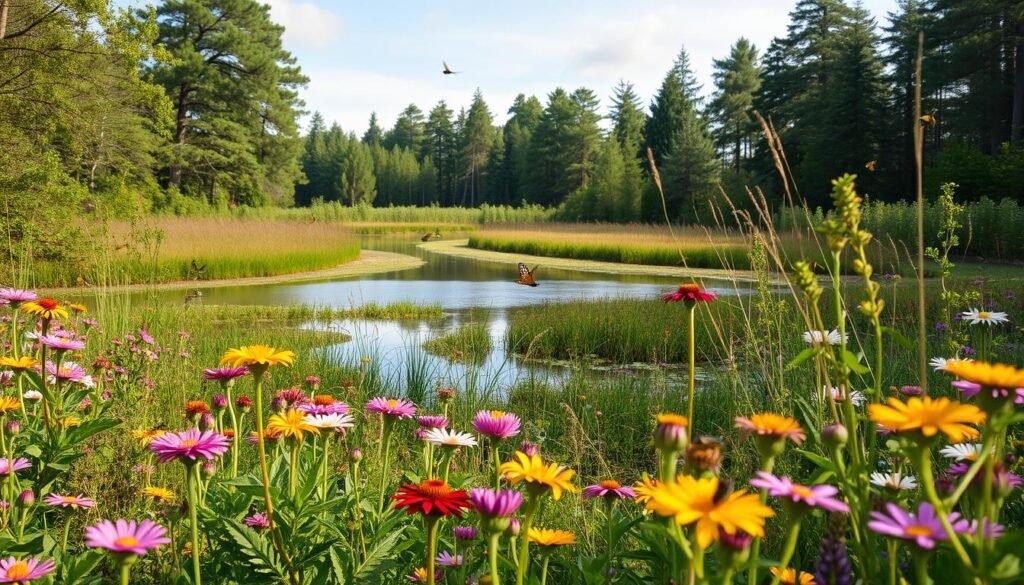
Geospatial pollination models translate land-cover maps into practical guidance for habitat placement. InVEST combines mapped land cover, pollinator guilds, biophysical nesting and floral attributes, and local farm data to produce spatial indices that managers can act on.
Key model inputs
Land cover sets where flowers and bare soil occur. Pollinator guilds add flight distances and foraging habits. Nesting and floral resources are scored by suitability.
Understanding outputs
InVEST returns three 0–1 indices: supply, abundance, and yield. Supply equals floral resources × nesting suitability × relative abundance. Abundance models floral density, foraging effort, and exponential decay with distance.
Central-place foraging and spatial decay
Central-place foraging means bees start at a nest and forage outward. Flight-distance parameters create exponential decay, so small bees provide little service beyond their typical range.
Use the 0–1 index to compare scenarios and track relative change; focus management near source habitats because off-range fields get minimal modeled benefit.
Data to Decisions: Translating Indices into Management Value
Model outputs can steer where limited funds will yield the largest gains for pollination and habitat. InVEST scores — supply, abundance, and yield — map relative service levels across landscapes and help set spatial priorities.
Convert indices to priorities by ranking parcels on supply and nesting suitability. Use the ranks to target easements, match seed mixes to soil types, and place herbaceous buffers where gains in supply are largest.
Test scenarios such as adding riparian herbaceous buffers to see marginal gains in supply and abundance. Scenario outcomes show which habitat changes return measurable pollination improvements near fields.
- Link yield indices to economic proxies so planners can weigh cost per unit gain.
- Include uncertainty bounds and re-run models in adaptive management cycles.
- Cross-walk model layers with farm operations to find high-leverage interventions on land.
“Scaled, transparent indices let managers compare options and invest where ecosystem services and species benefits align.”
Use data-driven targets to allocate resources, monitor outcomes, and adjust management as new field data refine model parameters and species responses.
Crop Connections: Soybeans and Other Pollinator-Influenced Production
Wild pollinators can boost crop performance even for self-fertile plants like soybean. Many legumes set more pods and produce heavier seeds when bees visit flowers, because animal visits improve pollen movement and fertilization success.
When self-pollinated crops still benefit from insects
Visits by wild bees increase pod set, seed weight, and uniformity in soybean. Small foraging species often move pollen between flowers within a plant and among plants, raising effective fruiting.
Estimating yield uplift near riparian and wet habitats
Models separate wild and managed contributions. Yield indices usually show the largest uplifts within typical flight ranges for small species—often within 100–400 meters of nesting habitat.
- Regional example: apples in Maryland frequently receive full pollination from native species rather than managed hives.
- Expect modest to measurable percent gains on fields adjoining buffers and small wetlands; gains taper with distance.
- Monitor yield across distance gradients to validate modeled uplift and adapt management.
| Metric | Near habitat (≤200 m) | Mid-range (200–500 m) | Far (>500 m) |
|---|---|---|---|
| Pod set / fruit set | Higher | Moderate | Baseline |
| Seed weight | Increased | Small increase | No change |
| Practical action | Prioritize buffers and floral mixes | Plant stepping stones | Consider field-edge plantings |
“Place nesting-supporting habitat close to fields; proximity drives pollination value more than total area.”
For design guidance on native plantings that support wild species and pollinators, consult this practical guide to native bee plantings. Combining targeted habitat with monitoring helps convert model indices into real production gains.
Landscape Configuration: Stepping Stones, Corridors, and Patch Design
Landscape layout often determines whether small-bodied pollinators can move between food and nest sites. Thoughtful placement of habitat patches turns isolated pockets into functional networks that support local bees and other species.
Heterogeneity, connectivity, and resource proximity for short-flight species
Stepping stones are small, flower-rich patches within the foraging range of short-flight bees. Corridors link those nodes so species can move safely across fields.
Resource proximity matters: nesting plus sequential bloom keeps activity steady through the season. Aim to pair ground nesting sites with nearby floral strips that bloom in sequence.
Design trade-offs matter. Larger patches hold more diversity but fewer edge effects. Multiple small, edge-rich patches can serve flight-limited bees better than one big block.
- Place stepping stones every 100–400 m for many small bee guilds.
- Link wet patches to riparian strips to extend usable foraging networks.
- Use trait-based planning—morphology and phenology—to match local species and nesting needs.
“Connectivity to intact habitats shapes species composition and stabilizes pollination across landscapes.”
Bee-Centric Restoration Planning in Wetlands and Riparian Zones
Good restoration begins with a clear census of species and nesting features across priority sites. Baseline surveys pair seasonal field sampling with historical collections like GBIF to map presence and known nest locations. Use short, repeat visits to capture phenology and detect transient pollinators.
Baseline assessments: species presence, nesting features, and floral calendars
Seasonal surveys should record active species, nest exposures, and microhabitats. Mine museum records and county collections to fill gaps. Build a simple floral calendar showing bloom windows for native plants and crops.
Floral resource design: phenological continuity and native plant richness
Design mixes to cover early, mid, and late season gaps. Prioritize native plants that match local soil and moisture. This sustains diversity and steadies pollination across crop rotations.
Non-floral provisions: bare ground, woody debris, and microhabitats
Create sun‑exposed bare patches, retain deadwood, and sculpt microtopography for nesting and shelter. Link patches with corridors to allow recruitment from nearby populations. Avoid high‑risk road edges and set clear maintenance protocols for invasive control and successional vegetation management.
Managing Wet Soils and Nesting Substrates for Ground-Nesting Bees
Simple microtopography changes let land managers create nesting sites in moist soils. Small mounded berms, gentle drainage gradients, and mixed textures produce sun-warmed flats that many ground species will use.
Some species line tunnels with hydrophobic lipids and accept fine-grained substrates. Models that score nesting suitability draw on expert panels and field traits to weight sun exposure, soil texture, and inundation frequency.
Practical steps: retain fine-grained patches with open sun exposure for moisture-adapted nesters. Create varied textures—coarse to fine—so species can select preferred micro-sites.
| Intervention | Why it helps | Practical tip |
|---|---|---|
| Mounded berms | Raise nest entrances above short inundation | Keep south-facing slopes with sparse vegetation |
| Sun-exposed flats | Speed soil drying and cue emergence | Clear small patches and limit disturbance |
| Mixed-texture zones | Support multiple species and sweat bees | Blend sand and fines along edges |
Match periodic inundation with nesting phenology; avoid heavy disturbance during peak emergence. Monitor nest aggregations and protect observed sites. For modeling and regional guidance see a recent synthesis.
Balancing Honey Bees and Wild Pollinators: Coexistence, Risks, and Trade-offs
Adding honeybee hives to mixed habitats can both supplement and stress local pollinator networks. Declines in managed colonies pushed attention toward native pollinators, and evidence now shows both competition and complementarity between groups.
Competition, complementary foraging, and network stability
Overlap in floral resources can create short-term competition at peak bloom, reducing wild bee abundance in some studies. Yet different weather tolerances and daily activity windows often let honey bees and wild bees provide complementary services.
Practical guidance: stock hives at lower densities near high-value fields, place apiaries away from known nesting hotspots, and schedule introductions outside peak wild bee emergence.
- Provide continuous native habitat to buffer resource pressure.
- Use placement and timing to reduce overlap at critical bloom stages.
- Monitor wild pollinator responses where managed hives are present and adapt management.
“Habitat provisioning reduces competition intensity and supports long-term bee diversity.”
Evidence Gaps, Monitoring Bias, and Modeling Limitations
Standard sampling tools often miss key parts of local bee communities. That gap shapes what studies report and how managers set priorities. Clearer evidence and consistent methods will make pollination data more reliable for decision making.
Pan-trap bias and sampling design
Pan traps favor certain small species and can undercount larger, rare, or crepuscular bees. Single-method surveys give a skewed view of wild bee diversity.
- Use mixed methods: pan traps, netting, timed observations, and nest searches to balance detection across guilds.
- Schedule repeated sampling across bloom windows to capture phenology and transient species.
Model uncertainty and transferability
Models like InVEST borrow parameters from literature and expert panels. Flight-distance, nesting suitability, and abundance weights are sensitive inputs.
| Issue | Effect on outputs | Mitigation |
|---|---|---|
| Parameter sensitivity | Large variation in yield and supply indices | Run scenario tests and sensitivity analysis |
| Transferability | Local ecology may differ from source studies | Calibrate with local field data and citizen records |
| Reporting | Overconfidence in projections | Publish uncertainty bounds and data sources |
“Transparentity about uncertainty helps target funds where services and species gains are most likely.”
Recommendation: pair models with local study data, use mixed sampling, test scenarios, and report uncertainty when guiding management and investment.
Policy and Practice: Leveraging Easements and Restoration for Pollination Services
Easements on private land can do more than protect water and soil. They can be designed to boost pollination and related ecosystem services that support crops and wild species.
Incentives, renewal, and stewardship
Design incentives that reward high-quality pollinator habitat within conserved areas. On Delmarva only ~4% of aquatic area is conserved, yet easement renewals run near 84% — a clear leverage point.
Recommend renewal criteria that include simple pollination metrics and habitat condition checks. Tie payments or bonus rates to demonstrated habitat improvements and monitoring results.
“Integrating pollinator metrics into easement terms turns short-term projects into durable landscape outcomes.”
| Policy action | Expected outcome | Practical step |
|---|---|---|
| Incentive tiers | Higher-quality habitat | Pay extra for verified floral and nesting resources |
| Renewal criteria | Long-term stewardship | Require monitoring and maintenance plans |
| Cross-agency data sharing | Aligned water and pollination goals | Share monitoring protocols and GIS layers |
Stewardship plans should spell out maintenance, monitoring, and adaptive management. Outreach to landowners will show the on-farm value and encourage uptake.
Conclusion
Practical site design — not size alone — determines whether a wet patch supplies consistent pollination services.
Modern evidence reframes small wetlands and riparian pockets as usable habitat for many ground-nesting species. That opens low-cost options to boost local pollination and broader ecosystem services.
Focus on short-season floral calendars, exposed nesting substrates, and close patch spacing to support small-bodied bee guilds. Connectivity and tested seed mixes convert habitat into measurable on-farm value.
Policy tools and easements should embed simple pollination metrics and monitoring requirements. Continue model refinement and field surveys so conservation investments align with outcomes and farmer needs.
FAQ
What ecological services do wetlands provide that support pollinators?
Wetlands supply water regulation, nutrient filtration, and diverse plant communities that offer continuous floral resources. These habitats create microclimates and nesting substrates that sustain wild pollinators, which in turn support nearby crop and native-plant reproduction.
Can ground-nesting wild bees use moist or fine-grained wetland soils?
Yes. Several ground-nesting species tolerate or exploit fine-grained, moist soils by selecting better-drained microsites, nesting in raised hummocks or exposed banks, or using lipid coatings and behaviors that reduce moisture intrusion. Management that provides a range of substrates increases nesting opportunities.
How do wild bee communities compare with honey bees for crop pollination value?
Wild bees often provide complementary or superior pollination for many crops, especially where small-bodied species are abundant. Economic analyses in U.S. agriculture show substantial value from insect pollinators overall, with native species sometimes meeting or exceeding services supplied by managed honey bees.
Which wild bee genera are important in riparian and wetland mosaics?
Ground-nesting genera such as Andrena, Lasioglossum, Agapostemon, and Augochlorella frequently occur in wetland-adjacent habitats. Small sweat bees and other solitary taxa contribute high species richness and temporal coverage, complementing bumble bees and honey bees.
How do wetlands influence pollination for self-pollinating crops like soybeans?
Even largely self-pollinated crops can show yield uplift from insect visitation. Wetland and riparian habitats near fields can boost local pollinator abundance and diversity, increasing fruit set and stability, especially during peak bloom or under stressful conditions.
What landscape features improve pollinator supply and movement across agricultural areas?
Heterogeneous mosaics with stepping-stone patches, corridors, and connected remnant wetlands support movement and resource access for small bees. Proximity of nesting sites to floral resources, patch size, and connectivity all influence pollinator abundance and foraging efficiency.
How does InVEST model pollination services and what inputs matter most?
InVEST links land-cover maps, pollinator guild traits, nesting and floral resource distributions, and farm locations to estimate pollinator supply, visitation, and crop yield effects. Key inputs include accurate land-cover, nesting suitability, floral calendars, and flight-distance parameters for different taxa.
What practical steps can restoration planners take to support wild pollinators in wetlands?
Conduct baseline surveys for species presence and nesting features, design native-plant mixes that provide phenological continuity, and include non-floral resources such as bare ground patches, woody debris, and microhabitats. Managing hydrology to create diverse moisture gradients helps nesting opportunities.
How should managers handle moist soils to favor ground-nesting bees?
Create or preserve well-drained microsites like sandy banks, elevated hummocks, and bare patches. Avoid prolonged inundation of potential nesting zones during peak nesting periods and maintain a mosaic of moisture conditions to serve multiple species’ needs.
Are there trade-offs between honey bee placement and wild pollinator conservation?
Yes. Managed honey bees can complement pollination but may compete for floral resources and alter foraging networks. Spatial planning, hive density limits, and preserving abundant native forage reduce negative interactions and support network stability for wild pollinators.
What monitoring biases affect our understanding of wetland pollinator communities?
Pan-trap sampling underdetects small or cryptic species and can skew abundance estimates. Standardizing methods, incorporating netting and floral observations, and accounting for detectability improve assessments. Recognize parameter uncertainty when translating indices into management actions.
How can easements and conservation incentives advance pollination benefits from wetlands?
Incentive programs and private aquatic conservation easements that prioritize habitat quality, native plant diversity, and long-term stewardship increase pollinator resources. Payments or technical support for habitat renewal and management boost sustained ecosystem-service delivery.
What evidence gaps remain about pollination services in wetland landscapes?
Gaps include limited data on small-bee nesting ecology in wet soils, transferability of model parameters across regions, and long-term effects of hydrologic change on pollinator populations. Targeted monitoring and experimental restoration trials can fill these knowledge needs.